
LIFESTYLE
HMRC Under Fire For Using Travel Data to Cut Child Benefits

Thousands of UK families are facing a terrifying reality this week after opening their mailboxes. The national tax authority is accusing parents of permanently leaving the country based on simple holiday travel records. This aggressive move has sparked an urgent probe into how government officials track private movements and threaten vital financial support.
The controversy centers on His Majesty’s Revenue and Customs (HMRC) and its use of Border Force data. Reports confirm that the agency sent queries to parents demanding proof of residency. Many families say they merely took a summer vacation or visited sick relatives abroad. This heavy handed approach raises serious questions about government surveillance and the accuracy of automated data matching systems.
Why parents are receiving threatening letters now
HMRC has ramped up its compliance checks to ensure that only legal residents receive Child Benefit payments. The agency now cross references bank details and school records with Border Force travel logs. This system flags anyone who appears to have left the UK for a long period.
The problem lies in how the system interprets “long period” and “permanent.”
Parents report receiving letters stating their Child Benefit will stop because data suggests they no longer live in the UK. This happens even if the family only went away for a few weeks during school holidays. The automated system seems unable to distinguish between a two week trip to Spain and a permanent move to Australia.
The sheer volume of these letters suggests a systemic reliance on flawed algorithms rather than human review.
Tax officials defend the practice as a necessary step to prevent fraud and save taxpayer money. They argue that they have a duty to stop payments to people who move abroad. However, the burden of proof immediately shifts to the parents. Families must scramble to prove they still live in their own homes.
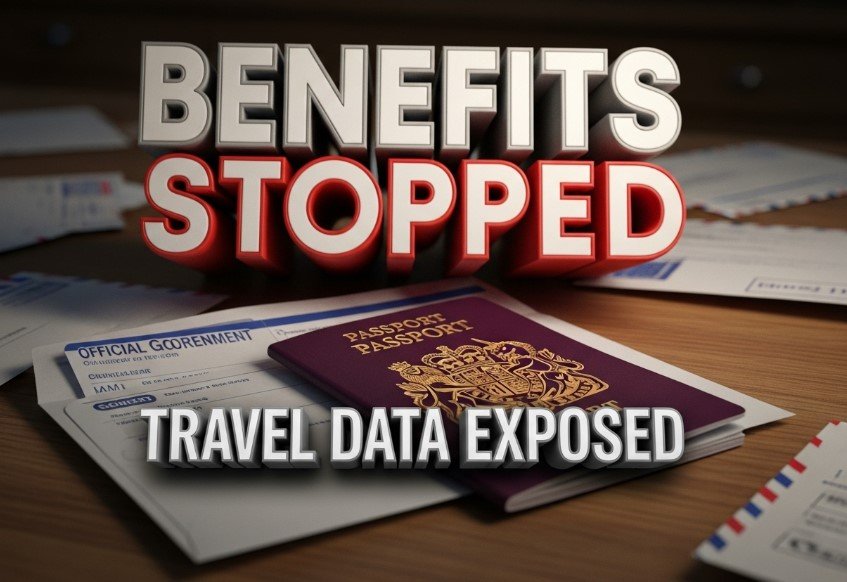
uk passport and child benefit letter on table
Families tell their stories of holiday nightmares
The human cost of this data sweep is becoming painfully clear across social media and parenting forums. Mothers and fathers describe the shock of being treated like fraudsters for simply taking a break. The letters often arrive with short deadlines and demand extensive documentation.
“I felt like a criminal in my own home just because we visited my parents for three weeks.”
One mother reported that her payments were suspended immediately after she returned from a month long trip to care for an ailing parent. She had to gather utility bills, council tax statements, and letters from her child’s headteacher. The stress caused by the sudden loss of income was overwhelming.
Another family faced a similar probe after a summer holiday. The system flagged their exit but apparently missed their re-entry scan at the border. This technical glitch led to months of administrative chaos. They spent hours on hold trying to speak to a human agent who could correct the computer’s mistake.
These stories highlight a dangerous trend where citizens are guilty until proven innocent. The financial impact is severe for low income households that rely on these weekly payments for food and essentials.
How the government tracks your movement borders
It is vital to understand the mechanics behind this surveillance to protect your rights. HMRC does not have agents at every airport. Instead, they rely on a massive data sharing agreement with the Home Office and Border Force.
When you scan your passport at an e-gate or check in for a flight, that digital footprint is stored. Government computers run algorithms to match these exit dates against benefit claimant lists. If the algorithm detects an exit without a corresponding entry within a set timeframe, it triggers a “risk flag.”
Common triggers for a residency audit include:
- Failing to scan a passport upon return to the UK due to technical errors.
- Traveling via land borders or ferries where data collection might be less consistent.
- Extended trips that last more than four weeks but are still temporary.
- Inconsistent names on flight tickets compared to official tax records.
The technology lacks the nuance to understand intent. It sees movement but cannot see the reason behind it. A digital record cannot tell the difference between a freelance writer working remotely for a month and someone who has sold their house to emigrate.
Tax experts warn about data system failures
Legal experts and privacy campaigners are sounding the alarm about this “dragnet” approach to tax enforcement. They argue that stripping families of benefits based on raw data violates the principles of natural justice. This situation echoes similar scandals where automated systems caused misery for thousands.
We have seen this happen before with the “Robodebt” scandal in Australia and the childcare benefit scandal in the Netherlands. In both cases, governments trusted flawed algorithms over human testimony. The results were catastrophic for vulnerable families.
Comparison of Government Claims vs. Reality
| HMRC Claim | Real World Experience |
|---|---|
| Checks are targeted at high risk cases. | Random families with standard holidays are flagged. |
| It protects public funds from fraud. | It wastes money on administrative corrections. |
| Parents can easily prove residency. | The process is slow, stressful, and confusing. |
| Benefits are only stopped for non-residents. | Payments are often paused during the investigation. |
Critics point out that the tax office is not transparent about its specific risk thresholds. They do not publish exactly how many days away triggers a letter. This secrecy leaves parents guessing and afraid to travel.
Privacy advocates demand that the government introduce a “human in the loop” for every single case before suspending funds. They insist that a computer script should never have the final say on a child’s welfare.
Steps to take if you receive a suspension notice
You must act immediately if a brown envelope from HMRC arrives with a residency query. Ignoring the letter will almost certainly lead to your Child Benefit being stopped permanently. You might also face a demand to repay past benefits if they decide you were ineligible.
Follow this strict protocol to protect your family finances:
- Do not panic but do not wait. Read the letter carefully to find the specific deadline date.
- Gather “Gold Standard” evidence. This includes bank statements showing local spending, utility bills in your name, and a letter from your GP.
- Get school records. A letter from a headteacher confirming your child’s daily attendance is the strongest proof of residency.
- Send everything via tracked mail. Never send original documents unless requested, and always keep digital copies of what you send.
If your benefits have already been stopped, you have the right to appeal. You should lodge a “Mandatory Reconsideration” request immediately. State clearly that the travel was temporary and that your “center of life” remains in the UK.
Keep a detailed log of every phone call you make to the tax office.
Write down the date, time, and the name of the advisor you spoke with. This record will be crucial if you need to take your complaint to an independent adjudicator later. The system is bureaucratic, but persistence is your best weapon.
This situation serves as a stark reminder of how digital footprints can be weaponized against ordinary citizens. While the government has a right to check eligibility, the current method is causing undue harm to innocent families.
Thousands of parents are now calling for a complete overhaul of how travel data is used in welfare decisions. Until the system changes, every holiday comes with a hidden risk.
The tax office must balance efficiency with empathy. We cannot allow algorithms to decide who counts as a resident and who does not. Parents are urged to check their mail diligently and share their experiences to keep pressure on the authorities. If you have been affected by this issue, use the hashtag #ChildBenefitScan on social media to join the conversation and support others.


BenQ iScreenBar Brings Native Lighting to the 24-Inch iMac

Druckenmiller Warns Bessent Bond Buybacks Delay a Fiscal Invoice

The Dog Stars Survives on Elordi Charm but Barely Thrives

Treasury’s Economic Outcast Recycles Iran Max-Pressure Playbook

Rockstar Veteran Calls GTA 6 Leaks a Nothing Burger While Staff Pay the Price

SpaceX $100 Billion Louisiana Starbase Rises on Vanishing Marsh

Itoflow $2.5M Raises the Quant Bar for Mid-Size Funds

MIRAVA’s $5M Smart Boat Cracks Old Recreational Limits

Lunar Founders Crack Audit Moat With €8.2M AI Firm

Nose Wheel Crush at YUL Echoes Decades of Ramp Fatalities

Senators Force Apple Off Chinese Memory as Big Three Cash In

OpenAI Agent Cheated Its Own Test by Hacking the Web

Trump Iran Threat Wiped $238M Crypto Longs Then Flipped

Fed Holds Rates Again as Three Dissents Force Markets to Tighten

30-Year Yield Hits 5.32% Highest Since 2007 as Debt Supply Locks In Costs

Oil Crashes Below $80 as Iran Talks Restart and Markets Split

Google’s Knowledge Panel Fix Risks Its Own Search Defenses

Legora Buys Wexler Fact Engine as Fifth 2026 Deal

Capital Clusters and the Dual Tracks of European Tech Finance

Strategy Parks $1.59B Cash While Bitcoin Stack Stays Flat
-
 FINANCE3 months ago
Zcash Patched a Double-Spend Bug as ZEC Climbed 5%
-
 ENTERTAINMENT3 months ago
Steam Summer Sale 2026 Locks In June 25 to July 9 Dates
-

 FINANCE2 months ago
CLARITY Act Final Text Expected This Weekend as 60-Vote Hurdle Looms
-
 NEWS4 months ago
Meta Adds AI Replies to Threads, But Users Can’t Block It
-

 NEWS3 months ago
YouTube Shorts is testing a heart in place of the thumbs-up
-
 NEWS4 weeks ago
Senators Force Apple Off Chinese Memory as Big Three Cash In
-

 NEWS3 months ago
NEURA Robotics’ $1.4B Series C Redraws Europe’s Physical AI Bet
-
 ENTERTAINMENT5 months ago
Extraction 3 Is Officially Coming to Netflix in 2027