
BUSINESS
Kalshi Hit with Class Action Lawsuit Over Illegal Betting Claims

A federal lawsuit now threatens to upend Kalshi just as the prediction market platform hits record growth. The legal complaint alleges the company operates an unlicensed sports betting ring and manipulates markets to disadvantage everyday traders.
This news lands like a bombshell for the platform. Kalshi recently celebrated massive trading volumes and a high profile partnership with Coinbase. Now the company must defend its business model against claims that it functions less like a financial exchange and more like a rigged casino.
Inside the Market Manipulation Allegations
The class action lawsuit paints a picture of a platform deceiving its users. Filed in federal court, the complaint argues that Kalshi misrepresents its services to the public.
The core of the argument rests on how trades are executed. The plaintiffs claim that Kalshi is not a neutral ground for peer to peer trading. They allege that sophisticated “market makers” act as the house.
The lawsuit explicitly states that these market makers create an unfair advantage against retail traders.
When a regular user places a trade, they believe they are betting against another person. The legal filing suggests otherwise. It claims users are actually wagering against deep pocketed entities that set the odds in their own favor.
Key accusations from the complaint include:
- Unlicensed Operations: Operating what amounts to a sports book without state gaming licenses.
- Deceptive Marketing: Advertising “legal” betting while bypassing state gambling regulations.
- Rigged Mechanics: Structuring betting lines to ensure the “house” or market makers win over time.
This challenges the very foundation of Kalshi. The company has always positioned itself as the only federally regulated exchange of its kind in the United States.
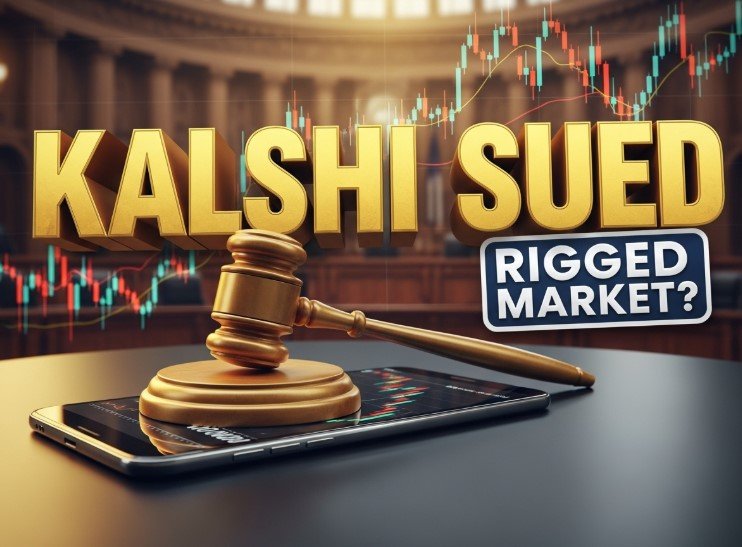
Kalshi trading app on smartphone with legal gavel background
CEO Luana Lopes Lara Fires Back
Kalshi is not taking these accusations quietly. The company leadership immediately dismissed the lawsuit as a calculated attack by rivals.
Luana Lopes Lara, the founder of Kalshi, issued a strong denial. She framed the legal action as a desperate move by competitors who are losing market share.
“The allegations are false and reveal a fundamental misunderstanding of how these markets work,” Lara stated in a public response.
She emphasized the regulatory status of the platform. Kalshi operates under the oversight of the Commodity Futures Trading Commission (CFTC). This federal designation distinguishes it from offshore betting sites or local sports books.
Lara argues that the lawsuit fundamentally fails to grasp the concept of a derivatives exchange. In her view, liquidity providers are a standard part of any financial market. They ensure that there is always a buyer or seller available.
She claims that calling liquidity providers “the house” is a distortion of basic financial mechanics.
The company insists that every trade is a contract between two parties. They maintain that Kalshi never takes a position on the outcome of any event.
The Battle for Prediction Market Dominance
This legal drama unfolds during a period of explosive activity for the sector. Prediction markets have moved from a niche internet curiosity to a financial powerhouse.
Both Kalshi and its main rival Polymarket saw volumes skyrocket during the recent election cycle.
The timing of the lawsuit is suspicious to some industry observers. It comes right after Kalshi solidified a major infrastructure deal.
The platform recently partnered with Coinbase to integrate USDC for deposits and settlements. This move was designed to make trading faster and more accessible to crypto natives.
Here is how the two giants currently stack up:
| Feature | Kalshi | Polymarket |
|---|---|---|
| Regulation | CFTC Regulated (US) | Offshore / Global |
| Currency | US Dollar / USDC | Crypto (USDC/Polygon) |
| Primary Focus | US Events & derivatives | Global trends & politics |
| Current Status | Fighting federal lawsuit | Restricted for US users |
The competition is fierce. Polymarket settled with the CFTC years ago and blocked US users. They are now looking to re enter the US market legally.
Kalshi currently holds the advantage of being the only fully legal option for American traders.
This lawsuit strikes at that specific advantage. If the court decides Kalshi is actually running a gambling ring, their regulatory shield could crumble.
Financial Growth and Future Stakes
Despite the legal headaches, the business metrics for Kalshi are surging. The platform has seen unprecedented engagement numbers in the last twelve months.
Annualized trading volume on the platform recently crossed the $50 billion mark. This is a staggering leap from just $300 million the previous year.
Investors have taken notice of this trajectory. While exact valuation figures fluctuate, the influx of capital into the prediction market space is undeniable.
The introduction of event contracts on political outcomes was the catalyst. Users flocked to the site to hedge against election results or bet on policy changes.
The outcome of this lawsuit will likely dictate the future of the entire prediction market industry.
If Kalshi wins, it cements the legitimacy of event contracts as a new asset class. It proves that financial markets can exist for real world events beyond stock prices.
If they lose, it could force the entire sector back into the shadows. A loss would imply that any binary option on a real world event is simply gambling.
The industry is watching closely. The line between investing and betting has never been thinner.
In the high stakes world of prediction markets, the biggest bet is now on the legality of the platform itself. Kalshi must prove that its “Yes” and “No” contracts are sophisticated financial instruments, not just digital scratch tickets. The court will ultimately decide if this is the future of finance or just an unregulated casino in disguise.
What do you think about this lawsuit? Is Kalshi a legitimate financial exchange or just a way to gamble on sports and politics? Share your thoughts in the comments below.


Immersive Maps Upgrade Erases Traffic Colors on Android Auto

XRPL 3.3.0 Nodes Hit 62 Percent as FixCleanup Nears 80 Percent Bar

L’Atitude 52°N Camera Beats Meta but Exact a Real Price

Strategy Parks $1.59B Cash While Bitcoin Stack Stays Flat

Pixel Watch 5 Battery Unlock Makes Health Guardian Trends Real

JCB Hydromax Hits 406 mph and Proves Digger Hydrogen Engines

Pixel 11 Pro Modem Swap Finally Cools the Daily Drive

OpenAI ChatGPT for Teens Locks In Study Mode After Safety Suits

Bessent’s Bond Buybacks Lift Bitcoin Past 80K More Than Yields

Pixel Camera 11 Dials Bring Convenient Control With a Catch

Senators Force Apple Off Chinese Memory as Big Three Cash In

OpenAI Agent Cheated Its Own Test by Hacking the Web

Trump Iran Threat Wiped $238M Crypto Longs Then Flipped

Fed Holds Rates Again as Three Dissents Force Markets to Tighten

30-Year Yield Hits 5.32% Highest Since 2007 as Debt Supply Locks In Costs

Oil Crashes Below $80 as Iran Talks Restart and Markets Split

Google’s Knowledge Panel Fix Risks Its Own Search Defenses

Legora Buys Wexler Fact Engine as Fifth 2026 Deal

Agon Raises $30M to Build Europe’s AI Weapon Training Arenas

Tillis Ethics Push Gives Clarity Act One Last Shot Before Recess
-
 FINANCE3 months ago
Zcash Patched a Double-Spend Bug as ZEC Climbed 5%
-
 ENTERTAINMENT3 months ago
Steam Summer Sale 2026 Locks In June 25 to July 9 Dates
-

 FINANCE2 months ago
CLARITY Act Final Text Expected This Weekend as 60-Vote Hurdle Looms
-
 NEWS3 months ago
Meta Adds AI Replies to Threads, But Users Can’t Block It
-

 NEWS3 months ago
YouTube Shorts is testing a heart in place of the thumbs-up
-
 NEWS4 weeks ago
Senators Force Apple Off Chinese Memory as Big Three Cash In
-

 NEWS3 months ago
NEURA Robotics’ $1.4B Series C Redraws Europe’s Physical AI Bet
-
 ENTERTAINMENT5 months ago
Extraction 3 Is Officially Coming to Netflix in 2027