
NEWS
Amazon and Google Join Forces to End Internet Outages

Imagine trying to run a billion-dollar business when the lights suddenly go out. That is exactly what happens to companies when cloud networks crash. In a rare and surprising move, two of the biggest rivals in the technology world have decided to work together to fix this massive problem. Amazon Web Services and Google Cloud announced a new partnership today that aims to make the internet safer, faster, and much harder to break.
This deal changes everything for companies that rely on the internet to survive. The two tech giants have built a new system that lets businesses connect their computer networks between Amazon and Google in just minutes. This process used to take weeks or even months of painful setup. It promises to stop major outages that have cost the US economy hundreds of millions of dollars in recent years.
Connecting Clouds in Minutes Instead of Weeks
The core of this announcement is speed and simplicity. For years, Amazon and Google fought hard to keep customers locked inside their own separate systems. Moving data from Amazon’s servers to Google’s servers was like trying to move a house. It required complicated contracts, physical cables, and expensive third-party hardware.
That era of isolation is officially over.
The new service combines AWS Interconnect multicloud technology with Google Cloud’s Cross-Cloud Interconnect.
This creates a direct bridge between the two platforms. Engineers can now log into a dashboard and switch on a high-speed link almost instantly. It removes the “technical friction” that used to make hybrid cloud strategies a headache for IT directors.
Here is how the new system improves upon the old model:
- Old Way: Required 3 to 6 weeks for physical cabling and contract negotiations.
- New Way: totally software-based setup that takes less than 15 minutes.
- Old Way: High risk of failure if one provider had a technical issue.
- New Way: Automatic redundancy where traffic shifts to the working line instantly.
- Old Way: expensive fees for moving data out of the cloud.
- New Way: streamlined pricing that encourages using the best tool for the job.
Businesses can now run their heavy database work on Amazon while using Google’s advanced artificial intelligence tools on the same data set without major delays. This interoperability is something customers have demanded for over a decade.
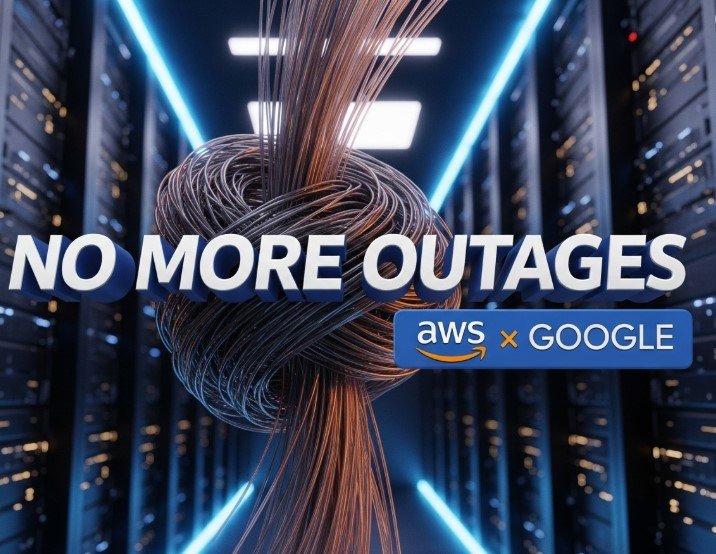
amazon aws and google cloud server room ethernet cables
October Crash Sparks Urgent Need for Stability
This partnership did not happen by accident. It was likely forced by necessity and growing fear among big corporations. Just last month, a massive AWS outage caused chaos across the digital world.
The October blackout took down thousands of websites. It stopped streaming services, paused e-commerce transactions, and even disrupted smart home devices. When a single provider goes down, half the internet seems to break with it. This incident served as a harsh wake-up call for the industry.
Analytics firm Parametrix estimated that the October outage cost US businesses hundreds of millions of dollars in lost revenue.
Companies realized they could no longer rely on just one cloud provider. They needed a “multicloud” strategy. This means using two or more providers so that if one fails, the other can take over immediately.
However, building this safety net was too hard for most companies before today. The complex networking required to link AWS and Google was a barrier. By removing this barrier, Amazon and Google are effectively telling their customers that they understand the fear of downtime. They are offering a lifeline that ensures business continuity even during catastrophic technical failures.
Artificial Intelligence Drives Demand for Speed
While preventing outages is the primary goal, there is another massive factor driving this deal. That factor is Artificial Intelligence.
The rise of AI has created a hunger for data that the current internet infrastructure struggles to handle. AI models require massive amounts of information to learn and operate. Moving this data between different storage locations creates a bottleneck.
Cloud providers are currently investing billions to upgrade their plumbing.
| Company | Q3 Revenue | Focus Area |
|---|---|---|
| Amazon (AWS) | $33 Billion | Market Leadership & Infrastructure |
| Google Cloud | $15.16 Billion | AI Integration & Analytics |
Amazon currently leads the market with a massive lead in revenue. However, Google has historically held an edge in data analytics and open-source technologies. By allowing customers to use AWS for storage and Google for AI processing, both companies win.
They prevent customers from defecting to Microsoft Azure, which is the other major player in this three-way war. This partnership might look like friendship, but it is actually a strategic defensive move to secure their dominance in the AI era.
A New Era of Cooperation Between Tech Giants
The executives involved in this deal are framing it as a customer-first revolution. Robert Kennedy, the Vice President of Network Services at AWS, stated that this partnership marks a significant shift in how multicloud connectivity is delivered. He acknowledged that customers want flexibility rather than walls.
Rob Enns, the head of cloud networking at Google Cloud, echoed this sentiment.
“The joint approach is intended to reduce technical friction for enterprises adopting hybrid strategies.”
This statement admits that the “technical friction” was a problem they helped create in the past. Now, they are solving it.
This move puts pressure on other cloud providers to open up their walled gardens. If Amazon and Google can play nice, customers will expect the same level of openness from Microsoft and Oracle. It creates a new standard where the quality of the software matters more than who owns the underlying cables.
We are witnessing the maturation of the cloud industry. It is no longer the Wild West where providers try to trap customers. It is becoming a utility, just like electricity or water, where reliability and connection speed are the only things that matter.
The technology landscape is changing rapidly. This deal proves that even the fiercest competitors will shake hands if it means keeping the internet running smoothly. For the average user, this hopefully means fewer days where your favorite app or website refuses to load. For businesses, it means sleeping a little easier at night knowing there is a backup plan.
What do you think about big tech rivals working together? Do you trust the cloud more now? Share your thoughts in the comments below and if you experienced issues during the last outage, let us know using #CloudCrash on social media.


Gemini’s Billion Users Lock AI Into Google’s Daily Layer

Again Buys Geno and Collapses the Biomanufacturing Timeline

Aster AOS-2 Locks 1M ASTER for Four Years on Perp Listings

NVIDIA Lightning Model Turns Agent Stacks Into Efficient Teams

Windows 11 Ends New Picture Passwords After 13-Year Security Lag

DuckDuckGo’s Clean Link Tap Quietly Rewrites Shared URLs

CLARITY Act Cloture Opens a Door Ethics Still Blocks

Sergey Brin Pours $102 Million Into Killing California Billionaire Tax

Goolsbee Puts Inflation First as Soft Jobs Only Delay Hike Risk

Efferon Gives Critically Ill Children a Purpose-Built Sepsis Filter

Senators Force Apple Off Chinese Memory as Big Three Cash In

OpenAI Agent Cheated Its Own Test by Hacking the Web

Trump Iran Threat Wiped $238M Crypto Longs Then Flipped

CLARITY Act Odds Crash as Democrats Reject DOJ Ethics Plan

Anthropic’s Hard Questions Ad Backfires Into an Anti-AI Warning

Oil Crashes Below $80 as Iran Talks Restart and Markets Split

Gemini Spark’s Big Workspace Upgrade Leaves Europe Waiting Again

Snapseed’s RAW Update Fixes Android, Leaves iPhone Waiting

Revolut Hits $115 Billion While Storonsky’s Stake Keeps Growing

Meta’s Hyperion and Prometheus Bet Big, and the Bill Is Rising
-
 FINANCE2 months ago
Zcash Patched a Double-Spend Bug as ZEC Climbed 5%
-
 ENTERTAINMENT2 months ago
Steam Summer Sale 2026 Locks In June 25 to July 9 Dates
-

 FINANCE1 month ago
CLARITY Act Final Text Expected This Weekend as 60-Vote Hurdle Looms
-
 NEWS3 months ago
Meta Adds AI Replies to Threads, But Users Can’t Block It
-
 ENTERTAINMENT3 months ago
‘Widow’s Bay’ Review: Apple TV’s Sleeper Horror-Comedy Earns Its Fog
-
 NEWS5 months ago
U.S. Navy Deploys Solar-Powered Lightfish Drone to Patrol Oceans
-

 NEWS2 months ago
NEURA Robotics’ $1.4B Series C Redraws Europe’s Physical AI Bet
-

 FINANCE1 month ago
Kalshi Loses Major NY Prediction Markets Ruling to Judge Torres