
BUSINESS
NHTSA Forces Refunds on 82,964 Achilles ATR Tires
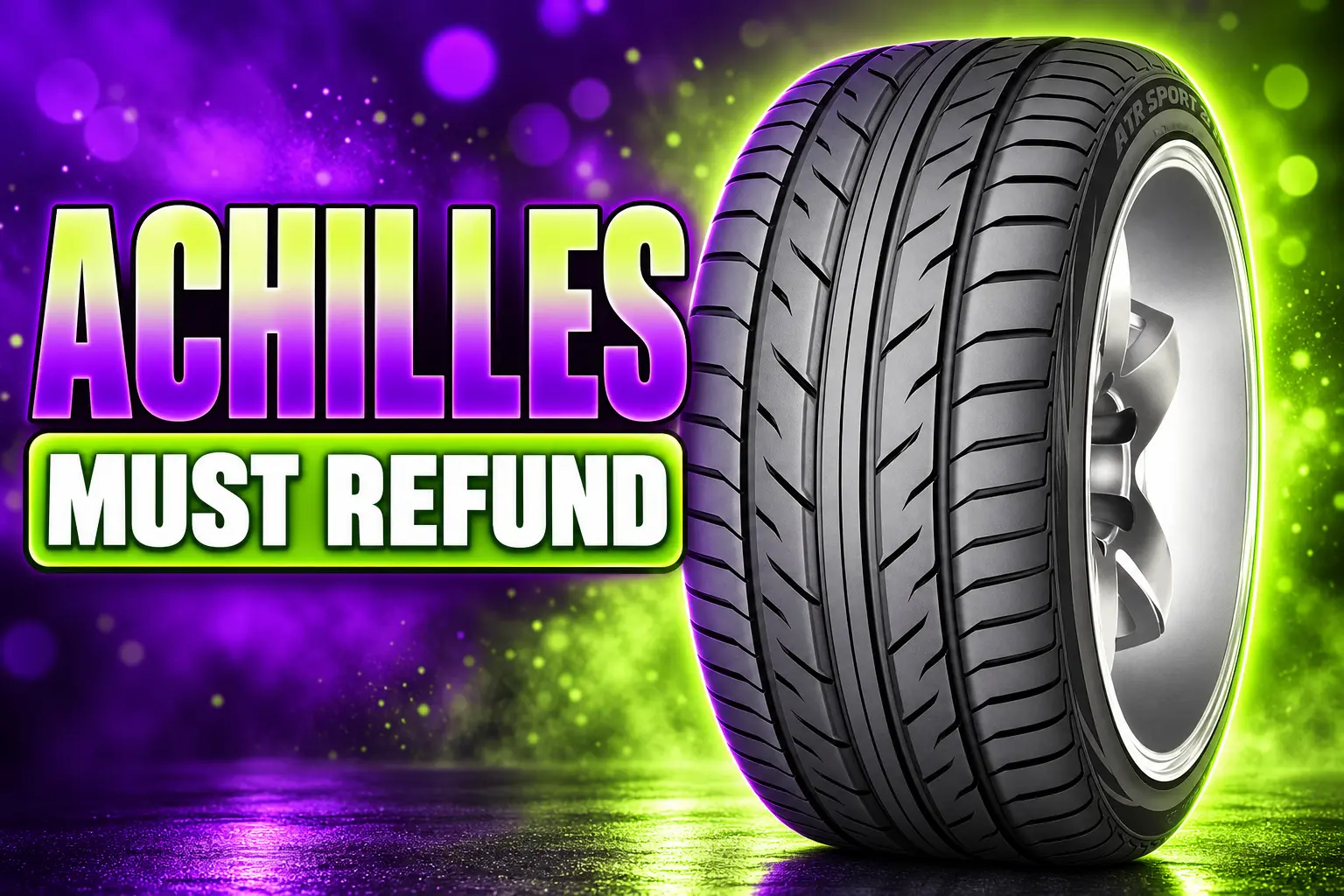
After denying a 2020 petition, NHTSA put 82,964 Achilles ATR Sport 2 tires into a cash-refund recall because their 14-character TIN will not register.

NHTSA on December 1, 2025, told PT. Multistrada Arah Sarana Tbk it must refund certain Achilles ATR Sport 2 tires whose identification numbers are too long to register.
Campaign 25T020 names 82,964 tires from the Cikarang, Indonesia, plant. Multistrada had added extra TIN digits to improve tracking, then learned its own Achilles site would not accept a 14-character number.
An 82,964-Tire Refund for a Number That Would Not Register
The December 1 letter went to Britton Swingle, Multistrada’s sales manager at 10660 El Poche in El Monte, California. NHTSA’s subject line called the problem an incorrectly formatted tire identification number under the tire identification and recordkeeping rules.
The filing behind that letter, dated November 24, 2025, lists 82,964 potentially involved Achilles tires, all ATR Sport 2, and puts the share with the marking error at 100 percent. Plant code 5K sits on every sidewall in the campaign. Remedy type is reimburse. Dealers inspect the tires, and customers get the purchase price back at no cost.
If a shop cannot help, Multistrada said owners may call Michelin Consumer Care at 1-888-971-3801 for refund options. The same filing left the reimbursement period, the costs, and the owner-letter dates marked “to be amended,” and it listed dealer and owner notification as “No Dealers” and “No Owners” on a phased recall.
NHTSA’s letter states the safety theory in one chain: without registration, an owner may never see a later recall notice, which can leave a bad tire in service and raise the risk of a crash. The agency is not alleging belt separation or a bad compound on these ATR Sport 2 units. The crash risk it names is a letter that never arrives.
THE 25T020 COUNT
- Campaign total: 82,964 Achilles ATR Sport 2 tires, with the error estimated at 100 percent of that group.
- The stamp: a 14-character TIN built from a 6-character optional code on plant 5K molds.
- The site limit: the Achilles registration form accepted only a 13-character number.
- The fix in the plant: all molds were corrected in 2020; the tires already sold were not restamped.
Swingle’s letter also names the five sizes: 245/50ZR20, 245/45R17, 225/55ZR18, 295/25ZR21, and 205/45ZR17. Production on those SKUs runs from early 2016 into March 2020, so the newest units were already more than five years old when NHTSA mailed the acknowledgment.
Multistrada Lengthened the Code and Broke the Form
The company’s own 573 report says it changed the optional code “in an effort to improve tire identification and traceability.” At the Cikarang plant it put six characters in the third grouping of the TIN. Federal rules for the older two-symbol plant code allow an optional code of no more than four symbols.
Under 49 CFR 574.5(g), a two-symbol plant code is followed by a size code of no more than two symbols, then that optional group, then a four-digit week-and-year date. Plant 5K plus a two-character size code plus six optional characters plus the date is 14 symbols. NHTSA assigned makers a new three-symbol plant code for a 13-symbol TIN, and it let firms keep the two-symbol code only through April 13, 2025. These tires were built years before that sunset, on the old layout, with two extra optional characters the old layout never allowed.
FMVSS No. 139, at S5.5.1, is the performance standard that points passenger and light-truck tires to that Part 574 stamp. The 573 cites both. Nine molds, Multistrada said, were cut on the wrong reading of the optional group. The extra characters were meant to carry more information. They made the number too long for the form that is supposed to collect owner names for the next recall.
FROM THE FIRST BAD STAMP TO THE DENIAL
- February 21, 2020: A returned tire shows a five-character optional code during a routine internal check, and Multistrada opens a marking review.
- March 11, 2020: The review finds multiple SKUs with five- or six-character optional codes; warehouse stock is blocked and mold work begins.
- May 5, 2020: Achilles Tire USA confirms it holds no subject tires still under its control.
- June 1, 2020: Multistrada files noncompliance report 20T010 and, on June 25, 2020, asks NHTSA to treat the extra digits as inconsequential to safety.
- February 26, 2021: NHTSA publishes the petition in the Federal Register at 86 FR 11823; no comments arrive.
- November 17, 2025: NHTSA denies the petition. On November 24, 2025, Multistrada files 25T020. The December 1 letter follows.
The 573 chronology notes that in March 2020 the U.S. distribution and sales network for Multistrada and Achilles Tire USA “was in transition,” so legal and reporting duties had to be sorted before the 20T010 paper went in. The molds were corrected that same year. The petition then sat.
What NHTSA Found on the Achilles Registration Site
NHTSA rejected Multistrada’s bid because the extra characters blocked the very registration the company said still worked. The agency’s November 17, 2025, notice denied the inconsequential-noncompliance petition and restored the duty to notify owners and provide a free remedy under 49 U.S.C. 30118 and 30120.
In 2020 Multistrada had told the agency a TIN marking error creates no operational safety risk, that the extra characters have no bearing on tire performance, and that plant code and date code were still on the sidewall. On identification, it wrote that the extra characters did not stop a distributor, a dealer, or a consumer from registering the tires. It also cited “confirmation that tires with extraneous TIN optional code characters can be properly registered on the Achilles Tire USA website.”
But when NHTSA attempted to register one of the subject tires, it was not possible to register a TIN with more than 13 characters. As the Achilles tire registration system is limited to accepting only a 13-character number, the subject tires, which have 14-character TINs, cannot be registered.
National Highway Traffic Safety Administration, Federal Register notice, November 17, 2025
The agency added that even if the form were later rebuilt to take 14 characters, a person who already failed once would be unlikely to try again unless a recall letter arrived. Eileen Sullivan, associate administrator for enforcement, signed the denial. NHTSA also wrote that it does not treat the absence of complaints as proof that a noncompliance is harmless.
The 573 repeats the same limit in the company’s own voice after the denial: the Achilles system “is currently limited to accepting only a 13-character number,” so tires with six-digit optional codes cannot be registered. Multistrada further noted that after 2023 a TIN longer than 13 characters would not go into “the database.” The tracking upgrade had taken the tires off the list that tracking depends on.
Five Sizes, Nine Molds, Plant Code 5K
Campaign 25T020 is not a scatter of random SKUs. It is five ATR Sport 2 sizes from nine molds, each with a six-character optional code that begins with a three-letter stem and ends in 241. The 225/55ZR18 accounts for 38,717 of the 82,964 tires. The 295/25ZR21 accounts for 248, built only from January 1, 2018, through December 23, 2019.
ATR SPORT 2 SIZES IN CAMPAIGN 25T020
| Size | Tires | Production window | Optional code |
|---|---|---|---|
| 245/50ZR20 | 30,924 | Jan. 1, 2016 to Mar. 2, 2020 | KWA241 |
| 245/45R17 | 9,160 | Jan. 1, 2016 to Mar. 1, 2020 | HVA241 |
| 225/55ZR18 | 38,717 | Jan. 4, 2016 to Mar. 2, 2020 | IWA241 |
| 295/25ZR21 | 248 | Jan. 1, 2018 to Dec. 23, 2019 | JWA241 |
| 205/45ZR17 | 3,915 | Jan. 3, 2016 to Mar. 9, 2020 | HWA241 |
Size codes on those stamps are NG, NF, LH, SB, and JF, in the same order. Date codes on the larger SKUs run from week 0116 through week 1020. The 295/25ZR21 uses 0118 through 5219. Add the five counts and the total is 82,964.
An ATR Sport 2 is an ultra-high-performance replacement tire, the kind that often goes on a sport sedan or a show car and comes off when the tread or the calendar says it is done. A refund of the original purchase price on a 2016 tire is a different offer than a new tire in the driveway. The 573 does not set a dollar figure. It says the plan is still to be amended.
Michelin Already Owned 99.64% of the Factory
The letter went out on Multistrada letterhead, but the factory had already changed hands. Compagnie Générale des Établissements Michelin said on March 8, 2019, that it had bought 87.59 percent of PT Multistrada Arah Sarana Tbk, the Indonesian maker behind Achilles and Corsa. On June 19, 2019, after a required public offer, Michelin said it held 99.64% of Multistrada’s share capital and had paid USD 545 million in total.
The March 2019 announcement put Multistrada’s capacity at 11 million passenger-car tires, plus two-wheel and truck output, and put 2017 net sales at USD 281 million. Michelin said it would move the plant from lower-tier passenger tires toward Michelin group brands. The marking error NHTSA later refused to waive was already in the molds. The first bad stamp turned up in a field return on February 21, 2020, less than a year after the March close, while U.S. sales contracts were still being rewritten.
That is why a Michelin Consumer Care number appears in a Multistrada 573. The Indonesian company remains the named manufacturer on 25T020. The parent that bought it in 2019 is the backstop the filing gives owners when a dealer cannot process the refund. Michelin’s 2019 plan was to convert capacity. The 2025 filing is a check for tires the plant no longer marks that way.
Independent shops and online sellers moved a lot of Achilles product in those years as a cheaper UHP option. First purchasers who never registered are the people the TIN system is built to find. Used-car buyers who inherited a 2017 ATR Sport 2 never saw a card. The refund program has to reach both groups without a working registry, which is the same gap that caused the campaign.
The Denied Petition’s Four-Brand Inventory
Campaign 25T020 is the first public remedy slice, not the whole obligation. The petition NHTSA denied on November 17, 2025, covered about 1,673,307 Achilles, Corsa, Radar, and Milestar tires made between January 3, 2016, and March 14, 2020. Docket NHTSA-2020-0072 is that broader file. Related recall number 20T010 sits on the 25T020 form for a reason.
LINES NAMED IN THE 2020 PETITION
- Achilles: 868 All Seasons, ATR Sport 2, Desert Hawk H/T2, 122, ATR-K Sport, and Desert Hawk UHP.
- Corsa: All Terrain XL and Highway Terrain.
- Radar: Renegade H/T and Renegade A/T.
- Milestar: MS932XP, Patagonia M/T, and Grantland.
The 25T020 population is the ATR Sport 2 tires with six-character optional codes. The denied petition also swept in five-character codes found in the 2020 review. NHTSA did not split the inconsequentiality question by digit count. It said Multistrada had not met its burden on FMVSS No. 139, and that the company must notify and remedy. Other SKUs from that 1,673,307-tire list are not in the 25T020 size table. They remain under the denial even if they have not yet appeared on a second campaign form.
Multistrada’s 2020 argument was that a dealer could still read plant, size, optional code, and date, and that production records could match those fields if a notice were required. NHTSA’s answer was narrower. Direct owner mail needs a registration record. The Achilles website was the path Multistrada pointed to, and that path rejected the long TIN. Public notices and dealer bulletins are the fallback, and the agency treated that fallback as the problem, not the cure.
How to Check an ATR Sport 2 Sidewall
The DOT stamp on the intended outboard sidewall is the campaign filter. For these tires the plant group is 5K. Next comes a two-character size code, then a six-character optional code, then a four-digit date code. If the optional group is six characters, the whole TIN is 14 characters and the tire is in the group Multistrada cannot register.
THE FOUR GROUPS ON A 5K STAMP
- Plant: 5K, the two-symbol Cikarang code used on every tire in 25T020.
- Size code: NG, NF, LH, SB, or JF, matching the five ATR Sport 2 sizes in the table.
- Optional code: KWA241, HVA241, IWA241, JWA241, or HWA241 on the recalled SKUs.
- Date code: four digits for week and year, inside the production windows above.
Match size, optional code, and date window, then ask a dealer to inspect. The filed remedy is a refund of the purchase price, not a new ATR Sport 2. Keep the receipt if you still have it. If the shop stalls, the 573 points to Michelin Consumer Care at 1-888-971-3801. NHTSA’s letter did not attach a completion deadline, and Multistrada’s November 24 filing left those dates blank.
The nine molds were corrected in 2020, so a later ATR Sport 2 from Cikarang should carry a legal optional code. The 82,964 tires already in the market still carry the long stamp, and the 1,673,307-tire petition NHTSA denied is the larger list that denial put back under the notification statute. The extra digits were added to make those tires easier to find. The form that finds their owners still stops at 13.

UPI MDR Delay Hands Traders the Calendar After Paytm Falls

Google Messages Builds Nine In-Chat Games After Samsung’s Exit

Anthropic’s $100 Million Academy Trains the Firms That Bill Both Sides

Toyota’s Electric C-HR Leaves the Cheap Twin to Subaru

Markets Bet the Fed Skips October After Hawkish Minutes

The Orchard Bug Forced Zcash to Open an Empty Pool

The $5.99 Game That Won Steam’s 2026 Summer Sale

Don Lee Joins Hemsworth as Extraction 3 Starts Shooting

YouTube Shorts Retires Dislikes and Swaps Likes for Hearts

NEURA Robotics Is Spending Its $1.4B on a Machine Stack
-
 NEWS4 months ago
The Orchard Bug Forced Zcash to Open an Empty Pool
-
 GAMING4 months ago
The $5.99 Game That Won Steam’s 2026 Summer Sale
-
 ENTERTAINMENT6 months ago
Don Lee Joins Hemsworth as Extraction 3 Starts Shooting
-
 NEWS4 months ago
YouTube Shorts Retires Dislikes and Swaps Likes for Hearts
-
 NEWS4 months ago
NEURA Robotics Is Spending Its $1.4B on a Machine Stack
-
 AUTO6 months ago
Kawasaki Bets the New Z1100 Against Its Own Supercharger
-

 BUSINESS5 months ago
Norway’s Export Bank Backs Nscale’s $790 Million Narvik Loan
-

 GAMING4 months ago
Game of Thrones Dragonfire Follows Boston’s Conquest Playbook