
LIFESTYLE
New York Bill May Pay You to Ditch Gas Lawn Tools

If you live in New York and plan to buy a mower, stop right now. A new Senate bill could put money back in your pocket for choosing electric equipment over gas. With noise complaints and pollution levels rising, Albany is finally moving to incentivize a greener backyard for everyone. Here is why you should wait to see if this bill passes before swiping your credit card.
A Financial Push for Greener Pastures
New York lawmakers are taking a fresh approach to environmental cleanup. Instead of just banning gas-powered tools outright, they are looking to pay you to switch. The proposed legislation aims to establish a rebate program for residents and professional landscapers. This program would offer point-of-sale rebates or tax credits when you trade in old gas guzzlers for battery-powered alternatives.
The goal is to make clean energy tools as affordable as their fossil-fuel counterparts.
Currently, the upfront cost of a high-quality electric mower or commercial-grade leaf blower can be higher than gas models. This bill intends to bridge that gap. If passed, the rebate could cover a significant percentage of the purchase price. This makes the switch financially logical for homeowners who are on the fence.
Early reports suggest the program works similarly to electric vehicle incentives. You buy a qualified tool, and the discount applies instantly or comes back at tax time. This method has proven effective in other sectors and could rapidly accelerate the adoption of green landscaping gear across the state.
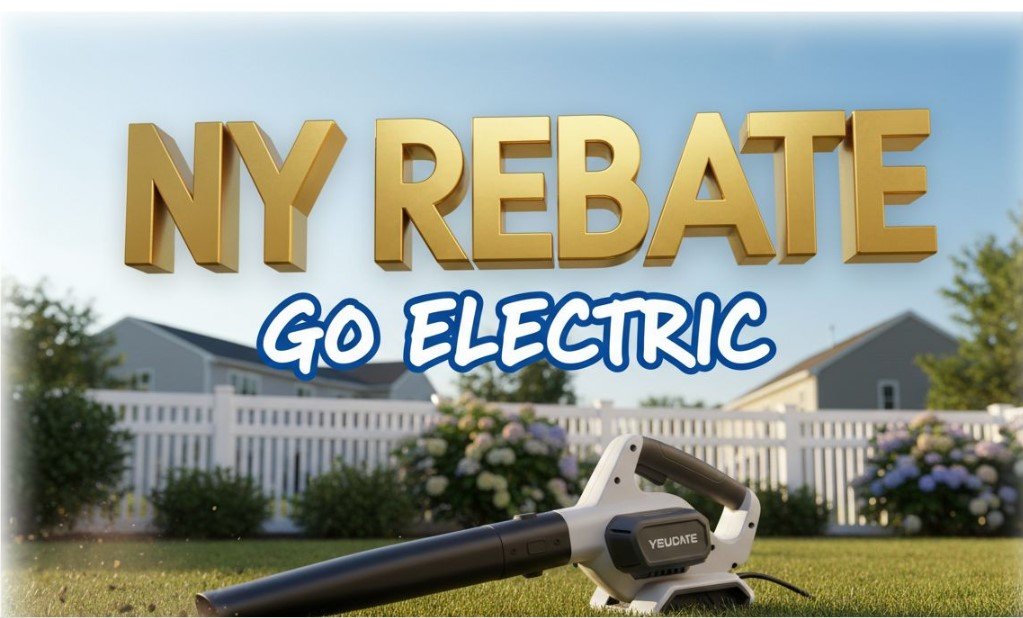
battery powered electric leaf blower on green grass lawn
Key Proposal Details:
- Target: Residential homeowners and commercial landscaping companies.
- Mechanism: Point-of-sale rebate or annual tax credit.
- Eligible Items: Electric lawn mowers, leaf blowers, weed trimmers, and chainsaws.
- Goal: Drastic reduction in local air and noise pollution by 2030.
Why Gas Tools Are Under Fire
The push for this legislation is not just about peace and quiet. The environmental data surrounding small gas engines is staggering. Recent EPA monitoring reveals that Monroe County leads upstate New York in air pollution specifically from gas-powered lawn equipment.
These small machines are surprisingly dirty. Because they lack the catalytic converters found in cars, they spew raw exhaust. Environment America reports that lawn equipment in Monroe County alone generates over 100,000 tons of climate emissions annually.
To put that in perspective, that is roughly equivalent to the pollution output of 22,000 cars driving on the road for a year. This data underscores a massive blind spot in our fight against climate change. We worry about highway traffic but ignore the two-stroke engine running next door.
A wider study by the New York Public Interest Research Group painted an even grimmer picture for the whole state. In 2020 alone, gas lawn equipment in New York emitted an estimated 1.37 million tons of pollutants.
This equals the emissions of approximately 300,000 cars. Lawmakers are using these hard numbers to justify the cost of the rebate program. They argue that tax dollars spent here will lower healthcare and environmental cleanup costs down the road.
The Hidden Health Costs in Your Yard
It is not just about the ozone layer or global warming. The exhaust from these tools poses immediate health risks to the operator and the neighbors. Gas engines release high levels of particulate matter known as PM2.5.
These microscopic particles can penetrate deep into the lungs and enter the bloodstream. Health experts link PM2.5 exposure to asthma attacks, cardiovascular disease, and even premature death.
Landscaping workers face the highest risk. They often operate these machines for eight hours a day, breathing in fumes at close range. The proposed bill hopes to encourage landscaping businesses to switch their fleets by offering bulk incentives.
Noise is the second major health factor. Gas leaf blowers often operate at decibel levels that can cause permanent hearing loss over time. The low-frequency drone of a gas blower can penetrate walls and windows, disturbing sleep and increasing stress levels for entire neighborhoods.
Comparison of Noise Levels:
| Equipment Type | Decibel Level (dB) | Impact on Hearing |
|---|---|---|
| Gas Leaf Blower | 90 – 100 dB | Risk of injury after 15 mins |
| Electric Blower | 65 – 75 dB | Safe for short durations |
| Normal Conversation | 60 dB | No risk |
Is Electric Equipment Ready for Prime Time
Skeptics often argue that battery power cannot match the grunt of a gas engine. A few years ago, that might have been true. Today, modern lithium-ion technology has leveled the playing field for almost all residential tasks.
Top-tier electric brands now offer 60-volt and 80-volt systems. These units provide torque and cutting power that rivals reputable gas models. For a typical quarter-acre lot in the suburbs, a single charge is usually sufficient to mow, trim, and blow off the driveway.
However, “range anxiety” still exists for commercial crews. They worry about batteries dying in the middle of a job. The legislation takes this into account.
By lowering the cost of entry, the bill allows pros to buy extra batteries. This ensures they can cycle through power packs all day without downtime. Manufacturers are also rolling out mobile charging solutions for trucks, which this bill may also help subsidize.
This transition is happening regardless of the law. Major manufacturers are already announcing plans to phase out gas engines. This Senate bill simply aims to help New Yorkers get ahead of the curve without breaking the bank.
The market is shifting, and your wallet should benefit from the change.
New York would not be the first to act, but this bill puts it at the forefront of the movement. California has moved toward bans, but New York’s incentive-based approach might be more popular. It rewards good behavior rather than punishing those who cannot afford to switch yet.
With spring around the corner, keeping an eye on Albany could save you hundreds of dollars. If this bill passes, the smartest move is to wait. Your new electric mower could end up being the cheapest tool you have ever bought.
While we wait for the final vote, the message from environmental groups and health experts is clear. The era of the gas engine in the garden is ending. It is now up to the Senate to decide how fast we reach the finish line.
Tell us what you think about this potential rebate program. Would a tax credit convince you to ditch your gas mower, or do you prefer the power of the old engines? If you are already seeing the impact of this debate online, join the conversation using #NYGreenLawn and share your thoughts with your neighbors.


Boldr’s $5M Bet Puts HVAC Contractors at Grid Center

NEON Bets Big on Lily James Cliffhanger for February 2027

Gemini Locks Apex Pipes for Crypto Event Contracts

Sony Email Restates Old License Rules Amid Disc Backlash

TidalSense Breaks Spirometry’s Grip With a 75-Second COPD Test

Asus Zenbook Duo 2026 Makes Dual Screens a Daily Driver

SoftBank’s €172M Robot Bet Tops Europe’s €684M Funding Week

NEURA Gives Cleaning Robots a New Brain With ADLATUS Deal

Lotus Emira V6 Manual Delivers Pure Thrills Before Hybrid Shift

Pimax Dream Air Cracks the Bulk Barrier for High-End PCVR

Senators Force Apple Off Chinese Memory as Big Three Cash In

OpenAI Agent Cheated Its Own Test by Hacking the Web

Trump Iran Threat Wiped $238M Crypto Longs Then Flipped

Fed Holds Rates Again as Three Dissents Force Markets to Tighten

30-Year Yield Hits 5.32% Highest Since 2007 as Debt Supply Locks In Costs

Oil Crashes Below $80 as Iran Talks Restart and Markets Split

Google’s Knowledge Panel Fix Risks Its Own Search Defenses

Legora Buys Wexler Fact Engine as Fifth 2026 Deal

Agon Raises $30M to Build Europe’s AI Weapon Training Arenas

Capital Clusters and the Dual Tracks of European Tech Finance
-
 FINANCE3 months ago
Zcash Patched a Double-Spend Bug as ZEC Climbed 5%
-
 ENTERTAINMENT3 months ago
Steam Summer Sale 2026 Locks In June 25 to July 9 Dates
-

 FINANCE2 months ago
CLARITY Act Final Text Expected This Weekend as 60-Vote Hurdle Looms
-
 NEWS3 months ago
Meta Adds AI Replies to Threads, But Users Can’t Block It
-

 NEWS3 months ago
YouTube Shorts is testing a heart in place of the thumbs-up
-
 NEWS4 weeks ago
Senators Force Apple Off Chinese Memory as Big Three Cash In
-

 NEWS3 months ago
NEURA Robotics’ $1.4B Series C Redraws Europe’s Physical AI Bet
-
 ENTERTAINMENT5 months ago
Extraction 3 Is Officially Coming to Netflix in 2027