
NEWS
Navy AI Tool Slashes 160 Hours of Work to Just 10 Minutes

The United States Navy has officially turned the tide on manufacturing delays with a stunning technological breakthrough. A new artificial intelligence tool has successfully compressed a complex 160-hour scheduling task into a mere 10 minutes. This massive leap in efficiency signals a new era for American shipbuilding as the military branch races to modernize its fleet against global competitors.
Revolutionizing The Shipyard
The United States Navy is currently facing one of its toughest challenges in decades. The production of essential submarines and surface ships has been plagued by schedule slips and workforce shortages. However, a new pilot program with General Dynamics Electric Boat has produced jaw-dropping results that could solve these critical issues.
The Electric Boat team recently tested a new software called the Shipbuilding Operating System or Ship OS. This system utilizes advanced artificial intelligence provided by software giant Palantir. When applied to a complicated scheduling task that typically requires 160 hours of manual labor, the AI completed the entire job in less than 10 minutes.
This is not just a minor improvement. It represents a 95,900 percent increase in speed for that specific task.
The system works by integrating data from various disparate sources that shipbuilders use daily. It cleans the data and presents it in a unified view. This allows engineers and planners to spot problems instantly rather than digging through paperwork for weeks.
Key benefits observed during the initial testing phase include:
- Drastic reduction in manual data entry.
- Immediate identification of supply chain bottlenecks.
- Real-time adjustments to engineering workflows.
- Enhanced ability to predict and mitigate manufacturing risks.
-
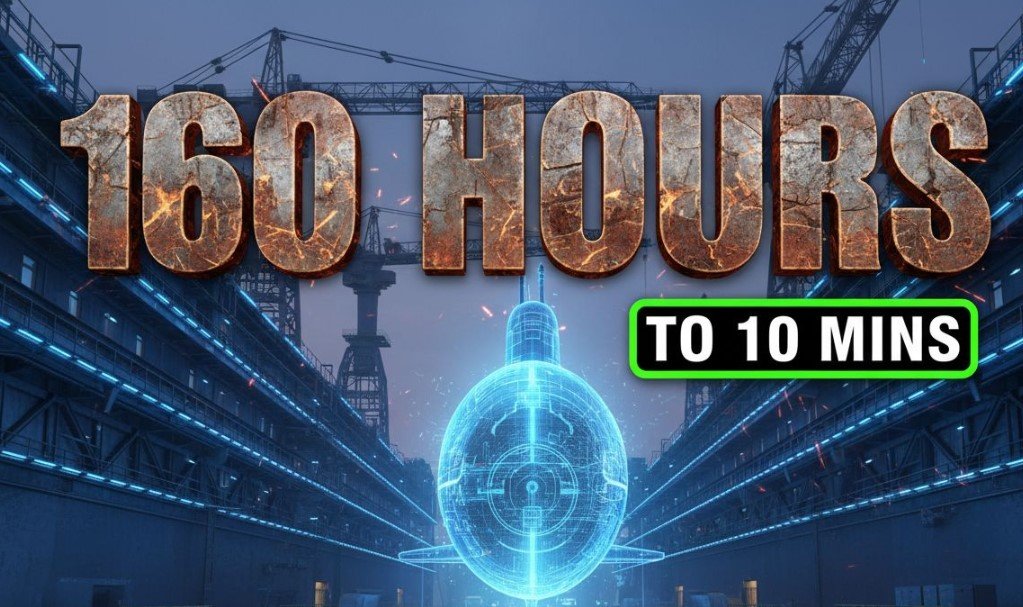
US Navy submarine construction dry dock industrial scene
A Massive Investment in Speed
The Navy is confident enough in these early results to back the technology with serious funding. On December 9, Secretary of the Navy John Phelan announced a significant financial commitment to expand this program. The branch plans to invest $448 million to fully develop and deploy the Ship OS tool across its industrial base.
This investment targets the most critical area of need first. The initial rollout will focus on submarine builders and their vast network of suppliers.
The submarine industrial base has struggled recently to meet the demand for new Virginia-class and Columbia-class boats. These vessels are vital for national security. By injecting AI into the workflow, the Navy hopes to recover lost time and get these ships into the water faster.
Once the system is perfected within the submarine sector, the Navy plans to apply the lessons learned to surface ship production. This phased approach ensures that the technology is battle-tested before being used fleet-wide.
“We cannot fight tomorrow’s wars with yesterday’s timeline. This technology allows us to buy back the one thing we can never create more of, which is time.”
Proven Results at Portsmouth
The success at General Dynamics is not an isolated incident. The Ship OS platform has also been put to the test at the Portsmouth Naval Shipyard with equally impressive outcomes. This facility is responsible for the repair and overhaul of the active submarine fleet.
Portsmouth Naval Shipyard reported that the AI tool cut material review times from several weeks down to under one hour.
Maintenance delays are a major pain point for the Navy. When a submarine is stuck in a dry dock waiting for parts or paperwork, it is not out patrolling the seas. Reducing a multi-week review process to a single lunch break effectively adds weeks of operational availability to the fleet.
The system achieves this by automating the cross-referencing of technical manuals and inventory lists.
| Metric | Traditional Method | With Ship OS AI |
|---|---|---|
| Scheduling Task | 160 Hours | 10 Minutes |
| Material Review | 2 to 3 Weeks | < 1 Hour |
| Data Access | Siloed / Fragmented | Unified / Instant |
Embracing A Digital Future
The adoption of Ship OS is part of a broader cultural shift within the Navy. The branch is actively moving away from analog processes and fully embracing the digital age. This transition is being driven by leadership who understand that data is a weapon.
Vice Admiral Carl Chebi, the Naval Air Systems Commander, recently spoke about the need for a fresh perspective. He noted that the younger generation is already fluent in these tools. He shared a personal anecdote about his teenage daughter teaching him how to use ChatGPT.
“There is new technology coming down and we have got a lot of folks who have thought about the problem in the same way for a long time,” Chebi stated at a recent industry conference. He emphasized that the Navy needs help thinking about old problems in new ways.
Rear Admiral Elizabeth Okano, the Naval Information Warfare Systems Commander, explained the practical application for sailors. She described how the tool digests massive technical manuals. A sailor can simply type a question into the system and get an immediate, accurate answer. This eliminates hours spent flipping through thousands of pages of documentation to find a specific torque spec or repair procedure.
The message from the top is clear. The Navy is no longer just experimenting with AI. They are building their future around it.
Summary:
The US Navy has successfully deployed a new AI tool called Ship OS that reduced a 160-hour shipbuilding task to just 10 minutes. Backed by a new $448 million investment announced by Secretary John Phelan, this Palantir-powered technology addresses critical delays in submarine production. Early tests at Portsmouth Naval Shipyard also showed material reviews dropping from weeks to under an hour. This move signifies a major shift toward digital modernization to improve fleet readiness and support the workforce.


Dolly Parton’s $450 Million Fortune Keeps Working After Her Death

SpaceX’s $60B Cursor Buy Immediately Costs It OpenAI Models

Rays Forever Home Wins County Vote as College and Taxpayers Carry the Load

Apple TV Hits $14.99 as Sports and Hits Bill Comes Due

Swift Telescopes Restart as Orbit Drop Accelerates

Oracle’s 2.8 GW Bloom Deal Exposes the AI Power Bypass

Galaxy S26 Beta 7 Ports Fold 8 AI as Stable Nears

Walmart Pays $50 Million to Close Federal Opioid Pharmacy Case

Space Mirror Demo Revives 1993 Russian Night-Light Test

Measles Death Dispute Deepens Distrust in Pennsylvania Outbreak

Senators Force Apple Off Chinese Memory as Big Three Cash In

Trump Iran Threat Wiped $238M Crypto Longs Then Flipped

30-Year Yield Hits 5.32% Highest Since 2007 as Debt Supply Locks In Costs

Oil Crashes Below $80 as Iran Talks Restart and Markets Split

Strategy Parks $1.59B Cash While Bitcoin Stack Stays Flat

Astute’s $1.2M bet makes B2B creator deals feed AI discovery

Capital Clusters and the Dual Tracks of European Tech Finance

BlackRock Turns Cash Empire Into Stablecoin Reserve Rails

The 20% Savings Ideal Meets a 2.7% Reality Check

SpaceX Stock Rebound Tests Real Demand Before Huge Unlock
-
 FINANCE3 months ago
Zcash Patched a Double-Spend Bug as ZEC Climbed 5%
-
 ENTERTAINMENT3 months ago
Steam Summer Sale 2026 Locks In June 25 to July 9 Dates
-

 FINANCE2 months ago
CLARITY Act Final Text Expected This Weekend as 60-Vote Hurdle Looms
-
 NEWS4 months ago
Meta Adds AI Replies to Threads, But Users Can’t Block It
-

 NEWS3 months ago
YouTube Shorts is testing a heart in place of the thumbs-up
-
 NEWS4 weeks ago
Senators Force Apple Off Chinese Memory as Big Three Cash In
-

 NEWS3 months ago
NEURA Robotics’ $1.4B Series C Redraws Europe’s Physical AI Bet
-
 ENTERTAINMENT5 months ago
Extraction 3 Is Officially Coming to Netflix in 2027