
NEWS
Cowboy secures future with ReBirth deal to restart production

Brussels e-bike innovator Cowboy has officially secured its survival through a majority-stake acquisition by French mobility giant ReBirth Group. This strategic lifeline injects €15 million to restart stalled manufacturing and stabilize the brand after months of uncertainty. It marks a pivotal shift for the connected mobility company as it seeks long-term profitability.
The financial rescue and leadership shakeup
The acquisition represents a dramatic restructuring of Cowboy to save it from the turbulent headwinds facing the e-bike industry.
ReBirth Group Holding SA has stepped in with a combination of new capital and reinvestment from existing shareholders. This deal involves a critical conversion of legacy financial obligations into equity. It effectively cleans the balance sheet for the Belgian startup.
The transaction provides the necessary cash flow to immediately resume operations that had slowed due to liquidity constraints.
A major casualty of this transition is the departure of Adrien Roose. The Cowboy founder and CEO has left the company as part of the deal. His exit signals the end of the startup era and the beginning of an industrial integration phase under new management.
Grégory Trébaol, CEO of ReBirth Group, will now oversee the brand’s direction.
“I would like to thank Cowboy’s founders for their vision, ambition, and the remarkable company they have built in a difficult market. This transaction opens a new chapter for Cowboy,” Trébaol stated regarding the acquisition.
The deal was not just a boardroom decision. It received overwhelming support from the Crowdcube community and current investors. This indicates a collective realization that the brand required industrial backing to survive.
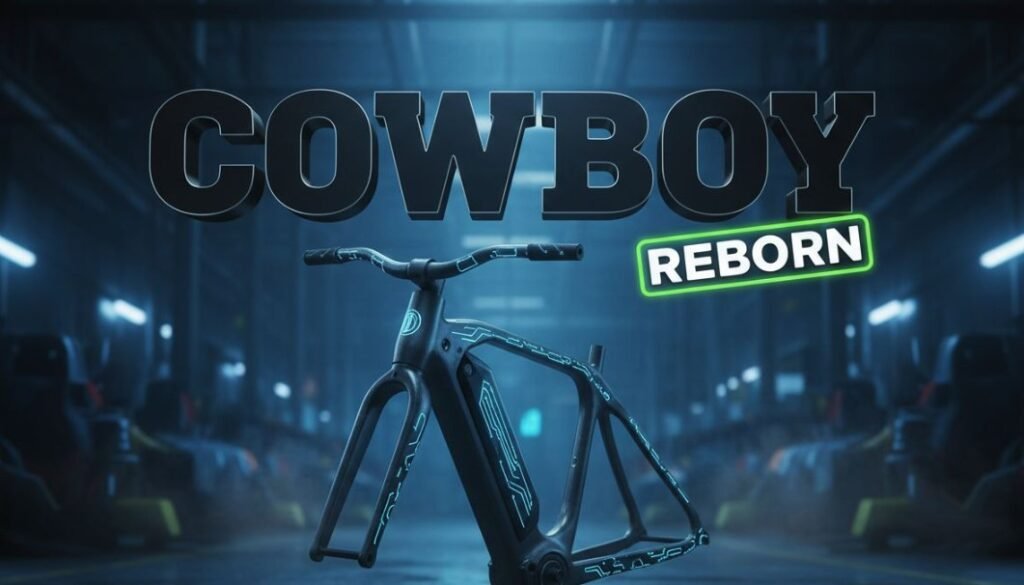
modern electric cowboy bike handlebar silhouette in dark studio
Industrial reboot and production plans
The most urgent priority for the new ownership is addressing the manufacturing halt and delivery backlog.
Operations are set to resume immediately at the French assembly facility. The company has outlined an aggressive schedule to get bikes back on the assembly line by January. This is vital news for customers who have faced uncertain waiting times.
A comprehensive production plan targets over 1,500 new bikes in the first month of 2025.
The integration with ReBirth promises to solve the supply chain bottlenecks that frequently plagued Cowboy as a standalone entity. ReBirth controls a vast network of suppliers across Europe and Asia.
The immediate operational roadmap includes:
- January Restart: Full reactivation of the French assembly lines.
- Backlog Clearance: Prioritizing orders for customers currently on the waiting list.
- Spare Parts: A dedicated portion of the new funding is allocated solely to restocking parts.
- Timeline Updates: Customers will receive revised delivery dates in the coming weeks.
By vertically integrating with a manufacturing heavy hitter, Cowboy gains access to better component pricing and predictable scheduling.
This moves the brand away from the volatile “just-in-time” production model that hurt many bike startups.
Leveraging retail power for growth
This deal is not merely about keeping the lights on. It is about expansion into physical retail spaces.
Cowboy has historically relied heavily on direct-to-consumer sales. This model offered high margins but limited service reach. ReBirth operates a massive physical footprint in France that will now open its doors to Cowboy products.
The brand will gain immediate access to ReBirth’s established network.
| Retail Channel | Scope of Access |
|---|---|
| Oxygen Stores | 95 locations across France |
| Ovelo Stores | 10 specialized bike shops |
| Independent Dealers | Network of 500 partner locations |
France is currently Cowboy’s fourth-largest market but is projected to become its fastest-growing region.
This physical presence addresses one of the biggest consumer complaints regarding online e-bike brands: after-sales support.
Riders in major French cities will soon have local spots for servicing and test rides. This infrastructure shift aligns with the broader industry trend of moving back to brick-and-mortar reliability.
Existing markets in the Netherlands, Belgium, and Germany will see strengthened logistics support. The goal is to replicate the French retail success across these territories in the future.
What this means for existing riders
The acquisition naturally brings anxiety for the community of 80,000 existing riders.
However, the deal explicitly secures the continuity of digital services. The Cowboy app, which is central to the bike’s functionality, remains fully operational. The software teams will continue to work from the Brussels headquarters.
Hardware warranties and customer service channels are operating as normal under the new ownership structure.
Marta, Head of Customer Success at Cowboy, emphasized the focus on rebuilding trust.
“We previously set a high benchmark for after-sales service, and this new chapter allows us to return to that standard. We’re focused on rebuilding trust and delivering the consistent support our customers expect.”
The ongoing recall program regarding battery safety and other components will proceed without interruption.
The company has promised a detailed progress update on these recalls in the New Year. This ensures that safety remains a priority alongside the financial restructuring.
Riders can expect the unique software features that define the bike to remain. ReBirth intends to use Cowboy’s technology to enhance its other legacy brands like Solex and Peugeot. This suggests the software platform is a key asset they intend to protect and develop.
Synergy of software and steel
The merger creates a “best of both worlds” scenario on paper.
Cowboy brings a market-leading connected platform and award-winning design DNA. ReBirth brings industrial grit, factory capacity, and supply chain dominance.
This combination of digital innovation and industrial scale is becoming essential for survival in the e-bike sector.
The 2026 operational plan is already being drafted. It focuses on cost optimization and shared innovation.
Cowboy will operate independently regarding design and engineering. However, the backend logistics will be fully absorbed into ReBirth’s ecosystem. This should result in higher margins for the company and faster delivery times for the consumer.
The era of the “tech company that sells bikes” is ending. Cowboy is evolving into a bike manufacturer with a tech edge. This distinction is crucial for long-term viability in a market that has seen high-profile failures like VanMoof.
With a clean balance sheet and factories spinning up, Cowboy has a second chance to prove its model works.


Pixel Journal Auto Format Puts Google Private AI to the Diary Test

Android 17 QPR2 Beta 3 Quietly Delivers Native App Lock

Binance Cuts HTX Rails and Seals Off High-Risk Liquidity

Dell 14S Quietly Delivers Multi-Day Battery in Midrange Aluminum

OCC Conditionally Clears Trump-Linked USD1 Trust Bank

Coyote vs. Acme Turns Its Own Burial Into the Sharpest Gag

Google Health Adds Off Switch After AI Coach Clutter Backlash

SpaceX Issues 389 Million Shares as Cursor Deal Closes

Bank Leumi Hands Galaxy the Rails for Israeli Crypto Trading

Apple Maps Ad Bookings Open and Turn Local Search Into a Bid Game

Senators Force Apple Off Chinese Memory as Big Three Cash In

OpenAI Agent Cheated Its Own Test by Hacking the Web

Trump Iran Threat Wiped $238M Crypto Longs Then Flipped

CLARITY Act Odds Crash as Democrats Reject DOJ Ethics Plan

Revolut Hits $115 Billion While Storonsky’s Stake Keeps Growing

Anthropic’s Hard Questions Ad Backfires Into an Anti-AI Warning

Oil Crashes Below $80 as Iran Talks Restart and Markets Split

Duda’s New AI Tools Speed Up Agencies, but Risk Sameness

Community Banks’ $1.3 Trillion Warning Is Stalling Clarity Act

Applied Computing Lands $20M as KBR Doubles Down on Its Energy AI Bet
-
 FINANCE2 months ago
Zcash Patched a Double-Spend Bug as ZEC Climbed 5%
-
 ENTERTAINMENT2 months ago
Steam Summer Sale 2026 Locks In June 25 to July 9 Dates
-
 NEWS3 months ago
Meta Adds AI Replies to Threads, But Users Can’t Block It
-

 FINANCE1 month ago
CLARITY Act Final Text Expected This Weekend as 60-Vote Hurdle Looms
-

 NEWS2 months ago
YouTube Shorts is testing a heart in place of the thumbs-up
-

 NEWS2 months ago
NEURA Robotics’ $1.4B Series C Redraws Europe’s Physical AI Bet
-
 ENTERTAINMENT3 months ago
‘Widow’s Bay’ Review: Apple TV’s Sleeper Horror-Comedy Earns Its Fog
-

 FINANCE1 month ago
Kalshi Loses Major NY Prediction Markets Ruling to Judge Torres