
BUSINESS
America’s Economic Gap Widens as Small Businesses Struggle

Wall Street is throwing a record-breaking party while Main Street struggles to keep the lights on. A silent crisis is tearing through the American economy and creating a stark reality for business owners. Giant corporations are riding a wave of artificial intelligence hype to massive profits. Meanwhile, small businesses are quietly cutting jobs and scaling back operations just to survive.
Wall Street Booms While Main Street Bleeds
The contrast between large conglomerates and local enterprises has never been more aggressive. Large publicly traded companies are celebrating stock prices that defy gravity. Investors are pouring billions into tech giants and driving the S&P 500 to new heights.
This optimism is largely absent on the ground level. Small business owners face a brutal combination of economic headwinds. They are battling persistent inflation and high interest rates. Consumer spending has shifted significantly as families tighten their belts.
Recent data paints a worrying picture for the backbone of the economy. Private companies with fewer than 50 employees have shed jobs for six consecutive months.
The numbers are staggering. In November alone, these small firms eliminated 120,000 positions. This is not just a statistical blip. It represents a fundamental shift in the labor market.
Midsize and large organizations tell a different story entirely. They continued to hire aggressively during the same period. They have the capital reserves to weather storms that sink smaller ships.
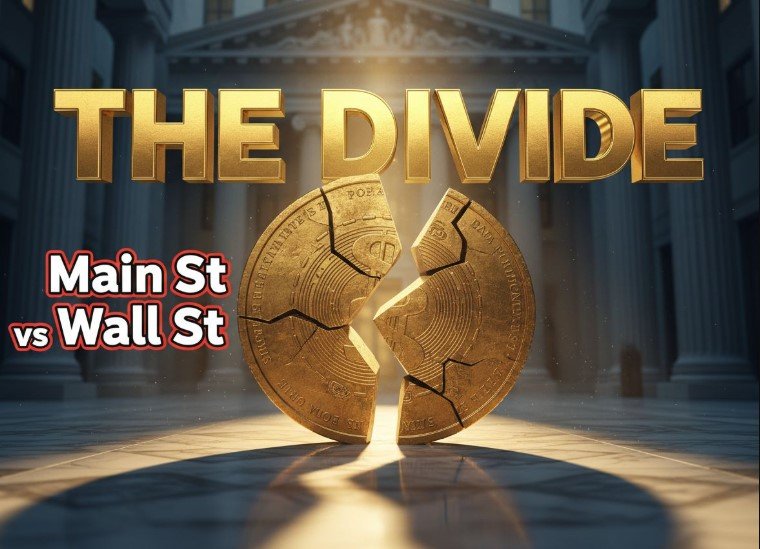
golden cracked coin showing economic inequality between large and small business
Soaring Costs Crush Small Margins
The root cause of this divide lies in financial resilience. Big corporations locked in low interest rates years ago on their debts. Small businesses rely on floating-rate credit lines that have become excruciatingly expensive.
Large firms also have the leverage to negotiate better prices with suppliers. They can absorb tariff hikes and shipping cost increases without breaking a sweat. Small shops have to pass those costs on to consumers immediately. This makes them less competitive.
The following table illustrates the disparity in resources between the two sectors:
| Economic Factor | Large Corporations | Small Businesses |
|---|---|---|
| Capital Access | Easy access to stock markets and low-interest bonds. | Reliance on high-interest bank loans and credit cards. |
| AI Adoption | Billions available to invest in automation and efficiency. | Limited budget to implement new time-saving technologies. |
| Labor Costs | Ability to offer high wages and comprehensive benefits. | Struggle to compete for talent due to thin profit margins. |
| Inflation Impact | Can absorb price shocks through volume sales. | Must raise prices immediately to maintain cash flow. |
These structural disadvantages are compounding daily. A small retailer cannot simply absorb a 10% hike in rent or inventory costs. They must cut labor or reduce hours to stay afloat.
Holiday Hiring Hits a Historic Low
The holiday season usually brings a hiring blitz for local shops. That tradition is disappearing rapidly. Business owners are opting for caution over expansion.
Almost Famous Popcorn provides a clear example of this trend. The Cedar Rapids company generates nearly 60% of its annual sales during the winter months. In previous years, they would bring on a dozen seasonal workers to handle the rush.
Sydney Rieckhoff serves as the CEO of the Iowa-based gourmet popcorn company. She noted that plans have changed drastically this year.
“In a normal year we’d hire 10 to 15, and this year we’re closer to four or five,” Rieckhoff stated.
Her observation reflects a broader hesitation across the market. Corporate gifting budgets have shrunk. Consumers are buying smaller items. The ripple effect is undeniable.
“As businesses place smaller orders for client and employee gifts, we’re definitely seeing more thoughtful spending,” she added.
This hesitation creates a dangerous feedback loop. Fewer hires mean less money circulating in the local economy. That leads to even lower sales for other nearby businesses.
Consumer Divide Mirrors Corporate Gap
The split in the business world is creating a similar canyon among American households. The wealth gap is widening in lockstep with the corporate performance gap.
Stock market gains primarily benefit the wealthiest Americans. They own the vast majority of shares in companies like Nvidia and Amazon. When big business booms, their net worth explodes.
Workers at small businesses often earn less than their corporate counterparts. They do not typically have access to stock options or robust retirement matching. This leaves them more vulnerable to inflation.
Key Economic Indicators:
- GDP Contribution: Small businesses produce over 40% of the nation’s GDP.
- Employment: They employ nearly half of all US workers.
- Profit Trends: Small business profits are shrinking while corporate profits rise.
- Stability: Cash reserves for small firms are dangerously low compared to 2020.
Taylor Bowley works as an economist at the Bank of America Institute. He highlighted this divergence in a recent analysis.
“We’re seeing two different economic realities on both the consumer and the business landscape,” Bowley explained.
This dual reality poses a risk to long-term stability. An economy cannot thrive on the success of a few dozen mega-corporations alone. The health of the entire system depends on the millions of smaller entities that sustain local communities.
The Artificial Intelligence Advantage
Technology is acting as an accelerant for this divide. Large companies are using AI to replace entry-level tasks and boost productivity. They have the data infrastructure to make these tools work effectively.
Net income for S&P 500 companies surged 12.9% in the third quarter. This growth is largely fueled by efficiency gains and tech dominance.
Small businesses often lack the technical know-how to implement these solutions. They are left fighting 21st-century battles with 20th-century tools. The barrier to entry for advanced tech is lowering, but it is not low enough yet.
This technological gap creates an uneven playing field. A multinational chain can use algorithms to optimize supply chains and staffing instantly. A local restaurant owner has to guess based on gut feeling and manual spreadsheets.
The U.S. Chamber of Commerce warns that Main Street’s struggles will eventually drag down the broader figures. You cannot have a healthy tree with rotting roots. Policy makers may need to intervene to level the playing field before the damage becomes permanent.
America stands at a precarious economic crossroad where the path to prosperity is narrowing for the little guy. The resilience of the American entrepreneur is legendary, but even the strongest spirit needs capital to survive. We are witnessing a fundamental restructuring of the economy that favors scale over agility. It is a trend that demands immediate attention from both consumers and leaders.


NFL Preseason Week 2 Quietly Tests the Schemes That Matter

Alonso’s Towering Drive Stands Foul and Flips Orioles Momentum

US Debt Crosses $40 Trillion as Interest Crowds the Budget

Trevon Diggs Joins Seahawks on One-Year Deal After Cowboys Exit

Pixel Watch 5 Turns Passive Trends Into Early Health Alerts

Pixel 11 Pro Fold Sleek Build Undercuts Its Own Unfolding Appeal

Tugboat Wilkinson’s Scoreless Debut Pays Off Giants’ Bailey Trade

Brown Shines for Pats as Love for Eagles Meets Trade Reality

Pixel Watch 5 Turns Wrist Data Into Early Metabolic Alerts

Resistance Stars Pay the Price in Democratic Primaries

Senators Force Apple Off Chinese Memory as Big Three Cash In

Revolut Hits $115 Billion While Storonsky’s Stake Keeps Growing

OpenAI Agent Cheated Its Own Test by Hacking the Web

Trump Iran Threat Wiped $238M Crypto Longs Then Flipped

30-Year Yield Hits 5.32% Highest Since 2007 as Debt Supply Locks In Costs

Fed Holds Rates Again as Three Dissents Force Markets to Tighten

Memory Shortage Now Dictates Apple’s Two-Year Mac Roadmap

Oil Crashes Below $80 as Iran Talks Restart and Markets Split

Google’s Knowledge Panel Fix Risks Its Own Search Defenses

Community Banks’ $1.3 Trillion Warning Is Stalling Clarity Act
-
 FINANCE3 months ago
Zcash Patched a Double-Spend Bug as ZEC Climbed 5%
-
 ENTERTAINMENT3 months ago
Steam Summer Sale 2026 Locks In June 25 to July 9 Dates
-

 FINANCE2 months ago
CLARITY Act Final Text Expected This Weekend as 60-Vote Hurdle Looms
-
 NEWS3 months ago
Meta Adds AI Replies to Threads, But Users Can’t Block It
-

 NEWS2 months ago
YouTube Shorts is testing a heart in place of the thumbs-up
-

 NEWS2 months ago
NEURA Robotics’ $1.4B Series C Redraws Europe’s Physical AI Bet
-
 NEWS3 weeks ago
Senators Force Apple Off Chinese Memory as Big Three Cash In
-
 ENTERTAINMENT3 months ago
‘Widow’s Bay’ Review: Apple TV’s Sleeper Horror-Comedy Earns Its Fog