
BUSINESS
Russia’s 100 Million Tonne LNG Goal Slips Toward the US Gulf
Novak pushed Russia’s 100 million tonne LNG goal years past 2030, and US Gulf plants are taking the spare cargoes while Arctic LNG 2 still cannot fill its own.

Deputy Prime Minister Alexander Novak postponed Russia’s goal of 100 million tonnes of LNG a year on 25 December 2025, blaming Western sanctions. Construction would continue, he told Rossiya 24, and liquefied gas would remain a main driver of the energy industry.
The plants did keep running. What slipped is the path to a fifth of world trade. Arctic LNG 2 is now moving more cargo to China on a short ice-class fleet, and that fleet is about to inherit Yamal’s European volumes as well.
Novak Pushed the 100-Million-Tonne Goal Past 2030
Novak did not name a new year. He said the old target, 100 million tonnes a year, would be postponed by several years because of sanctions, while plant building went on. A government energy strategy still on the books points to 90 to 105 million tonnes by 2030 and 110 to 130 million tonnes by 2036, and it still talks about taking 20% of the global LNG market. Those pages and his interview are no longer describing the same calendar.
On the same day he spoke, he put 2025 output at 33 million tonnes after 34.7 million tonnes in 2024, and he blamed a heavier summer maintenance slate for the dip. Large-tonnage production sits at Sakhalin Energy (Gazprom with Japan’s Mitsui and Mitsubishi), Yamal LNG (Novatek with TotalEnergies, CNPC and China’s Silk Road Fund), Cryogas-Vysotsk, and Gazprom LNG Portovaya.
RUSSIA’S LNG LEDGER
- The old target: 100 million tonnes a year, postponed by several years on 25 December 2025.
- 2025 production: 33 million tonnes, per Novak, after 34.7 million tonnes in 2024.
- 2025 exports: 30.52 million tonnes in the International Gas Union’s traded tally, down 3.0 million tonnes, a 7.0% world share.
- The strategy still in print: 90 to 105 million tonnes by 2030, even as Novak pushed the 100-million-tonne mark past that date.
Those production and export figures are not the same pile. Novak was talking about what the plants made. The IGU is counting what left the country as seaborne cargo. Either way, Russia is producing about a third of the annual total it once billed as a 2030 job, and Murmansk LNG, listed in the strategy at 20.4 million tonnes a year by 2030, had already had work paused under sanctions.
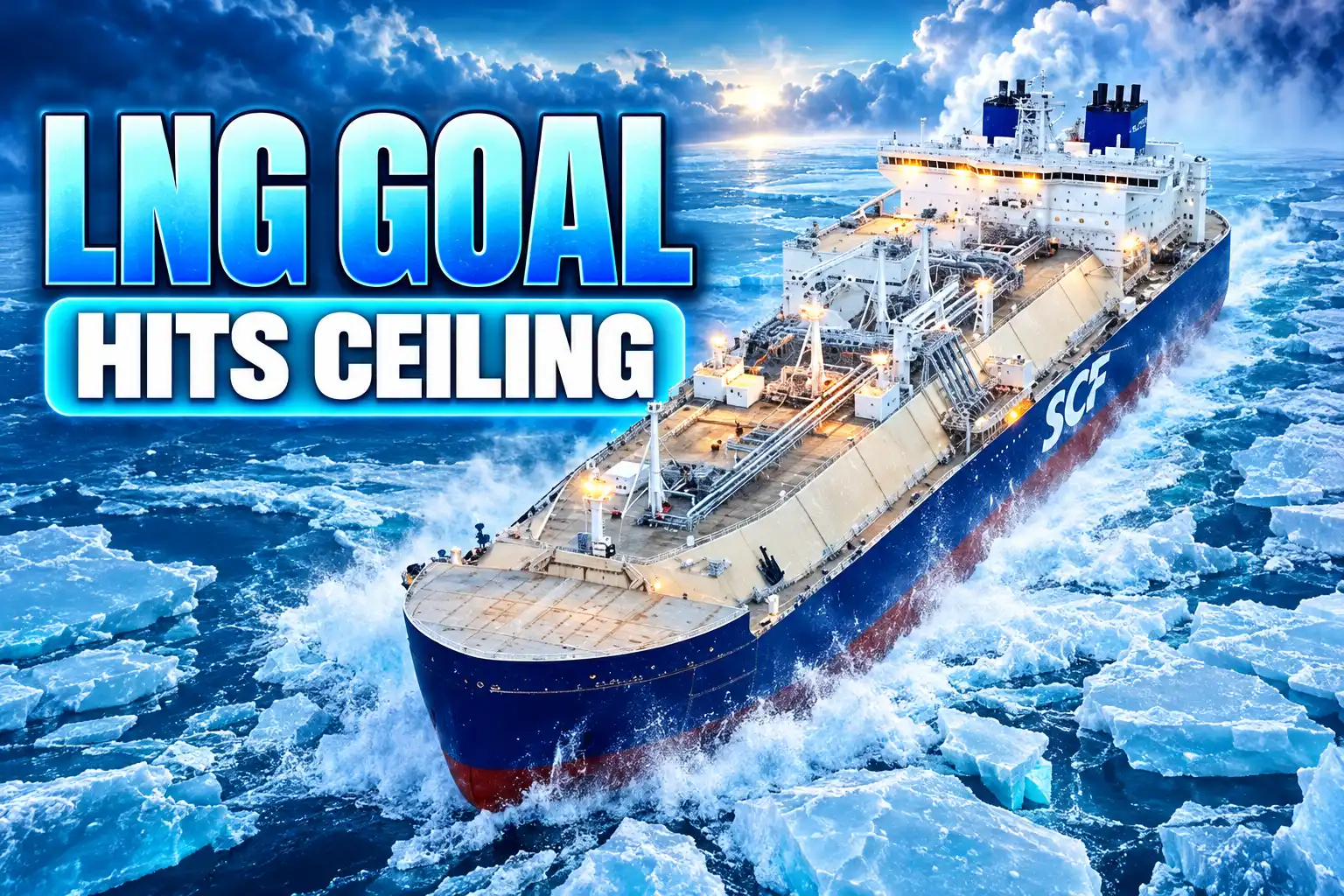
Arctic LNG 2 Is Running Harder, Not Wider
The project that was supposed to carry a large slice of that extra 100 million tonnes is Novatek’s Arctic LNG 2 on the Gydan Peninsula, designed for 19.8 million tonnes a year from three trains of 6.6 million tonnes. Two trains give a combined 13.2 million tonnes of nameplate capacity. The third train is still a concrete platform waiting on modules.
Our goal was to reach 100 million tonnes. It is clear that due to sanctions restrictions, this will now be postponed by several years.
Alexander Novak, Deputy Prime Minister, on Rossiya 24
The Oxford Institute for Energy Studies put 2025 output at the sanctioned plant at 1.2 million tonnes and said the wider Arctic cluster produced 20.8 million tonnes, 19.6 million of that from unsanctioned Yamal LNG, with Sakhalin adding 10.5 million tonnes. First commercial cargoes to Chinese offtakers only left in August 2025, more than a year and a half after Train 1 was ready to make molecules.
Shipment data for 2026 show a different pace. Arctic LNG 2 moved 2.8 million tonnes in the first eight months, and Rystad Energy has raised its full-year production estimate by about 9% to 5 million tonnes, with 5.2 to 5.4 million tonnes of export potential on the hulls now in service. Plant-level figures described in early September put July and August gas output above 27 million cubic meters a day, nearly double the August 2025 pace, with monthly LNG loadings also reported above 500,000 tonnes. That is a real ramp. It is still a long way from 13.2 million tonnes, let alone 19.8.
Three Icebreakers Against a 15-Ship Plan
The gas is not the scarce item. Arc7 ice-class LNG carriers are. Arctida, which tracks Northern Sea Route traffic, says uninterrupted operations need a fleet of 15 Arc7-class carriers. By summer 2026 the dedicated list was three: Christophe de Margerie, pulled over from Yamal LNG; Aleksey Kosygin, handed over at the Zvezda yard in late December 2025; and Konstantin Posyet, delivered on 18 June 2026. Pyotr Stolypin, Sergey Witte and Viktor Chernomyrdin were still on the slipways. At about one Zvezda delivery every six months, a 15-ship fleet is a five-to-seven-year job.
THE ARCTIC LNG 2 SHIP GAP
| Item | Design or need | Mid-2026 reality |
|---|---|---|
| Dedicated Arc7 carriers | 15 for year-round operations | 3 in service |
| Two-train nameplate | 13.2 million tonnes a year | Rystad 5.2 to 5.4 million tonnes of export potential |
| Rystad 2026 output | Full two-train run | 5 million tonnes |
| Tankers on the account | A specialised Arctic fleet | At least 20, up from 11 at the end of 2025 |
The extra hulls are mostly conventional ships with opaque ownership, the LNG version of a shadow fleet, plus a handful of Arc4 vessels that can handle lighter ice. They nearly doubled in under a year. They still cannot replace ice-breaking shuttles in January.
Winter Traffic Runs Through Two Floating Depots
Once output rose to about 14 million cubic meters a day in early 2026 against those three ice-class hulls, operators went to a two-stop model. Aleksey Kosygin’s first eastbound commercial run in January 2026 still needed the nuclear icebreaker Arktika, including a stop near Saint Lawrence Bay, so the “independent” Arc7 design is not a winter solo act.
THE TWO-STOP ROUTE TO CHINA
- The shuttle: Arc7 ships run LNG from the Utrenny terminal to the Saam floating store in Ura Bay, Murmansk Region, and the Koryak floating store in Bechevinskaya Bay, Kamchatka, with ship-to-ship transfers of 12 to 24 hours.
- The long haul: Conventional carriers such as Pioneer, Asya Energy, Everest Energy and Buran take the cargo from those depots to China in open water only.
- The winter cap: Arctida puts cold-season loadings at 20% to 30% of the first train’s design, because a conventional hull cannot be bullied through heavy ice even with nuclear escort, as Buran showed in December 2025 when it aborted a convoy into Utrenny.
Daria Melnik, vice president of oil and gas research at Rystad Energy, has called shipping the principal constraint. Ashley Sherman, a senior LNG analyst at Vortexa, has said four Arc7s could in principle get two trains close to full if the Russian transshipment hubs scale. Those two views can both be true: more ordinary tankers lift the summer ceiling, and the ice-class shortage still owns the winter.
WHERE EXPERTS DISAGREE
- Rystad: With the present fleet the plant can export 5.2 to 5.4 million tonnes a year, and it may need as many as 30 conventional ships to reach full capacity.
- Vortexa: Four Arc7 hulls could let two trains run near full, but only if ship-to-ship transfers in Russian waters keep up.
Novatek has also been trying to recover ice-class ships ordered in Asia and stranded since 2022. Until those hulls actually berth at Utrenny, the argument is academic.
China Takes the Cargoes at a Steep Discount
China is the only known buyer of sanctioned Arctic LNG 2 cargoes. PipeChina’s Beihai terminal in Guangxi had taken 41 cargoes totalling about 2.6 million tonnes by summer 2026, many via the two Russian floating stores, and it has also taken three cargoes from sanctioned Portovaya. A second PipeChina terminal at Longkou in Shandong, planned at 5 million tonnes a year against Beihai’s 6 million, was being readied before the winter heating season to shorten the run from the Koryak store off Kamchatka.
The commercial terms match a captive seller. Because of secondary-sanctions risk, the supplier has been offering Chinese offtakers discounts of 30% to 40%. That haircut, plus the extra days in floating storage and the two-stop voyage, is the price of keeping Train 1 and a half-built Train 2 in the market at all. TotalEnergies completed the transfer of its 10% Arctic LNG 2 stake to Novatek’s NordLine unit in August 2026, after writing the holding off at $4.1 billion in 2022. Novatek’s direct interest, already 60%, moves to 70%.
CNPC and CNOOC still sit on the register, and China is building the terminals that make the trade ordinary rather than improvised. The 100-million-tonne national plan was a global market-share project. What is actually scaling is a discounted, China-facing Arctic stream that lives or dies on a handful of ice-class hulls.
A Record Half-Year of Yamal Cargoes Into Europe
Yamal LNG is the other half of the Arctic story, and it is not under the same blocking sanctions as Arctic LNG 2. Nameplate is 17.4 million tonnes a year. In the first half of 2026, EU countries took 9.97 million tonnes from Yamal in 136 cargoes, a 16% rise, with an estimated value of €5.96 billion ($6.82 billion), most of it into France, Belgium and Spain. Kpler compiled the cargo count. Companies were filling long-term contracts before the legal window shuts.
The Commission’s own stocktake of the REPowerEU gas regulation now sets a phase out Russian LNG imports that ends long-term cargoes on 1 January 2027. Russian gas had already fallen from 45% of EU imports in 2021 to 12% in 2025, or 36 billion cubic meters after 152 billion in 2021. LNG is the leftover pipe.
THE EU BAN CALENDAR
- 3 February 2026: Regulation (EU) 2026/261 enters into force, making the phase-out binding.
- 25 April 2026: Imports under short-term LNG contracts are banned.
- 1 January 2027: Imports under long-term LNG contracts are banned, and EU operators may not trade or market Russian LNG to third countries either.
- 30 September 2027: Long-term pipeline imports are banned.
The short-term ban in April did not cut Yamal’s European run, because the big offtake sits in older long-term paper. TotalEnergies still holds 20% of Yamal. Germany’s SEFE and Spain’s Naturgy hold long-term offtake. Once the 1 January 2027 line is crossed, those cargoes cannot be quietly redirected by an EU trader to Asia. They have to find a non-EU ship and a non-EU buyer, or they stay in the tanks.
In the first eight months of 2026, Russian LNG exports as a whole were up 13.7%, with 10.3 million tonnes still going to Europe, up 10.7%. Yamal shipped 12.0 million tonnes in that window, flat on a year earlier. Sakhalin-2 shipped 6.2 million tonnes, down from 6.5 million. August loadings were 2.58 million tonnes, up 29%. The growth engine in those eight months was Arctic LNG 2. The volume still sitting in Europe is Yamal’s, and it is on a timer.
Who Filled the Gap Russia Left?
While Moscow pushed its 100-million-tonne date, the rest of the market did not wait. The IGU’s 2026 World LNG Report puts global trade at 436.98 million tonnes in 2025, up 25.74 million tonnes, or 6.3%. The United States supplied 22.3 million tonnes of that increase and finished the year at 110.74 million tonnes, 25.3% of world exports. Qatar shipped 81.51 million tonnes and Australia 80.32 million. Together those three held 62% of the trade. The same report records 30.52 million tonnes of Russian exports, a drop of 3.0 million tonnes that left Russia fourth, at 7.0%.
THE 2025 EXPORT RANKING
| Exporter | 2025 exports (Mt) | World share |
|---|---|---|
| United States | 110.74 | 25.3% |
| Qatar | 81.51 | 18.7% |
| Australia | 80.32 | 18.4% |
| Russia | 30.52 | 7.0% |
Final investment decisions in 2025 went the same way. The IEA’s capacity tracker shows the United States took more than 90% of new liquefaction decisions that year, some 83 billion cubic meters a year of newly sanctioned capacity, and the IGU separately counted 68.4 million tonnes a year of liquefaction approved worldwide. The IEA excludes Arctic LNG 2’s 27 billion cubic meters a year from the list of projects moving toward normal commercial operation.
Qatar, the supplier that was supposed to share the 2020s with the United States, then lost two Ras Laffan trains, 12.8 million tonnes a year, to damage in the 2026 Iran war, with repairs put at three to five years. That shock is what lifted European TTF prices and pulled Atlantic cargoes toward Asia. It is not a vacancy that discounted Gydan molecules can fill, because those molecules cannot legally dock in the EU after 1 January 2027 and cannot book an EU-operated ship even for a third-country run. The 100-million-tonne delay did not create a global shortage. It confirmed that the next wave of unencumbered LNG is American.
When Yamal Turns East, the Ships Run Out
The second-order problem sits in the voyage count, not the nameplate. Modelling by the Centre for High North Logistics says Sabetta handled about 270 voyages in 2025, 206 of them directed to Europe. If those Yamal volumes are all sent to Asia after 2027, the existing fleet can complete only about 120 to 130 voyages a year, less than half the 2025 total. The operational Arctic Arc7 pool is about 17 ships, and Arctic LNG 2 is already borrowing from it.
Shipping capacity remains the principal constraint.
Daria Melnik, vice president of oil and gas research, Rystad Energy
Yamal and Arctic LNG 2 share ice, a coastline and, increasingly, a customer. When the European window closes on 1 January 2027, Yamal’s winter westbound run has to go the long way, through the same ice and onto the same specialised hulls that Arctic LNG 2 uses to feed Beihai and, soon, Longkou. Conventional shadow tankers can take summer overflow. They cannot do January on the Northern Sea Route.
Novak postponed a 100-million-tonne ambition and said the yards would keep pouring concrete. The concrete is the easy part. A 270-voyage year at Sabetta shrinks to 120 or 130 if the same ships have to run east, and Arctic LNG 2 is already competing for those hulls.

Triumph Bonneville 400 Puts Its Badge on a 349cc Tax Cut

Verstappen Takes First 2026 Pole at a Relocated Bahrain GP

Anthropic Warns a Pentagon Fight Can Hit Private Clients

FDA Closes Taylor Farms Lettuce Probe Without a Cause

Galaxy Z Fold 8 Ultra Gets a 5,298MB October Security Update

The Orchard Bug Forced Zcash to Open an Empty Pool

The $5.99 Game That Won Steam’s 2026 Summer Sale

Don Lee Joins Hemsworth as Extraction 3 Starts Shooting

YouTube Shorts Retires Dislikes and Swaps Likes for Hearts

NEURA Robotics Is Spending Its $1.4B on a Machine Stack
-
 NEWS4 months ago
The Orchard Bug Forced Zcash to Open an Empty Pool
-
 GAMING4 months ago
The $5.99 Game That Won Steam’s 2026 Summer Sale
-
 ENTERTAINMENT6 months ago
Don Lee Joins Hemsworth as Extraction 3 Starts Shooting
-
 NEWS4 months ago
YouTube Shorts Retires Dislikes and Swaps Likes for Hearts
-
 NEWS4 months ago
NEURA Robotics Is Spending Its $1.4B on a Machine Stack
-

 AUTO6 months ago
Kawasaki Bets the New Z1100 Against Its Own Supercharger
-
 BUSINESS5 months ago
Norway’s Export Bank Backs Nscale’s $790 Million Narvik Loan
-

 GAMING4 months ago
Game of Thrones Dragonfire Follows Boston’s Conquest Playbook