
NEWS
China Beams Gigabit Internet From Space With 2 Watt Laser

The global space race has shifted gears from putting boots on the moon to beaming high speed data to your living room. China just achieved a massive breakthrough that could threaten the dominance of Western tech giants like SpaceX. Researchers have successfully transmitted gigabit internet from high orbit to Earth using a laser device that consumes less energy than a standard bedside lamp. This development signals a major leap forward in the quest for next generation 6G connectivity.
Cracking the Code of Laser Connectivity
We often associate satellite internet with massive solar arrays and heavy power consumption. However, a team from the Peking University of Posts and Telecommunications and the Chinese Academy of Sciences has rewritten the rulebook. They achieved a download speed of 1 gigabit per second (Gbps) using a laser system that operates on just 2 watts of power. This is an incredibly low energy footprint for such a high data output.
To put this into perspective, consider the current market leader. Starlink satellites generally use about 10 watts for their laser systems and nearly 50 watts for the radio signals they beam down to Earth. The Chinese system delivers high speeds with a fraction of that energy budget. This efficiency matters because power generation is one of the biggest limiting factors for spacecraft design and longevity.
Key advantages of this low power system include:
- Longer Satellite Life: Less strain on batteries and solar panels means the hardware lasts longer in the vacuum of space.
- Reduced Thermal Load: Lower power consumption generates less heat which reduces the need for heavy cooling systems.
- Cost Efficiency: Smaller power requirements allow for lighter satellites which are cheaper to launch.
This test proves that we do not need raw power to achieve speed. We need precision. The researchers utilized the optical spectrum rather than traditional radio waves. Radio waves have been the standard for decades. They are reliable but have limited bandwidth. Lasers operate at much higher frequencies and can carry vast amounts of data. It is like upgrading from a garden hose to a fire hose for moving information.
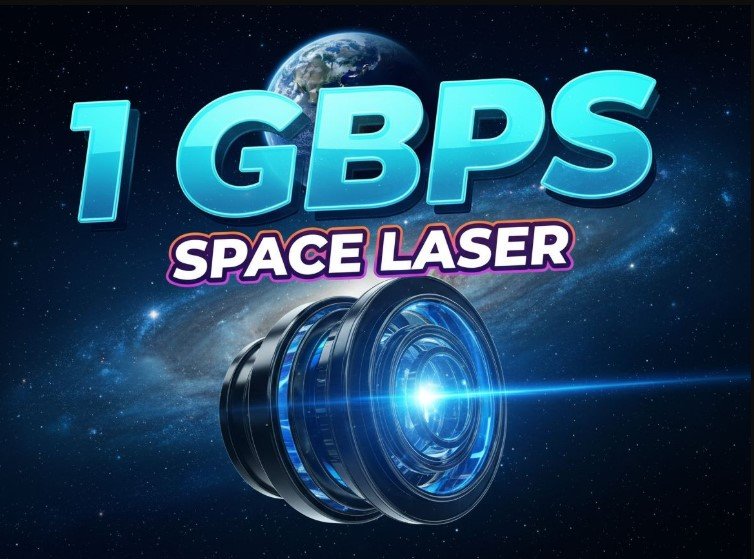
satellite laser communication system optical lens space internet technology
How Scientists Tamed the Turbulent Skies
Beaming a laser from space to the ground sounds perfect on paper. The reality is much messier. The atmosphere is full of obstacles like rain, clouds, smog and invisible turbulence that can scatter light. This is why most current satellite providers stick to radio waves which punch through clouds easily. Lasers usually fail when the weather turns bad.
The Chinese team solved this utilizing a new technology called AO-MDR synergy. This stands for Adaptive Optics and Multi-Aperture Digital Reception. Think of it as noise cancelling headphones but for light signals.
The Atmospheric Challenge vs. The Solution
| Challenge | Traditional Outcome | The New Solution (AO-MDR) |
|---|---|---|
| Atmospheric Turbulence | Signal scatters and data is lost. | Realigns light waves in real time. |
| Signal Fading | Connection drops or slows down. | Multiple sensors merge weak signals. |
| High Distance | Beam widens and loses intensity. | Telescopes refocus the beam effectively. |
They utilized a massive 1.8 meter telescope on the ground equipped with 357 tiny micro mirrors. These mirrors adjust thousands of times per second. They correct the distortion caused by the air before the data is processed. The team also split the laser beam into different channels.
This is where the genius lies. By splitting the signal, they created redundancy. If one part of the beam hit a pocket of turbulence, the other parts could still get through. Custom chips on the ground then stitched these fragmented signals back together. This method pushed the probability of getting a usable signal from a shaky 72 percent up to a reliable 91 percent.
Solving the Low Earth Orbit Traffic Jam
Space is getting crowded. Companies like SpaceX and Amazon are launching thousands of satellites into Low Earth Orbit (LEO). This is the region of space roughly 550 kilometers above us. While this proximity offers low latency, it creates two massive problems.
First, it creates a traffic jam that risks collisions and creates space debris. Second, it ruins the night sky for astronomers. Trails of bright satellites are now photobombing crucial scientific observations.
The Chinese experiment took a completely different approach. They parked their satellite in a much higher orbit. Their laser transmission came from approximately 36,000 kilometers away. This is known as a geostationary orbit.
Why High Orbit Matters:
- Less Congestion: There are far fewer objects at this altitude compared to the crowded LEO belts.
- Wider Coverage: A single satellite at this height can “see” nearly half the planet at once unlike LEO satellites that have a narrow view.
- Astronomy Friendly: Satellites at this distance are dimmer and move with the rotation of the Earth which causes less interference for telescopes.
The fact that they maintained a 1 Gbps connection from this extreme distance is the real news. Light loses intensity as it travels. Hitting a target from 36,000 kilometers away with a 2 watt laser is like hitting a bullseye on a dartboard from miles away while driving a car. It demonstrates a level of pointing accuracy that was previously thought to be impossible for commercial applications.
The Silent War for Future 6G Dominance
This technological victory is not just about faster downloads. It is a strategic move in the race for 6G supremacy. The next generation of global internet will likely rely on a hybrid of ground based towers and space based lasers. China is positioning itself to lead this infrastructure.
While Starlink currently relies on lasers to talk between its own satellites, it still uses radio waves to talk to your home dish. This creates a bottleneck. If China can commercialize direct laser to ground communication, they could bypass that bottleneck entirely.
NASA has also been experimenting with this technology. Their TBIRD project achieved incredible speeds of 200 Gbps recently. However, that was a raw data dump in a short burst. The Chinese demonstration focused on a sustained, reliable link using minimal power which is more applicable to everyday consumer internet needs.
The implications for the future are vast. We could see airplanes, ships and remote research stations getting fiber optic speeds without a single cable. It also suggests that the future internet infrastructure might move higher up into space. This would leave the lower orbits clear and reduce the risk of the Kessler Syndrome where space debris makes orbit unusable.
The competition is fierce. Western companies have the lead in launch capacity and rocket reusability. China is countering with advanced optical technologies and signal processing. The winner of this race will control the digital nervous system of the 21st century.
History shows us that competition drives innovation. As these superpowers vie for control of the stars, the people on the ground stand to benefit from faster, cheaper and more reliable connections. We are witnessing the end of the dial up era of space communication. The age of the space laser has officially arrived.


Orbio Closes $21M From Dawn Capital to Scale AI Frontline Agents

Honda’s Electric Trial Bike Lands in the Top Five at TrialGP Japan

GTA 6’s November Launch Is Reshaping the 2026 Game Calendar

Qorelo Lands $3.5M Seed to Tackle SAP’s 2027 Migration Crunch

Italian Edtech Sirius Game Raises €1.3M to Scale Primary School Play

Bestie Bite Raises €1.5M to Take AI Video Reviews to the US

European Tech’s €2.8B Week Came With a US Acquirer Twist
Rainn Wilson Calls Out Media’s Double Standard on Platner

OnePlus N6 Confirmed for June 30 India Launch as First N-Series Phone

Munich Court: Google Liable for False Answers in AI Overviews

Zcash Patched a Double-Spend Bug as ZEC Climbed 5%

Steam Summer Sale 2026 Locks In June 25 to July 9 Dates

Amazon Scraps Its Stargate Revival After a 20-Week Writers Room

Citigroup Says ETF Outflows Drove Bitcoin’s Crash, Not Strategy’s Sale

Coinbase Invests in Ethena, ENA Jumps 10% on Open-Market Buy

CLARITY Act Floor Vote Likely Shifts to August, Lummis Says

Gigaton Lands $26M to Replace Heavy Industry’s Control Stack

London AI Lab Inherent Raises $50m to Reinvent Science
Quobly’s €115M Bet to Scale Silicon Quantum Computing

SpaceX Frees 5% of IPO Shares While Locking Musk for a Year
-
FINANCE3 weeks ago
Zcash Patched a Double-Spend Bug as ZEC Climbed 5%
-
ENTERTAINMENT3 weeks ago
Steam Summer Sale 2026 Locks In June 25 to July 9 Dates
-
 NEWS1 month ago
Meta Adds AI Replies to Threads, But Users Can’t Block It
-
 ENTERTAINMENT1 month ago
‘Widow’s Bay’ Review: Apple TV’s Sleeper Horror-Comedy Earns Its Fog
-
ENTERTAINMENT3 weeks ago
Amazon Scraps Its Stargate Revival After a 20-Week Writers Room
-
FINANCE3 weeks ago
Citigroup Says ETF Outflows Drove Bitcoin’s Crash, Not Strategy’s Sale
-
FINANCE3 weeks ago
Coinbase Invests in Ethena, ENA Jumps 10% on Open-Market Buy
-
FINANCE3 weeks ago
CLARITY Act Floor Vote Likely Shifts to August, Lummis Says