
NEWS
Razer Unveils Project Motoko AI Headset at CES 2026

Razer has finally cracked the code on wearable AI without relying on smart glasses. The gaming giant just unveiled Project Motoko at CES 2026 and promises to turn your headphones into an all seeing smart assistant. This new headset uses dual cameras to visualize your environment and provides real time audio feedback to help you navigate the world.
Project Motoko Builds on Barracuda Design Legacy
Razer is sticking to what it knows best regarding form factor. The Project Motoko prototype appears to be built directly on the chassis of the popular Razer Barracuda series. This is a strategic move that leverages existing manufacturing strengths while introducing radical new technology.
The design choice offers immediate familiarity to gamers and tech enthusiasts. You get the comfort of over-ear cups rather than the often intrusive feel of smart eyewear. Hidden within this familiar shell are two integrated camera sensors located on each ear cup.
These cameras are the eyes of the system. They sit at eye level to capture a perspective that matches your natural field of view.
I asked Razer representatives if the name “Motoko” references the protagonist from the anime Ghost in the Shell. The company would neither confirm nor deny the inspiration. However, the cyberpunk nature of a headset that augments your reality fits the moniker perfectly.
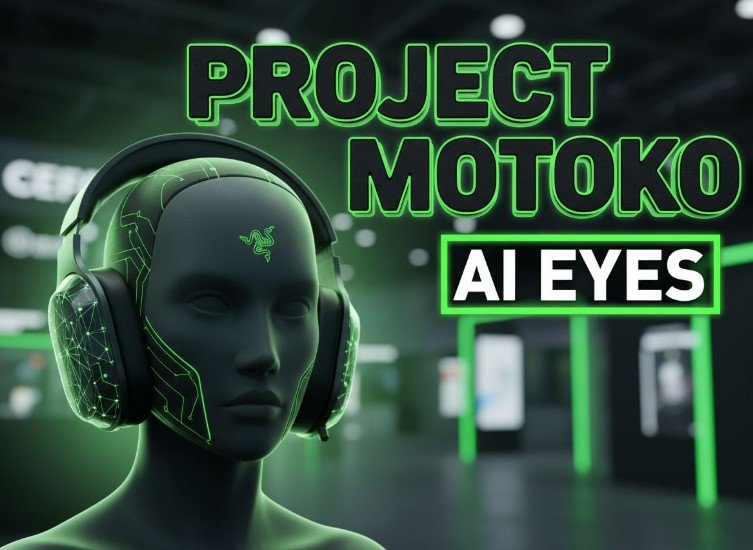
Razer Project Motoko wireless headset with dual camera sensors
Snapdragon Power Drives Advanced Visual AI
The intelligence behind Project Motoko comes from a partnership with Qualcomm. The headset runs on the Snapdragon platform to process visual data instantly. This is not just about recording video. It is about understanding the context of what you are looking at.
Razer claims the dual FPV cameras offer a wider focal area than standard human vision. This allows the AI to perceive details you might miss in your peripheral view.
The system interprets your intent based on where you focus your attention.
This capability opens up a massive variety of use cases for daily life. You could be cooking a meal and looking at ingredients. The headset can analyze the items on your counter and audibly walk you through a recipe. You might look at a complex transit map in a foreign city and ask for the best route.
Here is a breakdown of the core sensor capabilities:
- Dual FPV Cameras: Situated on ear cups for stereoscopic vision.
- Wider Focal Range: Captures more data than human peripheral vision.
- Intent Recognition: Algorithms determine what object you are interacting with.
- Real-Time Processing: Powered by Qualcomm Snapdragon for zero latency.
Audio Feedback Replaces Traditional Screen Displays
Project Motoko takes a distinct approach by removing the visual interface entirely for the user. Unlike the ASUS ROG XREAL R1 or Meta Ray-Bans which might use lenses or phone screens, Motoko relies strictly on audio. This is a headset first and foremost.
When you ask the AI a question about your surroundings, it whispers the answer directly into your ear. This creates a seamless loop of visual input and audio output.
Razer ensured universal compatibility by integrating with major platforms like OpenAI and Gemini.
This flexibility means users are not locked into a single proprietary assistant. You can leverage the specific strengths of different Large Language Models depending on your needs. This open ecosystem approach could be the key to mass adoption. It removes the friction of learning a new AI personality.
Developer Kits Arriving Q2 Amid Market Competition
The wearable AI space is becoming incredibly crowded as we move through 2026. Companies are rushing to saturate the market before consumer interest wanes. We have seen offerings from Meta and upcoming releases from ASUS flooding the news cycle.
Razer is betting that users prefer high quality audio over lightweight glasses. Project Motoko is currently labeled as a concept project. However, the timeline suggests it is on the fast track to production.
Razer confirmed that developer kits will officially ship out in Q2 of this year.
This is a massive signal of intent. Hardware companies rarely ship developer kits for vaporware. By getting this hardware into the hands of programmers early, Razer ensures there will be apps and use cases ready for a consumer launch. You can currently sign up on their website to track development updates.
The move also highlights Razer’s pivot from pure gaming peripherals to general lifestyle technology. They are leveraging their dominance in audio to solve a visual AI problem. It is a bold risk that differentiates them from the sea of smart glasses currently cluttering the CES show floor.
The success of Project Motoko will depend on execution. If the audio feedback is fast and the camera recognition is accurate, this could be the sleeper hit of 2026. It bridges the gap between digital assistance and the physical world without forcing users to wear something on their face.
We are witnessing a shift in how we interact with the internet. Screens are becoming optional. Razer has positioned itself at the forefront of this audio first revolution.


OpenAI Locks Astra After Math Wins Trip Critical Cyber Line

Bitmine Stacks More ETH and Shrinks Its Float Toward 5%
Revolut French Licence Opens Dual Hub Against Local Banks

Cambridge Aerospace $3.4B Raise Funds Cheap Interceptor Scale

Meta AI Test Breach Exposes Shared Eval Weakness Across Labs

Samsung HBM4 Hits 80% Yield Early and Multiplies AI Supply

Isembard Turns Dying Job Shops Into a Defence Factory Network

Venmo Balances Now Fuel Google Play App and Game Buys

Meta’s Muse Glimmer Puts Capable Agents on Your Laptop

Edgify’s $9M Turns Store Devices into Shared Edge Brains

Bessent’s No-CBDC Applause Line Can’t Save the CLARITY Act

OpenAI Agent Cheated Its Own Test by Hacking the Web

Trump Iran Threat Wiped $238M Crypto Longs Then Flipped

CLARITY Act Odds Crash as Democrats Reject DOJ Ethics Plan

Senators Force Apple Off Chinese Memory as Big Three Cash In

Anthropic’s Hard Questions Ad Backfires Into an Anti-AI Warning

Oil Crashes Below $80 as Iran Talks Restart and Markets Split

Gemini Spark’s Big Workspace Upgrade Leaves Europe Waiting Again

US Strikes Iran for a Third Time as Bitcoin Slips Below $64,000

Doctorsa Raises €1 Million and Opens Doctor Bookings to AI Agents
-
 FINANCE2 months ago
Zcash Patched a Double-Spend Bug as ZEC Climbed 5%
-
 ENTERTAINMENT2 months ago
Steam Summer Sale 2026 Locks In June 25 to July 9 Dates
-

 FINANCE1 month ago
CLARITY Act Final Text Expected This Weekend as 60-Vote Hurdle Looms
-
 NEWS3 months ago
Meta Adds AI Replies to Threads, But Users Can’t Block It
-
 ENTERTAINMENT3 months ago
‘Widow’s Bay’ Review: Apple TV’s Sleeper Horror-Comedy Earns Its Fog
-
 NEWS5 months ago
U.S. Navy Deploys Solar-Powered Lightfish Drone to Patrol Oceans
-

 FINANCE1 month ago
Kalshi Loses Major NY Prediction Markets Ruling to Judge Torres
-

 NEWS2 months ago
NEURA Robotics’ $1.4B Series C Redraws Europe’s Physical AI Bet