
NEWS
Qualcomm’s 2nm Samsung Talks Squeeze Galaxy’s Exynos Chips
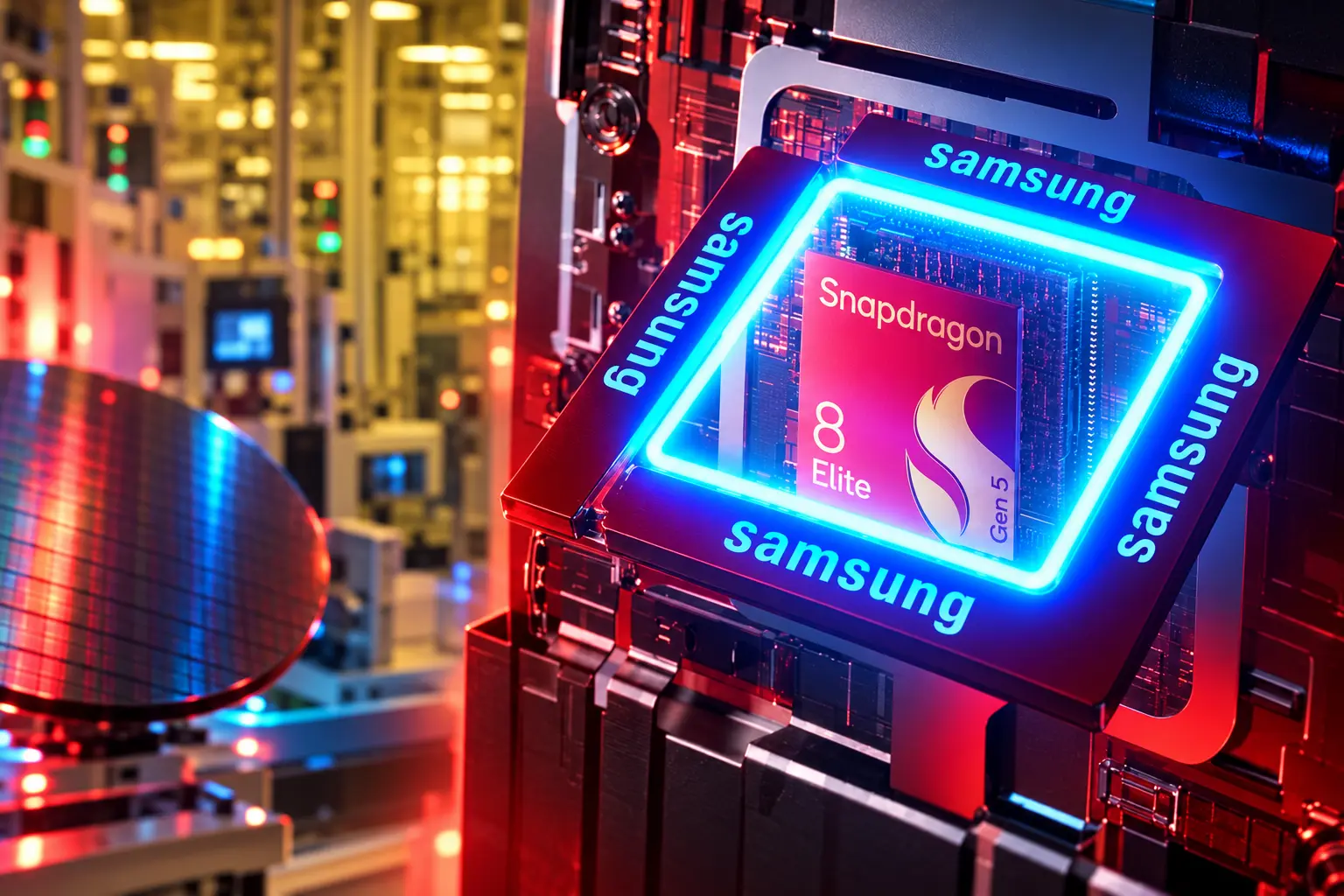
Qualcomm is swapping 2nm wafers with Samsung Foundry and wants every Galaxy S27 chip, a move that helps the fab and crowds Exynos.

Qualcomm is already swapping 2nm test wafers with Samsung Foundry, months after its chief said the design work was done. The mobile order still looks like a slice, not a foundry switch.
The quieter fight sits inside Samsung. Foundry wants Qualcomm silicon on its line. System LSI wants Exynos to keep a share of Galaxy. Qualcomm has told investors it wants that share back.
Wafers Are Already Moving at Hwaseong
Qualcomm chief executive Cristiano Amon sat down with a Korean reporter at CES 2026 on January 6 and put the foundry talks on the record. He did not name a Snapdragon SKU, a start date, or a split with TSMC. He did say the paper design was finished and that silicon had started to move.
Among many foundry companies, we have started discussions with Samsung Electronics for contract manufacturing using the latest 2-nanometer process. We have also completed the design work with the goal of commercialisation soon.
Cristiano Amon, Chief Executive, Qualcomm, CES 2026
In the same conversation he said the two companies had completed 2nm chip design and were exchanging wafers to tweak performance. That is further along than a slide-deck meeting. A tape-out is not a purchase order, but it is not a rumor mill item either.
Amon flew to Seoul in April 2026 and met Han Jin-man, president of Samsung Electronics’ Foundry Business, along with executives at SK hynix and LG Electronics. Memory supply was on the agenda as Qualcomm readies AI accelerators. So was the next Snapdragon on Samsung’s 2nm line.
The chip identity is still messy. Early Korean accounts pointed at a 2nm version of the Snapdragon 8 Elite Gen 5, the part TSMC already makes on 3nm for this year’s flagships. Later notes shifted to the Snapdragon 8 Elite Gen 6 class due at Snapdragon Summit. Qualcomm has not named the SKU in public.
A 10 Percent Slice of One Korean Line
Korean industry figures circulating in January put the first Qualcomm lot on a corner of Hwaseong S3, not on the new Texas plant. The math is small next to an AI foundry book, and that is the point.
THE HWASEONG SLICE
| Item | Figure |
|---|---|
| Hwaseong S3 capacity | 20,000 12-inch wafers a month |
| Reported Qualcomm share | 10 percent |
| Wafers for Qualcomm | 2,000 a month |
| Samsung 2nm wafer price | $20,000 (about 29 million won) |
| Implied annual take | About 690 billion won |
| Share of foundry sales | About 4 percent of 17 trillion won |
Those numbers are industry estimates, not a filing. They still show the shape of the deal Samsung can sell: a prestige mobile logo, a yield-learning lot, and a few percent of foundry revenue. They do not show TSMC losing the Snapdragon franchise.
Samsung has been running Samsung Foundry 2nm GAA logic nodes for its own Exynos 2600, which already ships as the first 2nm phone chip in parts of the Galaxy S26 family and in Galaxy Z Flip8 units outside the United States. Qualcomm would be a third-party customer on a node Samsung first proved on its own AP. That is useful for the foundry pitch. It is also how Exynos loses its private track.
Why TSMC’s Price Opened the Door
Qualcomm executives walked through the Samsung talks at a KeyBanc investor meeting in January. They did not describe a religious conversion to Korean yields. They listed three commercial reasons, and cost sat in the middle.
THREE REASONS QUALCOMM GAVE INVESTORS
- Second source: Cut the company’s dependence on TSMC for leading-edge phone silicon.
- Wafer cost: TSMC told customers it would lift prices on 3nm-and-below wafers by 15 percent a year for four years, while Samsung was pitching wafers more than 10 percent cheaper.
- Galaxy leverage: Samsung prefers chips built in its own fabs, so a foundry order can be used to sell more Snapdragon parts into Galaxy phones.
TSMC’s own N2 volume production in late 2025 is the backdrop. N2 is the firm’s first nanosheet node, sold as a full-node step of about 15 percent more speed or 30 percent less power than its 3nm class, and early output has been spoken for by Apple and a short list of CPU and accelerator customers. Qualcomm can still buy TSMC 2nm. It cannot assume the price or the slot it wants.
That is why a 10 percent Korean overlay can make sense even if TSMC keeps the volume. Samsung gets a logo. Qualcomm gets a second quote and a bargaining chip inside Samsung’s phone group.
The Hangover From Snapdragon 8 Gen 1
Anyone who bought a 2022 Android flagship remembers why this conversation is cautious. Qualcomm last used Samsung for a top Snapdragon in 2021, on the 4nm Snapdragon 8 Gen 1. Phones ran hot. Sustained clocks fell over. In May 2022 Qualcomm moved the mid-cycle Snapdragon 8+ Gen 1 to TSMC and claimed 10 percent more CPU speed, 10 percent more GPU speed, and 30 percent better power use. It then kept flagship Snapdragon production in Taiwan through the 8 Gen 2, 8 Gen 3, 8 Elite, and 8 Elite Gen 5 generations.
THE FOUNDRY SPLIT SINCE 2021
- 2021: Samsung Foundry makes Qualcomm’s last flagship phone AP, the Snapdragon 8 Gen 1, on 4nm.
- May 2022: Qualcomm ships the Snapdragon 8+ Gen 1 from TSMC and stays there for flagship Snapdragon parts.
- 2023: Galaxy S23 Ultra goes Snapdragon worldwide, still on TSMC silicon.
- July 24, 2025: Samsung files a 22.7648 trillion won foundry supply deal through December 31, 2033, later confirmed as Tesla.
- January 6, 2026: Amon says 2nm design with Samsung is done and wafers are moving.
- April 2026: Amon meets Han Jin-man in Seoul. Korean industry sources put average 2nm yield around 55 percent, under a 60 percent mass-production rule of thumb.
- July 22, 2026: Galaxy Z Fold8 and Fold8 Ultra launch on Snapdragon 8 Elite Gen 5 for Galaxy, with no public confirmation that the die is Samsung 2nm.
The heat hangover still sits in the replies whenever a “Qualcomm dumps TSMC” headline lands. People reach for the Snapdragon 888 and 8 Gen 1 years and assume a Samsung lot means another summer of throttling. Price is the cleaner read of Qualcomm’s own investor remarks. Memory of 2022 is why the first lot is a slice.
April’s yield talk is the other brake. A process that yields in the mid-50s can run. It is a hard sell as the sole source for a global phone chip. Han has said Samsung can grow 2nm yields by running major-customer lots, which is another way of saying Qualcomm would be paying tuition as well as wafer invoices.
Exynos Pays If Foundry Wins
Samsung is three businesses in this story, and they do not want the same outcome. Foundry needs outside 2nm volume. The phone group needs working flagship chips on time. System LSI needs Galaxy sockets for Exynos, or the in-house AP becomes a science project.
Qualcomm already supplies about 75 percent of Galaxy S26 application processors, with Exynos taking the other 25 percent. A Qualcomm official told the KeyBanc meeting the company hopes to take 100 percent of Galaxy S27, the way it did on Galaxy S25. The tool for that, in the same briefing, was the 2nm foundry order. Samsung likes dies from its own plants. If Snapdragon is one of those dies, the phone group has a reason to spread it wider.
That is a direct hit on Exynos 2600, which System LSI designed and Foundry makes on 2nm for S26 standard and Plus units in many regions and for Flip8 outside the United States. If Foundry’s best 2nm capacity goes to a paying external customer, internal Exynos lots compete for the same tools. Foundry bosses have a habit of ranking the customer who brings a purchase order over the sibling division that brings a transfer price.
The Galaxy Z Fold8 series, announced on July 22, 2026 and put on sale from August 7, did not settle this. Fold8 and Fold8 Ultra use Snapdragon 8 Elite Gen 5 for Galaxy worldwide. Flip8 uses that Snapdragon chip in the United States and Exynos 2600 elsewhere. Nobody from Qualcomm or Samsung has said those Snapdragon units are the 2nm Hwaseong lot. “For Galaxy” has usually meant a binned, clocked TSMC part. The mid-year foldables were not the public debut of Samsung-made Snapdragon 2nm.
Park Yu-ak, an analyst at Kiwoom Securities, has pointed to HBM base-die volume as the nearer earnings lift for Foundry and System LSI this year. Phone APs are the political chips. Memory silicon is the cash.
Tesla Booked Texas Before Qualcomm Called
If the question is who actually filled Samsung’s 2nm future, the answer is not Qualcomm. On July 28, 2025, Samsung Electronics disclosed a foundry supply contract worth 22.7648 trillion won ($16.5 billion), equal to 7.6 percent of 2024 sales of 300.9 trillion won, running from July 24, 2025 through December 31, 2033. Elon Musk then wrote that Samsung’s new Texas plant would be dedicated to Tesla’s next AI6 chip. Tesla already buys AI4 from Samsung. AI5 is dual-sourced with TSMC. AI6 is the long Samsung book.
The Taylor fab already fully booked its first 2nm shell before production starts, according to Korean industry accounts tied to Tesla’s AI5 and AI6, Broadcom communications chips, and Arm smart-device AI parts. Initial capacity is put at 50,000 wafer starts a month, trial operations as early as late September or early October, and mass production in 2027. Qualcomm’s rumored 2,000 wafers a month at Hwaseong is one twenty-fifth of that Texas shell. Samsung has spent about $37 billion on Taylor since 2022.
Samsung’s published SF2 pitch against SF3 was 12 percent more performance, 25 percent less power, and 5 percent less area. Foundry also told investors in its third-quarter 2025 results that customer orders on advanced nodes hit a record and that 2nm GAA products would ramp in the fourth quarter, with Taylor due to start on time in 2026. Google TPU I/O die work, AMD 2nm talks, and OpenAI’s later foundry outreach all sit in that same overflow story: TSMC’s leading-edge book is tight, and Samsung is taking the lots that will not wait.
WHAT WE KNOW
- Wafers: Amon said 2nm design with Samsung is done and wafers are being exchanged for performance changes.
- Tesla: The 22.7648 trillion won filing through December 31, 2033 is a signed foundry supply deal Musk tied to AI6 at Taylor.
- S26 split: Qualcomm has about 75 percent of Galaxy S26 APs; Exynos holds about 25 percent.
WHAT IS UNCONFIRMED
- The SKU: No public Qualcomm document names Snapdragon 8 Elite Gen 5, an 8s part, or Gen 6 as the Samsung 2nm chip.
- The contract: There is no Samsung disclosure equivalent to the Tesla filing for a Qualcomm 2nm AP order.
- Fold8 silicon: Snapdragon 8 Elite Gen 5 for Galaxy in the Z Fold8 series has not been identified as Hwaseong 2nm.
April yield estimates around 55 percent are the live risk on every one of those unconfirmed items. A customer can swap test wafers at 55 percent. A customer does not usually park a global phone SKU there.
Maui Will Show How Big the Order Is
Snapdragon Summit is set for September 22 to 24 in Maui. Qualcomm has already dripped the next Oryon CPU, including a 5GHz mobile claim, a new Adreno GPU, and the next Hexagon NPU, instead of holding the whole reveal for Hawaii. Leak tallies point at a Snapdragon 8 Elite Gen 6 and a Gen 6 Pro, both discussed as 2nm parts, with the Pro on LPDDR6. None of those teasers names a foundry.
If Amon uses the stage to say Samsung is a 2nm Snapdragon source, Foundry gets the logo it has chased since 2022 and Exynos faces a 2027 Galaxy map with less room. If he stays with architecture and leaves the fab unnamed, the January wafer swap remains a hedge: a cheap second quote against TSMC’s 2nm price path, and a bargaining chip with Samsung’s phone group that has not yet become a line item.
The Texas plant will still open around Tesla, Broadcom, and Arm. Qualcomm’s 2nm conversation with Samsung is about who puts the application processor in the next Galaxy Ultra, and whether System LSI still gets a vote.

UPI MDR Delay Hands Traders the Calendar After Paytm Falls

Google Messages Builds Nine In-Chat Games After Samsung’s Exit

Anthropic’s $100 Million Academy Trains the Firms That Bill Both Sides

Toyota’s Electric C-HR Leaves the Cheap Twin to Subaru

Markets Bet the Fed Skips October After Hawkish Minutes

The Orchard Bug Forced Zcash to Open an Empty Pool

The $5.99 Game That Won Steam’s 2026 Summer Sale

Don Lee Joins Hemsworth as Extraction 3 Starts Shooting

YouTube Shorts Retires Dislikes and Swaps Likes for Hearts

NEURA Robotics Is Spending Its $1.4B on a Machine Stack
-
 NEWS5 months ago
The Orchard Bug Forced Zcash to Open an Empty Pool
-
 GAMING5 months ago
The $5.99 Game That Won Steam’s 2026 Summer Sale
-
 ENTERTAINMENT7 months ago
Don Lee Joins Hemsworth as Extraction 3 Starts Shooting
-
 NEWS5 months ago
YouTube Shorts Retires Dislikes and Swaps Likes for Hearts
-
 NEWS4 months ago
NEURA Robotics Is Spending Its $1.4B on a Machine Stack
-

 NEWS5 months ago
Atlantic City Turned WWE’s Return Into a Civic Night
-

 AUTO6 months ago
Kawasaki Bets the New Z1100 Against Its Own Supercharger
-
 BUSINESS5 months ago
Norway’s Export Bank Backs Nscale’s $790 Million Narvik Loan