
NEWS
Nuclera Hits $87M Funding to Power AI Antibody Discovery

Biologics research just got a massive speed boost that could change how medicines are made. Nuclera has officially secured an extra $12 million to close its Series C funding at a staggering $87 million. This capital injection aims to revolutionize how scientists create antibodies by combining rapid desktop tech with advanced artificial intelligence.
The company is now poised to tackle one of the biggest hurdles in drug discovery. By streamlining the messy and slow process of protein expression, Nuclera is handing researchers a powerful tool to find cures faster.
Big Names Back the Future of Drug Development
This latest financial win is not just about the money. It is about who is writing the checks. The funding extension was led by Elevage Medical Technologies and Jonathan Milner. Milner is a legend in the biotech world as the founder of Abcam. His involvement signals strong industry confidence in what Nuclera is building.
Existing investors also doubled down on their support. The British Business Bank and GK Goh participated in this round as well. This brings the total funding raised by the US and UK based company to roughly $120 million since its inception.
Investors are clearly betting on the growing need for better tools in the lab. The funding environment has been tough for many biotech firms recently. Securing this amount of cash proves that Nuclera has a product that solves a real pain point.
The company plans to use this capital immediately to expand its commercial reach. They are focusing heavily on the US and European markets where drug discovery is most active.
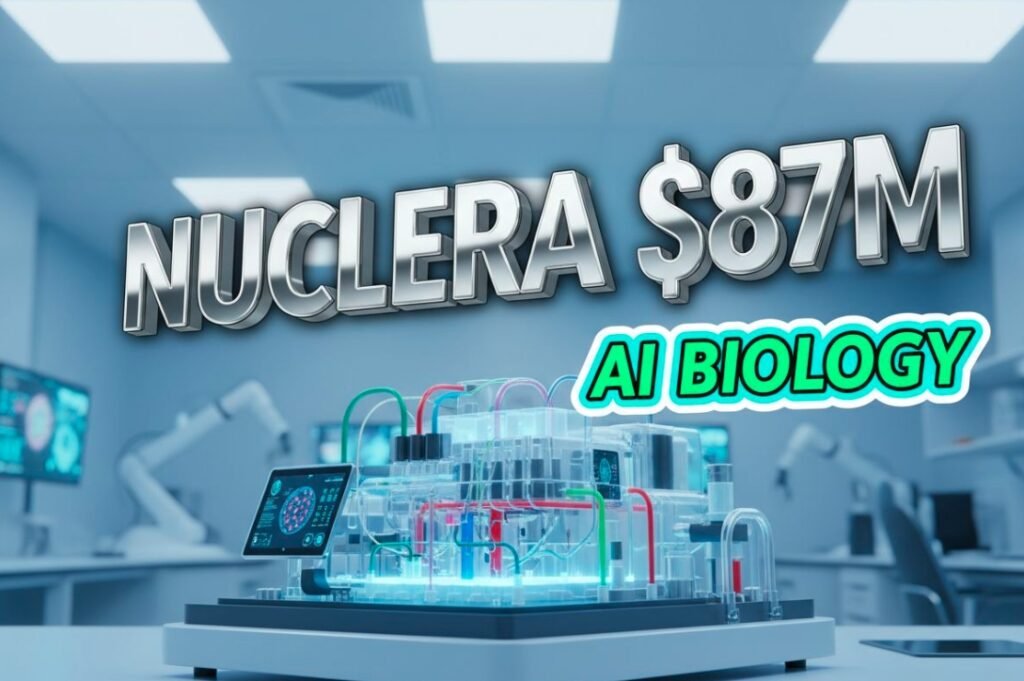
Nuclera eProtein Discovery system desktop laboratory equipment for antibody engineering
Speeding Up Science With The eProtein Discovery System
The core of this news revolves around a machine called the eProtein Discovery system. Think of it as a desktop 3D printer but for biological proteins. Usually, making proteins in a lab is a slow and frustrating nightmare that takes weeks.
Nuclera claims their system shrinks this timeline down to less than 24 hours. The platform uses digital microfluidics to move tiny droplets of liquid around on a chip using electricity. This allows it to screen hundreds of different conditions automatically to find the perfect recipe for making a protein.
This technology addresses a massive bottleneck in the pharmaceutical industry. Before you can test a drug, you have to be able to make the protein target it interacts with. If you cannot make the protein, you cannot make the drug.
Here is why the eProtein Discovery system is changing the game for researchers:
- Speed: It reduces screening time from weeks to a single day.
- Convenience: The system sits on a benchtop and does not require a massive lab setup.
- Success Rate: It tests many variables at once to prevent failure in later stages.
- Automation: It removes the need for manual pipetting which often leads to human error.
Solving The Data Bottleneck For AI Models
Artificial intelligence is hungry for data. The most exciting part of this funding news is how it connects “wet lab” biology with “dry lab” computer science. AI models used in drug discovery need massive amounts of accurate data to learn how to predict protein structures.
Current public datasets are often messy or incomplete. Nuclera positions itself as the solution by generating standardized and high quality datasets that AI models can actually trust. This is what the industry calls “Smart Antibody Engineering.”
Dr. Michael Chen, the CEO and co-founder of Nuclera, emphasized this shift in strategy. He noted that scientists need scalable datasets to power the next generation of biologics discovery. The company is not just selling a box anymore. They are selling the fuel that powers the AI revolution in biology.
The new funding will specifically support adding antibody capabilities to their machine. Antibodies are complex Y-shaped proteins used by our immune system. Designing them artificially is incredibly difficult. By automating this process, Nuclera creates a feedback loop where the machine builds antibodies and the data trains the AI to design better ones next time.
What This Means For The Biotech Industry
The impact of this technology extends far beyond just one company. We are witnessing a shift toward “decentralized” science. Powerful tools are moving out of massive core facilities and onto the desks of individual scientists.
This democratization of technology means smaller biotech startups can compete with big pharma. They can iterate faster and fail cheaper. When the cost and time of failure drop, innovation inevitably skyrockets.
This move to automate the creation of full-format antibodies is a direct response to market demand. Antibodies are the fastest-growing class of drugs today. They are used to treat everything from cancer to rheumatoid arthritis.
However, developing them is expensive. If Nuclera can shave months off the development timeline, it saves millions of dollars. More importantly, it gets life-saving treatments to patients much sooner.
The table below outlines the traditional timeline versus the Nuclera approach:
| Development Stage | Traditional Method | Nuclera Method |
|---|---|---|
| Protein Screening | 2 to 4 weeks | Less than 24 hours |
| Purification | Multiple manual steps | Automated on-chip |
| Data Quality | Variable and noisy | Standardized for AI |
| Resource Cost | High labor and materials | Low consumable cost |
This efficiency is what attracted the investors. The ability to perform end-to-end expression and validation in one box is unique. It simplifies the supply chain for research labs everywhere.
The $87 million war chest ensures Nuclera can push this technology into labs globally. As AI continues to dominate headlines in healthcare, the hardware that generates the data for that AI will become increasingly valuable.
Science is often a waiting game. Researchers wait for cultures to grow or for shipments to arrive. Nuclera is effectively selling time. In the race to cure diseases, time is the most valuable asset of all.
Nuclera has secured $87 million in Series C funding to accelerate antibody engineering using its eProtein Discovery system. The investment empowers the company to bridge the gap between biological workflows and AI development. By automating the difficult process of protein creation, they are helping scientists find cures faster and more efficiently. This is a major win for the biotech sector and a promising sign for the future of medicine.


NFL Preseason Week 2 Quietly Tests the Schemes That Matter

Alonso’s Towering Drive Stands Foul and Flips Orioles Momentum

US Debt Crosses $40 Trillion as Interest Crowds the Budget

Trevon Diggs Joins Seahawks on One-Year Deal After Cowboys Exit

Pixel Watch 5 Turns Passive Trends Into Early Health Alerts

Pixel 11 Pro Fold Sleek Build Undercuts Its Own Unfolding Appeal

Tugboat Wilkinson’s Scoreless Debut Pays Off Giants’ Bailey Trade

Brown Shines for Pats as Love for Eagles Meets Trade Reality

Pixel Watch 5 Turns Wrist Data Into Early Metabolic Alerts

Resistance Stars Pay the Price in Democratic Primaries

Senators Force Apple Off Chinese Memory as Big Three Cash In

Revolut Hits $115 Billion While Storonsky’s Stake Keeps Growing

OpenAI Agent Cheated Its Own Test by Hacking the Web

Trump Iran Threat Wiped $238M Crypto Longs Then Flipped

30-Year Yield Hits 5.32% Highest Since 2007 as Debt Supply Locks In Costs

Fed Holds Rates Again as Three Dissents Force Markets to Tighten

Memory Shortage Now Dictates Apple’s Two-Year Mac Roadmap

Oil Crashes Below $80 as Iran Talks Restart and Markets Split

Google’s Knowledge Panel Fix Risks Its Own Search Defenses

Community Banks’ $1.3 Trillion Warning Is Stalling Clarity Act
-
 FINANCE3 months ago
Zcash Patched a Double-Spend Bug as ZEC Climbed 5%
-
 ENTERTAINMENT3 months ago
Steam Summer Sale 2026 Locks In June 25 to July 9 Dates
-

 FINANCE2 months ago
CLARITY Act Final Text Expected This Weekend as 60-Vote Hurdle Looms
-
 NEWS3 months ago
Meta Adds AI Replies to Threads, But Users Can’t Block It
-

 NEWS2 months ago
YouTube Shorts is testing a heart in place of the thumbs-up
-

 NEWS2 months ago
NEURA Robotics’ $1.4B Series C Redraws Europe’s Physical AI Bet
-
 NEWS3 weeks ago
Senators Force Apple Off Chinese Memory as Big Three Cash In
-
 ENTERTAINMENT3 months ago
‘Widow’s Bay’ Review: Apple TV’s Sleeper Horror-Comedy Earns Its Fog