
BUSINESS
Bitcoin Defies Gravity as Hot Producer Price Data Shakes US Economy

Wall Street woke up to a rude awakening this morning. Inflation is not dead, it is arguably waking up from its nap with a vengeance. The latest government data shows prices at the factory level are surging faster than anyone anticipated.
Usually, this kind of news sends risky assets into a tailspin. But the crypto market is playing by its own rules today. While economists panic over rising costs, Bitcoin has blasted through a massive resistance level. The digital asset has climbed firmly above the psychological $95,000 mark. This divergence between traditional economic logic and crypto market reaction marks a pivotal moment for investors worldwide.
A Nasty Surprise in the Inflation Data
The Bureau of Labor Statistics released the Producer Price Index (PPI) for November, and the numbers are ugly. The report shows that wholesale inflation rose to 3% year over year. This is significantly higher than the 2.7% Wall Street experts had predicted.
This metric is crucial because it measures inflation at the wholesale level before it reaches consumers. When companies pay more to make goods, they eventually pass those costs on to you at the checkout line.
Even more concerning is the “Core” PPI data. This reading strips out volatile food and energy prices to give a clearer picture of the underlying trend. Core PPI jumped to 3.5%, smashing the estimated 2.7%.
Here is a breakdown of the key numbers released today:
| Metric | Expected | Actual | Status |
|---|---|---|---|
| Headline PPI (YoY) | 2.7% | 3.0% | Hot |
| Core PPI (YoY) | 2.7% | 3.5% | Very Hot |
| Headline PPI (MoM) | 0.2% | 0.2% | In Line |
The data indicates that inflation is sticky. It refuses to go down to the Federal Reserve’s 2% target. This suggests that the cost of doing business in America is rising rapidly.
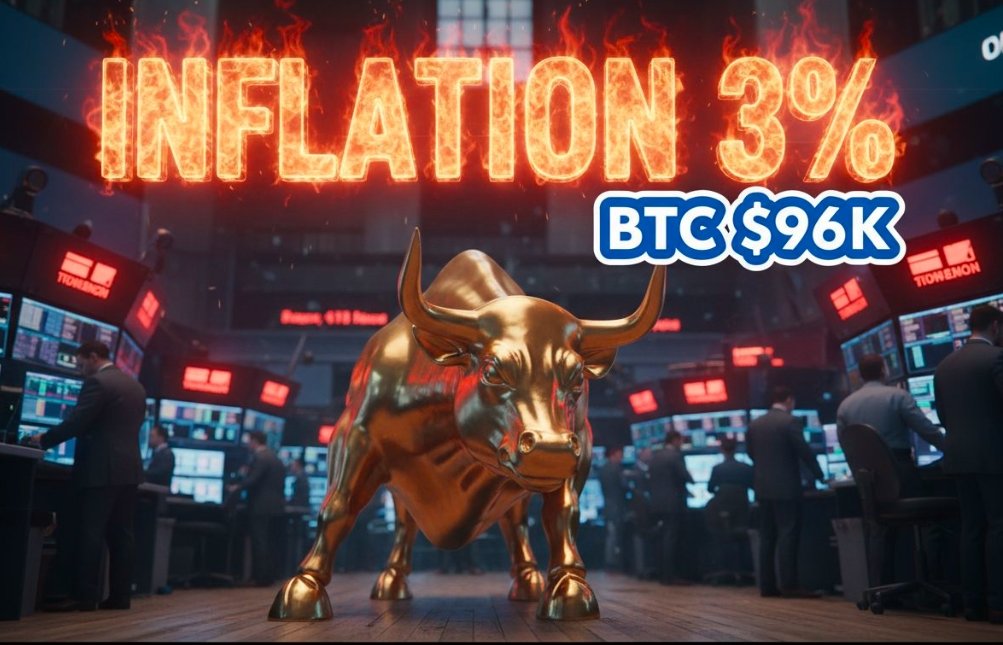
bitcoin price chart rising against inflation data background
Bitcoin Acts as the Ultimate Hedge
Logic dictates that high inflation forces the Federal Reserve to keep interest rates high. High rates usually hurt assets like stocks and crypto because they make borrowing money expensive. Yet, Bitcoin did the exact opposite of what traditional finance textbooks suggest.
The flagship cryptocurrency surged past $95,000 immediately after the bad news dropped. At the time of writing, Bitcoin is trading around $95,500 and looks ready to challenge the $96,000 level again.
Why is this happening?
Investors are viewing this hot inflation data as a warning sign for the US dollar. If inflation is rising, the purchasing power of the dollar is falling. Institutional investors are treating Bitcoin as “digital gold” to protect their wealth from currency devaluation.
We are seeing a massive flight to safety. But unlike in previous decades, safety does not just mean Treasury bonds anymore. It means scarce digital assets. The massive inflows into Spot Bitcoin ETFs over the last few weeks confirm that Wall Street giants are buying the dip aggressively.
The Fed is Between a Rock and a Hard Place
This PPI report is a nightmare for Federal Reserve Chair Jerome Powell. The central bank has been trying to engineer a “soft landing” where inflation comes down without crashing the economy.
Recent Consumer Price Index (CPI) data gave them some hope. It came in at 2.7%, which was respectable. But this new PPI data contradicts that narrative entirely. It signals that price pressures are building up in the supply chain pipeline.
- The Problem: If the Fed cuts rates now, they risk sending inflation spiraling out of control again.
- The Risk: If they keep rates high to fight inflation, they risk breaking the labor market and stalling growth.
- The Reality: The market is starting to price in a “higher for longer” rate environment.
Fed officials have previously warned that new tariffs and geopolitical tensions could keep prices high. Those warnings are now becoming reality. The discrepancy between the CPI and PPI suggests we are entering a volatile period where economic signals are mixed and confusing.
What This Means for Your Portfolio
The divergence between the stock market and the crypto market offers a valuable lesson. Diversification is no longer optional. It is a survival requirement.
Traditional stocks may struggle in the short term as companies deal with higher input costs. Profit margins could shrink. If companies cannot pass these higher costs to consumers, their stock prices will likely take a hit.
On the other hand, commodities and hard assets are shining. Bitcoin breaking $95,000 is not just a trading anomaly. It is a vote of no confidence in the central bank’s ability to control the currency.
“The market is realizing that the Fed might be trapped. When money loses value, people buy things that cannot be printed. That is the Bitcoin thesis playing out in real time.”
Investors should watch the $96,000 level closely. If Bitcoin can turn that resistance into support, the path to $100,000 becomes very clear. However, volatility will remain high. The next major catalyst will be the December PPI report released on January 30. Until then, expect choppy waters in traditional finance and continued aggressive accumulation in the crypto sector.
The era of easy money is over. The era of volatile inflation is back. Protect your buying power accordingly.
Summary: The US economy was hit with a hotter-than-expected inflation report today, with Producer Price Index rising to 3%. While this typically hurts markets, Bitcoin defied expectations by rallying past $95,000. Investors are increasingly using the cryptocurrency as a hedge against the devaluing dollar and sticky inflation. The Federal Reserve now faces a difficult challenge in balancing interest rates, leaving the traditional economy in a precarious spot while digital assets thrive.
We want to hear from you. Do you think Bitcoin will hit $100k before the end of the year, or will inflation drag it back down? Share your thoughts on X (formerly Twitter) using the hashtag #BitcoinInflationHedge and tag us in your predictions.


NFL Preseason Week 2 Quietly Tests the Schemes That Matter

Alonso’s Towering Drive Stands Foul and Flips Orioles Momentum

US Debt Crosses $40 Trillion as Interest Crowds the Budget

Trevon Diggs Joins Seahawks on One-Year Deal After Cowboys Exit

Pixel Watch 5 Turns Passive Trends Into Early Health Alerts

Pixel 11 Pro Fold Sleek Build Undercuts Its Own Unfolding Appeal

Tugboat Wilkinson’s Scoreless Debut Pays Off Giants’ Bailey Trade

Brown Shines for Pats as Love for Eagles Meets Trade Reality

Pixel Watch 5 Turns Wrist Data Into Early Metabolic Alerts

Resistance Stars Pay the Price in Democratic Primaries

Senators Force Apple Off Chinese Memory as Big Three Cash In

OpenAI Agent Cheated Its Own Test by Hacking the Web

Trump Iran Threat Wiped $238M Crypto Longs Then Flipped

Fed Holds Rates Again as Three Dissents Force Markets to Tighten

30-Year Yield Hits 5.32% Highest Since 2007 as Debt Supply Locks In Costs

Oil Crashes Below $80 as Iran Talks Restart and Markets Split

Google’s Knowledge Panel Fix Risks Its Own Search Defenses

Tillis Ethics Push Gives Clarity Act One Last Shot Before Recess

Agon Raises $30M to Build Europe’s AI Weapon Training Arenas

Legora Buys Wexler Fact Engine as Fifth 2026 Deal
-
 FINANCE3 months ago
Zcash Patched a Double-Spend Bug as ZEC Climbed 5%
-
 ENTERTAINMENT3 months ago
Steam Summer Sale 2026 Locks In June 25 to July 9 Dates
-

 FINANCE2 months ago
CLARITY Act Final Text Expected This Weekend as 60-Vote Hurdle Looms
-
 NEWS3 months ago
Meta Adds AI Replies to Threads, But Users Can’t Block It
-

 NEWS2 months ago
YouTube Shorts is testing a heart in place of the thumbs-up
-

 NEWS2 months ago
NEURA Robotics’ $1.4B Series C Redraws Europe’s Physical AI Bet
-
 NEWS3 weeks ago
Senators Force Apple Off Chinese Memory as Big Three Cash In
-

 FINANCE2 months ago
Kalshi Loses Major NY Prediction Markets Ruling to Judge Torres