
NEWS
Biorce’s $52.5 Million Bet on Faster Trial Protocols
European software founders and DST Global Partners funded Biorce’s $52.5 million Series A to stop costly trial protocol amendments.

Biorce closed a $52.5 million Series A on February 2, 2026, which it called the largest Series A yet in Iberian healthtech and AI. The Barcelona company sells Aika, software that drafts and scores clinical trial protocols so sponsors spend less time changing them after a study has started.
DST Global Partners joined as a new investor. Norrsken VC, YZR Capital, Mustard Seed Maze, and Endeavor Catalyst took part, and so did a cluster of European software founders who do not usually write checks into trial operations.
The Largest Iberian Healthtech Series A Yet
The company said the new round pushed its total funding above $60 million, after two earlier raises that it had stacked in euros. It also said it finished 2025 at about 200% above its revenue target, a claim it did not tie to a published target number.
BIORCE FUNDING ROUNDS
| Round | Date | Amount | Who put money in |
|---|---|---|---|
| Seed | November 2024 | €3.5 million | YZR Capital and Mustard Seed Maze, with other early funds |
| Extension | July 2025 | €5 million | Norrsken VC |
| Series A | February 2, 2026 | $52.5 million | DST Global Partners as a new investor, plus returning funds |
Those three closes sit 15 months apart from the first seed to Series A. Pedro Coelho, Biorce’s chief executive and an Endeavor Entrepreneur, used a round number in his prepared remarks that is slightly below the figure on the term sheet.
This $52 million round reflects both the scale of the problem we are addressing and the market’s confidence in our vision. Clinical trial delays and inefficiencies cost time, money, and ultimately lives. Our mission is to make trials faster, more reliable, and more accessible, so patients can benefit from new treatments sooner.
Pedro Coelho, CEO, company announcement
Tove Larsson, general partner at Norrsken VC and a Biorce board member, said the U.S. move was the next step after the firm doubled down. Markus Feuerecker, general partner at YZR Capital, board member, and lead on the 2024 seed, called the market a billion-dollar PharmaTech opening when YZR first wrote a check.
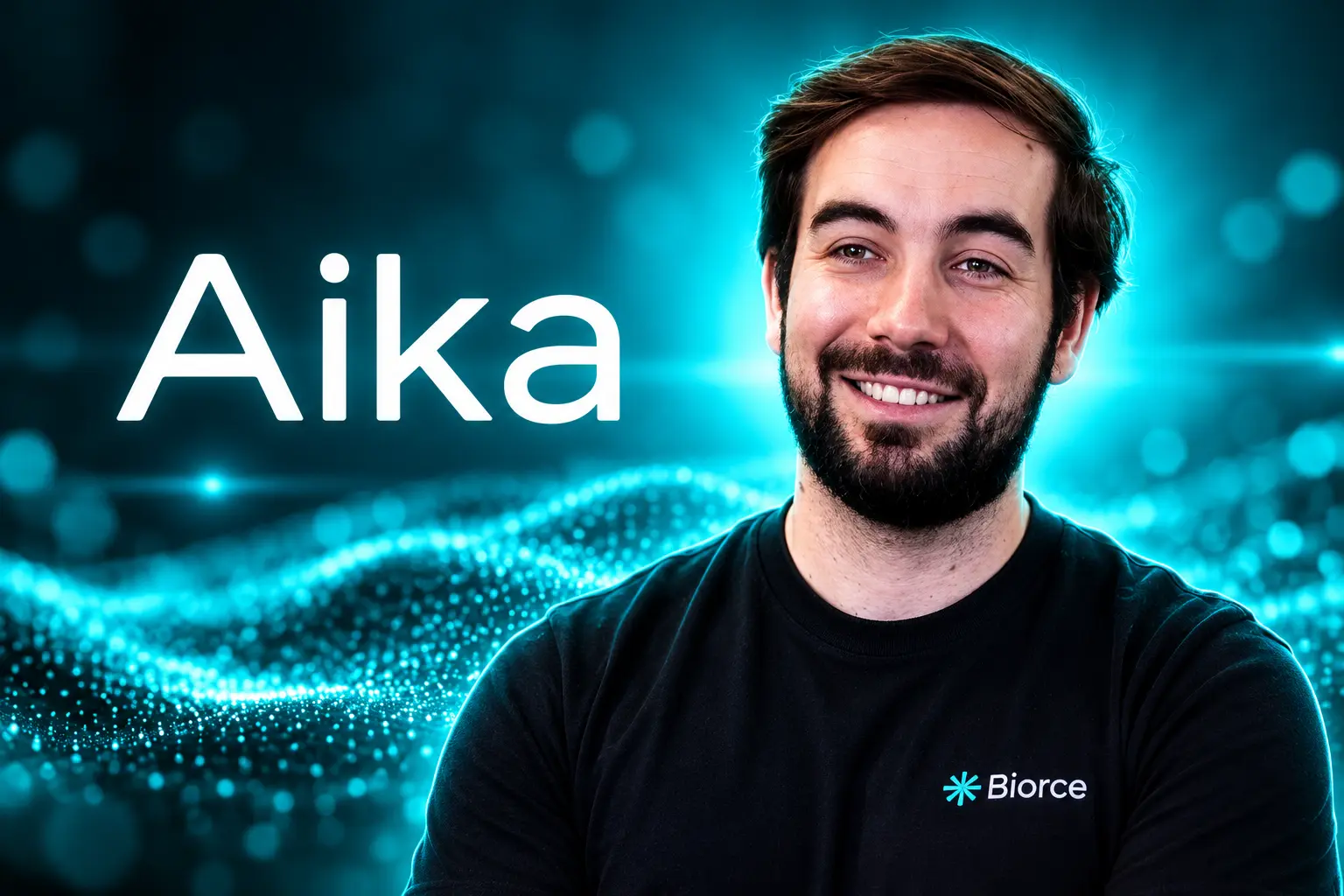
What Aika Changes in Trial Design
Aika is sold as a clinical-native layer from the first protocol choice through a regulatory packet, not as a single chatbot on top of Word. The public product page now lists a six-agent clinical operating system that keeps simulation, protocol text, site picks, contracts, budgets, and filing documents on one track.
AIKA’S SIX AGENTS
- Simulation: Health-economics scenarios and risk-adjusted value before a study is locked.
- Protocol: Evidence-based protocol generation and scoring against prior studies.
- Feasibility: Site lists and patient-pool estimates by country.
- Contracts: Automated clinical-trial-agreement redlines and fallback clauses.
- Budget: Multi-country study cost projection.
- Regulatory: eTMF-ready submission files.
On that same page, a submission-ready protocol is timed at 90 days the old way and under 30 days with Aika. The company also puts first-draft quality at 86% and says a hundred-page protocol that once occupied a 10-person team for 18 months can be drafted in about 90 seconds before humans edit it. Those two clocks measure different jobs, a rough first draft versus a packet a sponsor would file.
Biorce says the model sits on 1 million clinical trials and that Aika is already in use in oncology, neurology, and rare diseases. It publishes its own impact figures of a 70% faster workflow, a 60% cut in costs, 50% fewer protocol amendments, and about $400,000 saved per avoided amendment. Coelho has said a legal drug still takes 12 years to reach a patient and that about 40% of that span is lost to delays and errors.
Protocol Amendments Now Reach 76% of Trials
The bet only pays if those drafts survive contact with regulators and sites. Ken Getz’s group at the Tufts Center for the Study of Drug Development has counted protocol changes across four waves since 2010, and the Tufts CSDD amendment frequency data show the load getting heavier, not lighter.
TUFTS CSDD AMENDMENT BENCHMARKS
| Measure | Figure | Wave |
|---|---|---|
| Share of protocols with at least one substantial amendment | 76% | 2024, 950 protocols |
| Amendments per protocol that was changed | 3.3 | Same 2024 wave |
| Median direct cost, Phase II | $141,000 | 2016 |
| Median direct cost, Phase III | $535,000 | 2016 |
| Need identified to last oversight approval | 260 days | 2024 |
| Share judged unavoidable | 77% | Latest wave |
| Annual industry spend on Phase II and III amendments | $7 to $8 billion | Tufts estimate |
Biorce’s own sales copy uses that Phase III median as the old-way cost, which matches the median Phase III amendment cost from the 2016 Tufts paper in Therapeutic Innovation & Regulatory Science. A separate company line says each amendment typically pauses recruitment for six weeks and adds between €500,000 and €1 million, a recruitment halt that is not the same clock as the 260-day path from spotting a change to last approval.
Tufts has also reset an old scare figure on delay. A day lost is worth about $500,000 in missed drug sales in the corrected work, plus about $40,000 in direct trial-running cost, and $55,716 a day in Phase III. SNS Insider, cited in the raise announcement, puts clinical trial management at $120 billion in yearly global spend. Amendment work is a slice of that, not the whole pie, and it is still a slice large enough to fund a Series A.
Software Founders Buy a Seat on a Biology Problem
The cap table is the tell. Nik Storonsky, chief executive of Revolut; Arthur Mensch, co-founder and chief executive of Mistral AI; Paulo Rosado, founder of OutSystems; Albert Nieto, founder of Seedtag; Stef Van Grieken, co-founder of Cradle; and Alex Berriche, founder of Fleet, are named as angels. They are product people. The asset they are underwriting is a protocol engine, not a consumer app.
Coelho is not a tourist in that engine. Before Biorce he built TMFS, a contract research shop inside Talentmark aimed at oncology and cell and gene therapy, and he had been chief commercial officer at Konspol Holding. The company was founded in Barcelona in 2024 with Clara Bernardes, who came from pharma and is chief scientific officer; José Faria, who had been at Microsoft; and Diogo Pisoeiro, who had been at Porsche. All four are Portuguese.
The origin story is a family one. Coelho’s father, living in Colombia, was diagnosed with stage 4 melanoma and given a few months. A trial added 10 months of near-normal life, Coelho has said, before a brain tumor that he believes might have been avoided if treatment had started sooner. The idea for the company arrived in January 2024 on a Lisbon-to-San Francisco flight to the J.P. Morgan Health Conference.
“The enemy wasn’t just the disease. It was the time lost to inefficient processes that kept life-saving treatments from reaching the people who need them most,” Coelho has said of that stretch. In May 2026 he told an interviewer the company had billed €10 million in less than a year and had processed about 100 studies, against some 157,000 trials then active worldwide.
An Austin Floor and a Former AstraZeneca Office
The raise was written as a U.S. land grab, and the land grab happened. On April 7, 2026, Biorce opened a second American office at 515 Congress Avenue in Austin, adding an R&D floor to a New York commercial shop it already had. Coelho said the Texas site was a bid to build a global center for AI-driven trial work and to hire engineers in a city that has been pulling biotech and AI staff.
Barcelona stays the legal home. The company said it was moving into larger offices that used to be AstraZeneca’s headquarters in the city. In May 2026 Coelho put headcount above 100 and said he wanted to hire about 50 more people while multiplying 2026 revenue by 10 and finishing the year in profit. The February plan was more aggressive: 250 employees by the end of 2026. That target is still ahead of the calendar.
Norrsken’s earlier money was the bridge into that map. Invest in Spain recorded a €5 million Norrsken VC check in July 2025, after Biorce had sat inside Norrsken’s Barcelona hub, and Larsson called the firm the kind of company the impact fund exists to back. In March 2026, Biorce also took the 4YFN26 award at Mobile World Congress, a local trophy it then folded into the Austin announcement.
FROM A LISBON FLIGHT TO AN AUSTIN FLOOR
- January 2024: Coelho conceives the company on a Lisbon-to-San Francisco flight to the J.P. Morgan Health Conference.
- 2024: Biorce is founded in Barcelona with Bernardes, Faria, and Pisoeiro.
- November 2024: A €3.5 million seed closes, led by YZR Capital and Mustard Seed Maze.
- July 2025: Norrsken VC adds €5 million and a board seat for Larsson.
- February 2, 2026: A $52.5 million Series A closes with DST Global Partners as a new investor.
- April 7, 2026: An Austin R&D office opens at 515 Congress Avenue.
Coelho was still on the amendment circuit after the money landed. In May 2026 he joined an industry webinar on how AI can flag amendment risk before a protocol is locked, which is the same pitch the Series A bought at a much larger ticket.
Why Most Amendments Are Now Called Unavoidable
The hard part of the wager is not whether Aika can spit out a draft. It is whether a Barcelona operating system can sit in the same budget line as the trial software sponsors already pay for, and whether the remaining amendment pile is even a design problem.
Tufts’ latest wave found that 77% of amendments were judged unavoidable, with regulator requests and changes in study strategy at the top of the list, a sharp shift from the 2016 finding that 45% of substantial amendments were avoidable. If most changes now come from agencies and strategy, a cleaner first draft still helps, but it does not erase the tax.
Incumbents are not waiting. Medidata, owned by Dassault Systèmes, launched an AI protocol-simulation product in May 2025 on data it says covers 38,000 trials and 12 million patients. ConcertAI has claimed, on its own benchmarks, about 50% fewer substantial amendments when designs are iterated in software first. PhaseV, another AI-native design shop, raised a $50 million Series A in 2025. Unlearn sells digital twins that shrink control arms rather than rewrite protocols. Aika is trying to own the document itself.
Biorce said that in the first quarter of 2026 it would thicken protocol intelligence and add contract, negotiation, budget, and planning modules. Those contract and budget agents are now on the public platform page. Coelho has said he wants the full Aika build done in 2027. Until then the product is a stack of modules, and the Series A is a bet that pharma will let a two-year-old firm become the place those modules meet a regulator.
Frequently Asked Questions
What Security Marks Does Aika Advertise?
The product page lists Aika as GxP-aligned, SOC 2 Type II certified, and HIPAA-ready, which is the compliance language sponsors expect before a protocol tool sits on identifiable patient or site data. Those marks are company claims about the hosted system, not an FDA or EMA endorsement of any protocol the software drafts.
When Did Biorce Start Selling Aika?
Coelho has said the company was formed in January 2024 and began selling in March 2025, which means the first invoices went out about a year after the founding documents and well before the Series A. That sales clock is why a first-year billing figure of €10 million landed in 2026 interviews while the firm was still adding modules.
Which Trial Documents Can Aika Draft Besides the Protocol?
Biorce says Aika can produce the protocol, the Investigator’s Brochure, and the informed consent form, the three core texts a study needs before sites open. The platform page also lists health-economics simulations, feasibility reports, and eTMF-ready filing packs as outputs generated in minutes and then reviewed by people.
How Long Do Sites Run on Mismatched Protocol Versions?
Tufts CSDD’s 2024 wave found that investigative sites operate with different protocol versions for a mean of 215 days during an amendment cycle, the gap between the first ethics-committee approval and the last one. That overlap is a safety and data-quality problem as much as a calendar problem, because two versions of the same study can be in the field at once.
What Did the Four Founders Do Before Biorce?
Coelho ran a CRO focused on oncology and cell and gene therapy after a commercial role at Konspol Holding. Bernardes came from the pharmaceutical industry, Faria from Microsoft, and Pisoeiro from Porsche. The split is deliberate: one operator who has filed trials, one scientist, one engineer, and one product designer, all Portuguese, all based at the start in Barcelona.
The Austin office is already on Congress Avenue, and the Series A is in the bank. What is still unpaid is the Tufts number that keeps rising: most amendments, in the latest count, are no longer classed as sloppy drafting.
Disclaimer: This article is news reporting and analysis of a private financing round and a clinical-trial software product, and it is for information only. It is not investment advice, not a solicitation to buy or sell any security, and not medical, scientific, or regulatory advice about any trial, drug, or protocol. Readers who are considering an investment, a vendor contract, or a clinical-development decision should consult a licensed financial adviser, a qualified clinical-operations professional, and, where relevant, legal counsel before acting. Figures, headcount plans, product claims, and office status reflect the company statements and research cited here and can change as later rounds, filings, or trial results appear.

UPI MDR Delay Hands Traders the Calendar After Paytm Falls

Google Messages Builds Nine In-Chat Games After Samsung’s Exit

Anthropic’s $100 Million Academy Trains the Firms That Bill Both Sides

Toyota’s Electric C-HR Leaves the Cheap Twin to Subaru

Markets Bet the Fed Skips October After Hawkish Minutes

The Orchard Bug Forced Zcash to Open an Empty Pool

The $5.99 Game That Won Steam’s 2026 Summer Sale

Don Lee Joins Hemsworth as Extraction 3 Starts Shooting

YouTube Shorts Retires Dislikes and Swaps Likes for Hearts

NEURA Robotics Is Spending Its $1.4B on a Machine Stack
-
 NEWS5 months ago
The Orchard Bug Forced Zcash to Open an Empty Pool
-
 GAMING5 months ago
The $5.99 Game That Won Steam’s 2026 Summer Sale
-
 ENTERTAINMENT7 months ago
Don Lee Joins Hemsworth as Extraction 3 Starts Shooting
-
 NEWS5 months ago
YouTube Shorts Retires Dislikes and Swaps Likes for Hearts
-
 NEWS4 months ago
NEURA Robotics Is Spending Its $1.4B on a Machine Stack
-

 NEWS5 months ago
Atlantic City Turned WWE’s Return Into a Civic Night
-

 AUTO6 months ago
Kawasaki Bets the New Z1100 Against Its Own Supercharger
-

 BUSINESS5 months ago
Norway’s Export Bank Backs Nscale’s $790 Million Narvik Loan