
NEWS
Amara Turns Untagged Unreal Libraries Into Prompt-Built Rooms
01C’s Amara Unreal Engine plugin lays out rooms from untagged libraries in less than 9 minutes and later released 10,071 metric meshes the public changelog.

01C’s Amara Unreal Engine plugin builds in less than 9 minutes from a prompt, then fills the room from assets already in the project. The public changelog still ends on March 12, 2026.
Product Hunt logged the launch under Design Tools, with a No. 3 day rank on February 4, a No. 2 week rank in that aisle on February 11, and a No. 3 month rank on March 4. The files 01C actually shipped are a Windows editor plugin, a web mesh generator, and later a public pack of 10,071 metric meshes the changelog never named.
The Public Changelog Stops in March
London studio 01C, also trading as Zero One Creative, opened a text-to-3D and image-to-3D generator on January 26, 2026. On February 2 it added a Unreal plugin it called a semantic search and scene orchestration tool, able to find a “gothic chair” in an untagged library and place it from a sentence.
Dealroom records a €500,000 raise from EWOR in June 2025. The LinkedIn page lists 10 people. CEO and co-founder Ashkan Dabbagh, CTO Rupert Aspden, and co-founder James Elkin met at the National Film and Television School. An October 2025 hiring note on the Epic Developer Community still described three founders and two developers.
Dabbagh has said the point is to stay inside the stack teams already run. “We don’t want them to change their tech stack. We want to integrate into their workflows.”
THE SHIP CALENDAR
- January 26, 2026: 3D Model Generator Beta 1.0 opens text-to-3D and image-to-3D.
- February 2, 2026: Unreal plugin beta 1.1 adds semantic search and natural-language placement.
- March 3, 2026: Plugin 1.2v adds in-editor object creation and cuts listed build time to less than 9 minutes.
- March 12, 2026: Low-poly meshes down to 1000 polygons; last public changelog line.
- April 24, 2026: AmaraSpatial-10K goes up on Hugging Face with an arXiv paper.
- June 2, 2026: Dabbagh posts a 3D-agent demo reel that the changelog does not list.
February was almost a daily ship: object grounding, auto composition, intelligent clutter, templates, lighting, floorplan-to-3D, then Review, Plan, and Auto modes. Voice input landed on February 27. Undo inside Unreal landed on March 7. None of that log was updated for the April dataset or the June reel.
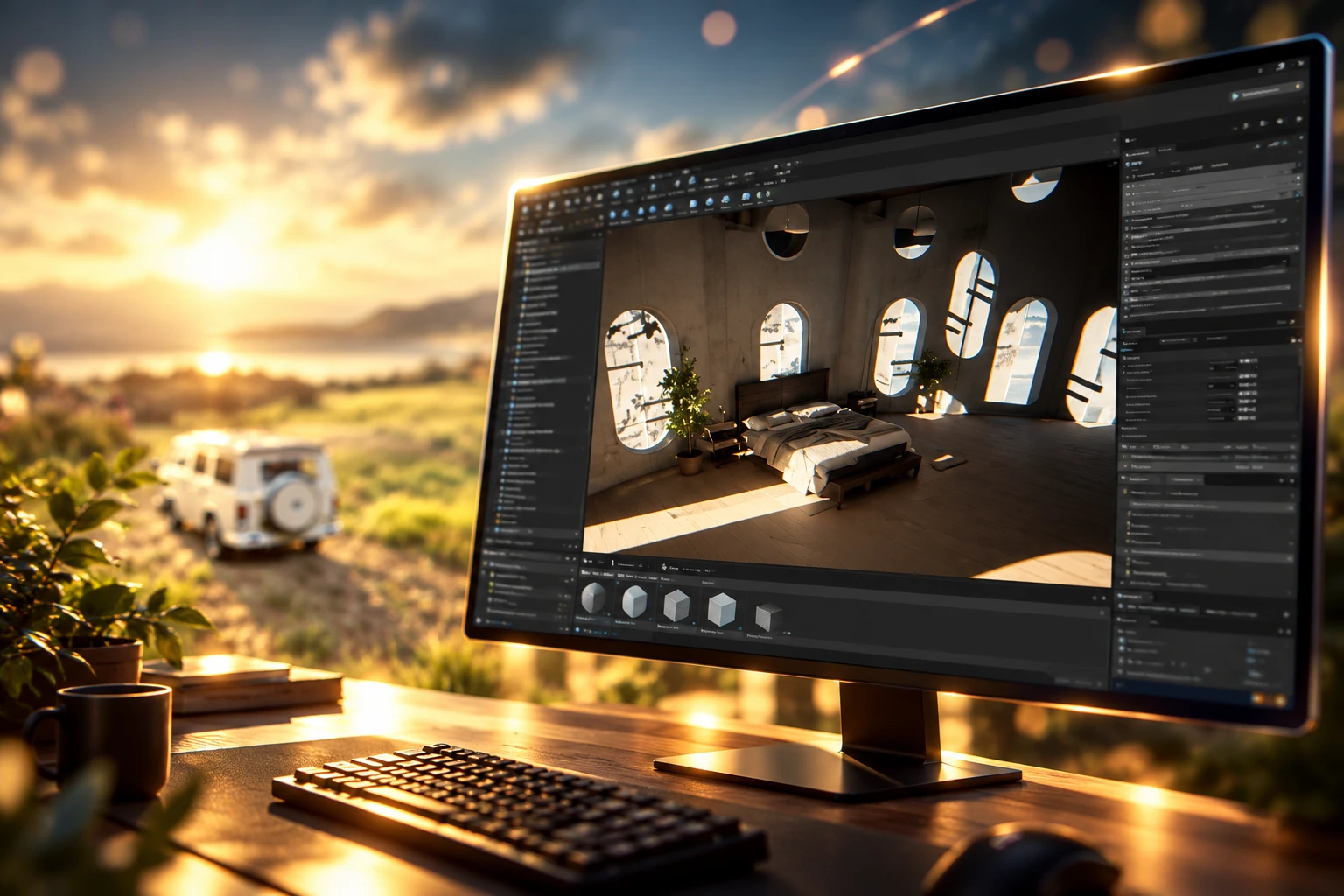
Amara Builds the Room Inside Unreal Engine
The plugin’s own getting-started pages still bundle Amara Plugin v1.1.0 in a Unreal 5.7 starter template, even though the changelog announced 1.2v on March 3. The assistant can see the viewport, so “this plant” and “the table” resolve to what you are looking at.
Official prompt guidelines for scene builds push detail. The sample that the docs and the public showcase both use is a 17th century English merchant’s study with two windows on one wall. Amara Academy walks the same scene through co-creation, lighting, and floorplan-to-3D.
On Hacker News, Dabbagh wrote the origin in one line: the team was tired of creative flow dying the moment someone had to hunt for a mesh or block out a room. Semantic search is the first patch for that. You type a style, not a filename. A Sync Assets pass indexes the Content Browser; large projects, the docs warn, can take a long stretch and may need to run overnight.
THE THREE BUILD MODES
- Review Mode: Amara proposes a matching asset and waits for approve or swap before it executes.
- Plan Mode: You set layout, then pick or skip assets in a widget, then it builds the room.
- Auto Mode: One prompt runs the whole pass without the extra gates.
Plan Mode grew three steps in three days: floor-plan upload or sketch on February 22, an asset-selection widget on February 23, and a cap of 4-5 planning questions on style, mood, and signature elements. That is not a mesh website with an import button. It is a director loop that treats the library you already paid for as the source of truth.
AmaraSpatial-10K Makes Messy Libraries Usable
On April 24, 2026, 01C put 10,071 spatially aligned meshes on Hugging Face under CC BY 4.0, with a five-year maintenance promise. The paper, “AmaraSpatial-10K: A Spatially and Semantically Aligned 3D Dataset for Spatial Computing and Embodied AI,” lists Mohammad Sadegh Salehi, Alex Perkins, Igor Maurell, Ashkan Dabbagh, and Raymond Wong. Version 2 is dated May 13, 2026.
The pack spans 10 top-level categories and 476 subcategories. Indoor Scenes is about 26%. Each item ships as a metric-scaled.glb with separated PBR maps, a convex collision hull, a paired reference image, and a multi-sentence caption. The authors’ complaint about web-scale banks is blunt: a generated chair may be 40 m tall, face the wrong way, or pivot from its centroid instead of the floor.
They scored seating meshes against a 0.6 m to 1.1 m height band.
SEATING HEIGHTS AGAINST OBJAverse
| Dataset | Seating assets | Median height | Mean height | Share in 0.6-1.1 m |
|---|---|---|---|---|
| Objaverse | 181 | 2.44 m | 717.79 m | 17.7% |
| AmaraSpatial-10K | 353 | 0.72 m | 0.80 m | 56.7% |
Objaverse’s seating sample runs from 0.020 m to 115,276.9 m. Text retrieval moves with the captions: the paper reports CLIP Recall at 5 of 0.612 against 0.181 on Objaverse, a 3.4× gain, with median rank falling from 267 to 3. Under Habitat-Sim it records a 99.1% physics-stability rate and about a 20× wall-time speed-up. A Holodeck drop-in test used N=6 scenes per pack and is labelled preliminary in the paper itself.
That is the sleeper under the Product Hunt badge. Scene assemblers fail when the chair is a tower. A metric, caption-rich bank is what lets a prompt land at human scale. The paper does not claim photogrammetry parity with Google Scanned Objects, and it says the set is not for verified LiDAR-style work.
What the Unreal Plugin Needs to Run
Official docs lock the assistant to Unreal Engine 5.7 on Windows. You need an Amara account with a valid subscription, then a one-time API key from the profile page. There is no public price on the product site. Third-party directories list figures; those pages are not 01C’s.
Install is a starter.uproject, not a Fab one-click the docs describe. Tools → Amara Connection takes the key. Updates mean deleting Plugins\AmaraPlugin\ and dropping in a zip from the same profile screen. Troubleshooting is short: check the key, the network, and whether the subscription is active; if search is empty, run Sync Assets and wait.
Helpful features listed next to the assistant are Refine Scene and Undo. Clear Scene, session reset, and a live context-window meter arrived in the February-March burst. The OS lock is the hard edge. Several other Unreal AI editors advertise macOS. Amara’s public plugin path does not.
Mesh Sites Still Beat It on a Single Chair
Dedicated generators still own the one-object contest. Meshy, Tripo, and Hyper3D Rodin sit behind Unreal wrappers such as GenAI Model Generator, which quotes per-mesh prices in cents. StudioTwin, Ludus AI, Nwiro, and Ultimate Engine Co-Pilot fight for editor time on animation, Blueprints, biomes, and local generation. PlanTo3D, posted on the Epic forums on September 3, 2026, turns architectural floor plans into editable walls and openings.
Amara’s wedge is not a better isolated sculpt. It is layout over a messy library, plus a public bank whose chairs actually sit near 0.72 m. A developer who ran Amara’s own generator on a benchmark still put single-mesh quality behind Rodin and Tripo, and treated AmaraSpatial-10K as curated synthetic data, usable with attribution, not as scanned hero art. That reading matches the paper’s own limit: authored alignment, not photogrammetric fidelity.
Dabbagh flagged the legal side in 2025. “Copyright is a big issue.” The CC BY 4.0 pack at least states the credit rule. Studio libraries you sync stay yours; the assistant is only indexing them.
June’s Demo Aimed at Robots as Well as Games
On June 2, 2026, Dabbagh posted a reel that went past greybox interiors. “Describe a world. Bring your own assets or let Amara generate them.” Follow-up clips showed a Persian palace with a rigged parrot, a forest you can drive through, a street assembled from many wall parts, a tavern pulled from AmaraSpatial-10K, a missile launch on an island the agent built, and NPC logic on top of a scene.
🚨 Meet 01C's 3D agent 'Amara'
Describe a world. Bring your own assets or let Amara generate them. You steer the vision; Amara builds the scene and thousands of articulated objects, fully editable, getting sharper every time you iterate.
More details below 👇 pic.twitter.com/7F6rZbV24u
— Ashkan (@ashkan01C) June 2, 2026
Coming from virtual production, we know this can work for film. You can generate a set, take a camera into Unreal, and start blocking shots immediately.
Ashkan Dabbagh, CEO and co-founder, 01C
The same reel sells simulation-ready rooms for embodied AI, down to articulated objects spawned on the fly. That is a second customer the Design Tools tag never named: labs that need stable physics more than a pretty hero mesh. Dealroom also repeats 01C’s claim that pre-launch work for McLaren, eBay, and Twix drew more than 40 million views, the commercial-studio side of the house that still sits on 01c.ai.
Those June clips are the company’s own. They are not dated changelog entries, and independent users did not flood the thread with reproduced scenes. The informed take that stuck was simpler: an agent that types into Unreal is a different product from a zip of meshes, and the public log has not caught the wider pitch.
Floorplan Suggestion Puts the Artist Back in the Loop
The last feature on the public log, dated March 9, 2026, is the one that shows the bet most clearly. Amara can suggest a floor plan before it builds. You preview, download, reject, or approve. Once approved, it builds from that plan using assets already in the library. March 12 only added the 1000-polygon option on the web generator.
That sequence is the product in miniature. Search the pile. Agree the layout. Keep the artist on approve and swap. Let the assistant spend the minutes that used to go to finding the gothic chair. Voice input and undo exist to keep that loop from feeling like a batch job you cannot reverse.
The unfinished part is documentation and reach. Getting-started still describes plugin v1.1.0. The assistant still needs Windows and Unreal Engine 5.7. The changelog still stops on March 12, 2026, while the dataset, the paper, and the June reel have already moved. Until those three line up, Amara is a fast in-editor layout tool with a serious asset paper, and a world-agent demo that the ship log has not yet claimed.

UPI MDR Delay Hands Traders the Calendar After Paytm Falls

Google Messages Builds Nine In-Chat Games After Samsung’s Exit

Anthropic’s $100 Million Academy Trains the Firms That Bill Both Sides

Toyota’s Electric C-HR Leaves the Cheap Twin to Subaru

Markets Bet the Fed Skips October After Hawkish Minutes

The Orchard Bug Forced Zcash to Open an Empty Pool

The $5.99 Game That Won Steam’s 2026 Summer Sale

Don Lee Joins Hemsworth as Extraction 3 Starts Shooting

YouTube Shorts Retires Dislikes and Swaps Likes for Hearts

NEURA Robotics Is Spending Its $1.4B on a Machine Stack
-
 NEWS5 months ago
The Orchard Bug Forced Zcash to Open an Empty Pool
-
 GAMING5 months ago
The $5.99 Game That Won Steam’s 2026 Summer Sale
-
 ENTERTAINMENT7 months ago
Don Lee Joins Hemsworth as Extraction 3 Starts Shooting
-
 NEWS5 months ago
YouTube Shorts Retires Dislikes and Swaps Likes for Hearts
-
 NEWS4 months ago
NEURA Robotics Is Spending Its $1.4B on a Machine Stack
-

 NEWS5 months ago
Atlantic City Turned WWE’s Return Into a Civic Night
-

 AUTO6 months ago
Kawasaki Bets the New Z1100 Against Its Own Supercharger
-

 BUSINESS5 months ago
Norway’s Export Bank Backs Nscale’s $790 Million Narvik Loan