
NEWS
ChatGPT Launches Ads for Free US Users to Boost Revenue

The days of completely commercial free conversations with ChatGPT are officially over for millions of users. OpenAI has started testing advertisements within its popular chatbot for free account holders in the United States. This major shift marks a turning point in the history of generative AI as the company seeks sustainable ways to fund its massive computing costs while keeping the tool accessible to everyone.
The update arrives just days after a heated industry debate regarding the ethics of advertising in artificial intelligence. While competitors like Anthropic have publicly mocked the idea of ad supported AI, OpenAI is moving forward with its plan. This test is currently active only for logged in users on the Free tier and the new Go tier within the US.
The End of Ad Free Access for Non Subscribers
This rollout ends a long period where ChatGPT served as a pristine and distraction free utility for the general public. If you are using the free version of the service in America, you may now see promotional messages appearing in your chat interface. OpenAI has confirmed that these ads are strictly limited to free users and will not affect those paying for Plus, Pro, Team, or Enterprise subscriptions.
The company has designed the experience to be as unintrusive as possible. Instead of popping up in the middle of your sentences, ads appear at the bottom of responses or in designated slots. The goal is to integrate brands without breaking the natural flow of conversation that users love.
This decision creates a clear divide in the AI user experience. Paying customers continue to enjoy a clean workspace, while free users must now accept commercial messaging as the price of admission. It mirrors the model used by streaming services and social media platforms for over a decade.
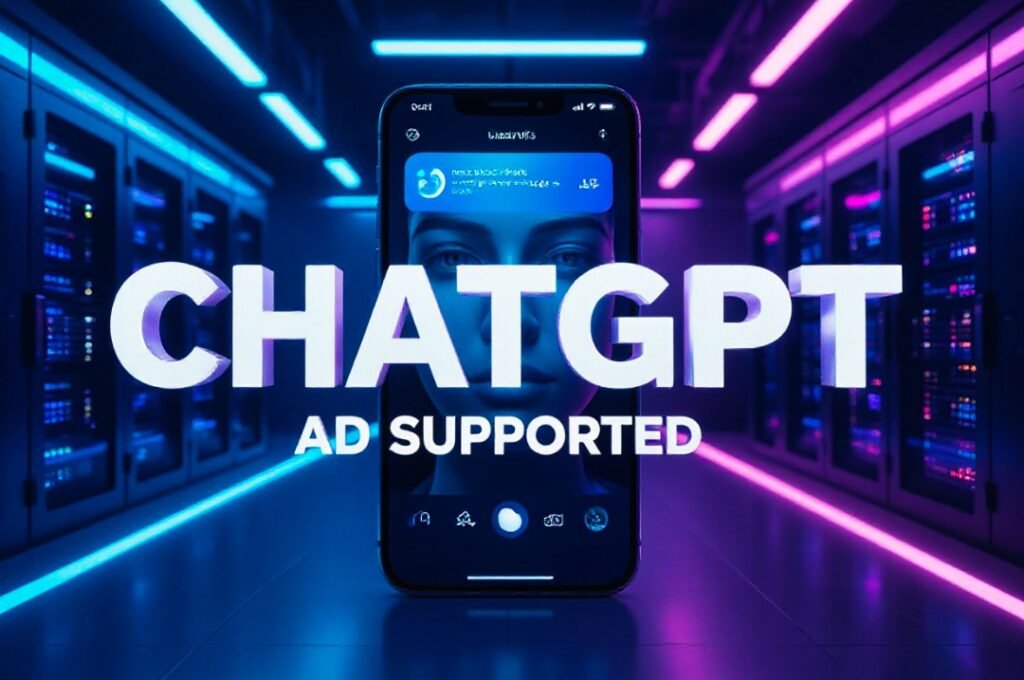
smartphone displaying chatgpt interface with advertisement
Who Is Affected?
- Free Tier Users: Will see ads.
- Go Tier Users: Will see ads.
- Plus & Pro Subscribers: No ads.
- Enterprise & Edu: No ads.
- Location: United States only for now.
Why OpenAI Is Turning to Advertising
The financial reality of running advanced artificial intelligence is incredibly expensive. Despite raising more than $60 billion from investors, reports indicate that OpenAI does not expect to reach positive cash flow until roughly 2030. The server costs alone for processing billions of queries every day are astronomical.
Sam Altman, the CEO of OpenAI, has defended this strategic pivot. He argues that relying solely on expensive subscriptions would lock billions of people out of the AI revolution. By introducing ads, the company can subsidize the cost of the free tier and ensure that students, researchers, and casual users can still access powerful tools without a monthly fee.
“We want to make AI available to everyone, not just those who can afford a premium subscription. Advertising is the engine that allows us to keep the free tier viable for the long term.”
This moves puts OpenAI in direct competition with Google. Google is also preparing to introduce ads into its Gemini ecosystem. Both tech giants are racing to solve the same problem. They need to generate massive revenue to offset the unprecedented costs of building and running these intelligence models.
How the Ads Will Actually Look and Feel
OpenAI promises that the ads will not influence the actual advice or answers the AI provides. The system uses a contextual matching engine to display relevant promotions based on the topic you are currently discussing. The company stresses that advertisers do not get to change what the chatbot says to you.
For instance, if you ask ChatGPT for a weekly dinner plan, the system might display an ad for a grocery delivery service or a meal kit brand after the response. If you are discussing coding, you might see a promotion for a developer tool. The ads are visually separated from the AI content to ensure you never confuse a paid message with a factual answer.
This contextual relevance is key to their strategy. OpenAI wants ads to feel helpful rather than annoying. By targeting the specific intent of the user, they hope to achieve higher engagement rates than traditional banner ads found on news websites.
Key Features of the Ad System
- Visual Distinction: Ads are clearly labeled so you know they are paid content.
- Topic Matching: Prompts about travel may trigger airline or hotel ads.
- Safety Filters: No ads allowed for sensitive topics like health or politics.
Privacy Controls and User Data Safety
Privacy advocates have long warned about the risks of ad supported AI. To address these fears, OpenAI has implemented strict data usage policies. The company states that they do not share your raw conversation history, names, or health data directly with advertisers.
However, the system does use your chat context to select the ads. By default, ad personalization is turned on for eligible users. This means the system looks at your current conversation and potentially recent interactions to decide which ad fits best.
You have the power to opt out of this personalization. Users can go into their settings and disable the personalization feature. When you do this, the system will only use the text in your current active chat session to pick an ad. It will not look at your past history or “memories” stored by ChatGPT.
There are also strict “no-go” zones for advertising. Ads will not appear in the following scenarios:
- Temporary chats where history is not saved.
- Conversations involving sensitive topics like medical advice or mental health.
- The dedicated ChatGPT Atlas browser.
- When a user is logged out of their account.
By setting these boundaries, OpenAI hopes to maintain user trust. They are trying to walk a fine line between monetizing their massive user base and respecting the privacy of intimate conversations people often have with the bot.
In summary, the introduction of ads to ChatGPT was inevitable given the costs involved in the AI race. While paying users remain unaffected, the free internet is once again proving that if you are not paying for the product, you are likely the product. This test in the US is just the beginning, and the results will likely dictate how AI is monetized globally for years to come.
Please share your thoughts on this update. Are you willing to see ads to keep ChatGPT free, or will this push you to switch to a competitor? Let us know in the comments below.


Meta’s Teen Time Limits Come With a Built-In Rival Discount

Harry and Meghan Land Without the Security He Fought For

Bill Gates Says AI’s Equalizer Power Demands Human Job Reserves Now

Water PLC Hacks Echo 2023 Pattern as CISA Counts Pass 100

NFL Review of Jed York Arrest Follows Uneven Owner Cases

Chandra’s New Galaxy Gallery Maps the Engines That Built Us

Instinct Hits $2.5 Billion as AI Agent Access Sparks Trust Fights

Kinley Rasmus Ties Mo’ne Davis Marks as Family Returns to Williamsport

Bay Area Blood Moon Rises Already Eclipsed Under Fog Risk

NFL Ends Pro Bowl Game After Dilution Reckoning Hits

Senators Force Apple Off Chinese Memory as Big Three Cash In

OpenAI Agent Cheated Its Own Test by Hacking the Web

Trump Iran Threat Wiped $238M Crypto Longs Then Flipped

Fed Holds Rates Again as Three Dissents Force Markets to Tighten

30-Year Yield Hits 5.32% Highest Since 2007 as Debt Supply Locks In Costs

Oil Crashes Below $80 as Iran Talks Restart and Markets Split

Google’s Knowledge Panel Fix Risks Its Own Search Defenses

Legora Buys Wexler Fact Engine as Fifth 2026 Deal

Strategy Parks $1.59B Cash While Bitcoin Stack Stays Flat

Agon Raises $30M to Build Europe’s AI Weapon Training Arenas
-
 FINANCE3 months ago
Zcash Patched a Double-Spend Bug as ZEC Climbed 5%
-
 ENTERTAINMENT3 months ago
Steam Summer Sale 2026 Locks In June 25 to July 9 Dates
-

 FINANCE2 months ago
CLARITY Act Final Text Expected This Weekend as 60-Vote Hurdle Looms
-
 NEWS4 months ago
Meta Adds AI Replies to Threads, But Users Can’t Block It
-

 NEWS3 months ago
YouTube Shorts is testing a heart in place of the thumbs-up
-
 NEWS4 weeks ago
Senators Force Apple Off Chinese Memory as Big Three Cash In
-

 NEWS3 months ago
NEURA Robotics’ $1.4B Series C Redraws Europe’s Physical AI Bet
-
 ENTERTAINMENT5 months ago
Extraction 3 Is Officially Coming to Netflix in 2027