
NEWS
Gas Prices Surge as Iran Conflict Threatens Global Supply

Drivers watching the pump meter tick higher are feeling a familiar dread this week. Tensions with Iran have officially rattled the energy market, sending crude oil prices toward dangerous territory not seen in years. Analysts warn this sudden spike might just be the beginning of a costly month for American families as fear grips the global supply chain.
Disruption at the Strait of Hormuz
The primary reason for the sudden panic at the pump involves a narrow strip of water known as the Strait of Hormuz. This is often called the jugular vein of the global economy. Approximately 20 million barrels of oil pass through this channel every single day.
Recent hostilities have left ships stranded and unable to pass safely. This blockage creates a massive bottleneck for energy supplies destined for countries around the world. When ships stop moving, supply drops, and prices naturally shoot up.
Key Statistics on the Strait of Hormuz:
- Daily Flow: ~21 million barrels of petroleum liquids.
- Global Impact: Accounts for roughly 21% of global petroleum liquid consumption.
- Risk Factor: It is the world’s most important oil chokepoint.
Wholesalers are currently reacting to fear rather than an actual shortage at the local station. They worry that replacing the gas they sell today will cost them significantly more tomorrow. This speculation drives up the wholesale price immediately, which is why you see the change on the street sign so quickly.
Tom Kloza, a veteran oil analyst, noted that panic is a major driver here. Markets hate uncertainty. When tankers cannot move freely in the Persian Gulf, the market assumes the worst case scenario.
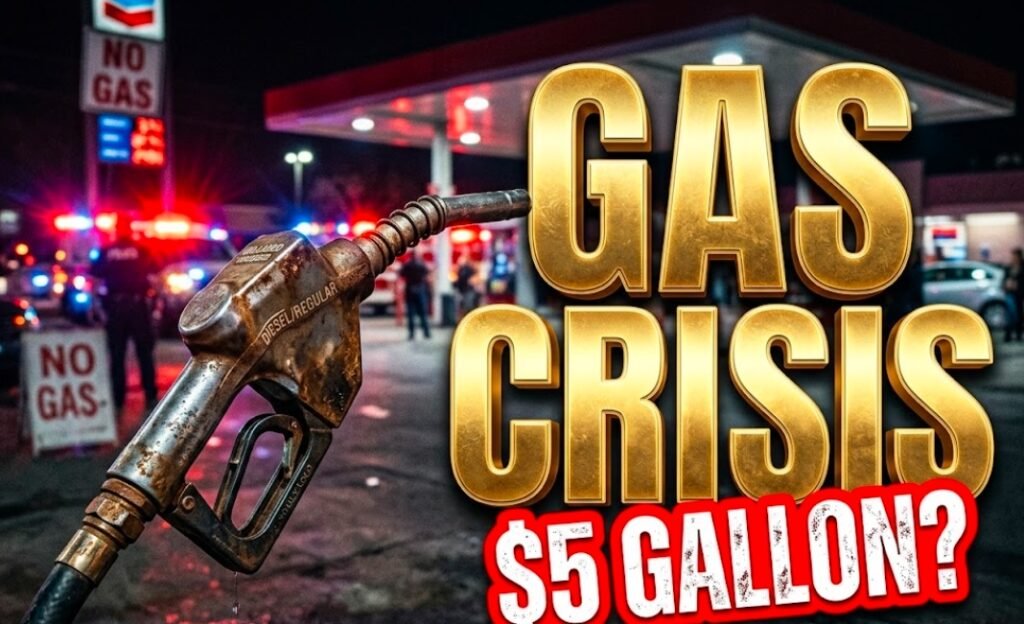
gas pump nozzle counting dollars with blurred background
Experts Predict Potential Price Hikes
The big question on everyone’s mind is how high the numbers will go. The answer depends entirely on how long the conflict disrupts shipping lanes. If the situation is resolved in days, prices may stabilize. If it drags on, we enter uncharted territory.
Some experts are painting a grim picture for the coming weeks.
Jay Young, CEO of King Operating Corporation, suggests that crude oil could breach the $100 per barrel mark. He warns that if the conflict escalates or lasts more than a month, consumers will feel severe pain.
“It can go to five, six dollars. Fill up anything you can right now,” Young stated, advising drivers to prepare for the worst.
However, not everyone agrees that we will hit record shattering numbers immediately. The record national average of $5.02 set in 2022 was driven by a perfect storm of post pandemic demand and the war in Ukraine.
Current market conditions are slightly different. The United States is pumping more oil domestically than it was in previous decades. This domestic production acts as a small buffer, but it cannot fully shield Americans from global price shocks. Oil is a global commodity, meaning its price is set on the world stage regardless of where it is drilled.
History of Conflict and Gas Costs
Looking back at history helps us understand the current trajectory. Geopolitical tension in the Middle East has always served as a catalyst for price volatility.
In 2003, during the invasion of Iraq, gas prices jumped notably. They did not reach the levels we see today, but the percentage increase was felt deeply by the economy at the time. More recently, the 2020 drone strike involving General Qassem Soleimani caused an immediate spike in crude prices.
Historical Price Reactions to Conflict:
- 2003 (Iraq War): Prices jumped from $1.45 to $1.60 quickly.
- 2008 (Global Instability): Prices eventually climbed over $4.00.
- 2020 (Iran Tension): Crude jumped to $70/barrel temporarily.
- 2022 (Russia-Ukraine): National average hit record $5.02.
The pattern is consistent. Fear causes a spike. If the supply is actually cut, the high prices stick around. If the supply remains flowing despite the fear, prices eventually drift back down.
Consumers are currently paying a “war premium” on every gallon. This is extra money paid simply because of the risk involved in transporting the oil, not necessarily because there is no gas left in the reserves.
The Ripple Effect on Inflation
The problem with rising oil prices extends far beyond your morning commute. High energy costs act as a tax on the entire economy. Everything you buy at the grocery store travels on a truck that runs on diesel fuel.
When diesel prices rise, trucking companies charge more to move goods.
How High Gas Prices Hit Your Wallet:
- Commuting: Direct cost to get to work increases.
- Groceries: Food prices rise due to transportation costs.
- Airline Tickets: Jet fuel costs force airlines to raise fares.
- Services: Lawn care, delivery, and rideshare services increase rates.
If the Strait of Hormuz remains blocked for weeks, we could see a resurgence of inflation across multiple sectors. This puts the Federal Reserve in a difficult position regarding interest rates.
Patrick De Haan of GasBuddy mentioned the possibility of oil reaching $150 a barrel in a worst case scenario. That would likely push gas prices well past the inflation adjusted highs of 2008. Families living paycheck to paycheck would be forced to cut discretionary spending immediately to keep their cars running.
Drivers should remain cautious but calm. While filling up your tank now is a smart hedge against tomorrow’s potential hike, panic buying can actually worsen the local supply issues.
The situation remains fluid. The coming days will determine if this is a temporary blip or a long term economic struggle for American drivers.
To summarize, the conflict with Iran has triggered immediate concern in global energy markets due to the strategic importance of the Strait of Hormuz. While experts disagree on exactly how high prices will go, the consensus is that volatility is here to stay for the near future. History shows us that these spikes can be rapid, but market adjustments often follow once the initial fear subsides. For now, tighten your budget and keep an eye on the headlines.
What are your thoughts on the rising gas prices? Do you think the US should tap into strategic reserves immediately? Share your opinion in the comments below using #GasPriceWatch and let us know how prices look in your city.


Conor Oberst’s Trump Writer’s Block Exposes a Bigger Crisis

Siemens Wires Its Chip Software Into NVIDIA’s Quantum Agents

Pixel 11 Price Hikes Reveal Memory Chipmakers’ Record Profits

Charles Schwab Backs the CLARITY Act as Odds Collapse

Nodes Upgrading to XRP Ledger’s xrpld 3.2.0 Fall Out of Sync

Trump Halts Iran Strikes as Bitcoin Stays Stuck Near $64K

ChatGPT’s Health Push Repeats a Bet That Killed Two Rivals

Crypto Rallies on Iran Truce While Fed Hike Odds Triple

Samsung’s New Lockout Rule Targets Thieves and Police Forensic Tools

Gemini Daily Brief Tests Custom Prompts, a Year Behind Samsung

CLARITY Act Final Text Expected This Weekend as 60-Vote Hurdle Looms

Kalshi Loses Major NY Prediction Markets Ruling to Judge Torres

Fed Minutes Cite AI Demand as Inflation Risk, Put a 2026 Hike Back on the Map

Marker AI Writing Startup Lands $13M Seed Led by Index Ventures

Dota 2 Esports World Cup 2026: Spirit Defends $2M Title In Paris

Meta’s Muse Spark 1.1 Beats Rivals on Price, Trails on Coding

CS2 Premier Season 5 Lands With Cache and a C4 Damage Rework

Trump Calls Iran ‘Islamic Republic of Japan’ as Ceasefire Ends

ARC Intelligence Closes €4M Seed Round in Roughly a Week

Finto Picks Munich Over Silicon Valley After YC, Raises $3.4M
-
 FINANCE2 months ago
Zcash Patched a Double-Spend Bug as ZEC Climbed 5%
-
 ENTERTAINMENT2 months ago
Steam Summer Sale 2026 Locks In June 25 to July 9 Dates
-
 NEWS3 months ago
Meta Adds AI Replies to Threads, But Users Can’t Block It
-
 FINANCE3 weeks ago
CLARITY Act Final Text Expected This Weekend as 60-Vote Hurdle Looms
-
 ENTERTAINMENT2 months ago
‘Widow’s Bay’ Review: Apple TV’s Sleeper Horror-Comedy Earns Its Fog
-
 NEWS7 months ago
FolderFresh Review: This Free Tool Automates Windows File Organizing
-
 NEWS4 months ago
U.S. Navy Deploys Solar-Powered Lightfish Drone to Patrol Oceans
-
 FINANCE3 weeks ago
Kalshi Loses Major NY Prediction Markets Ruling to Judge Torres