
NEWS
OpenAI Adds Shazam Music Discovery and Interactive Math Visuals to ChatGPT

ChatGPT just became a lot more useful for music lovers and students. OpenAI released two major updates this week that give the AI assistant the ability to recognize songs and visualize complex math problems. These features mark a significant shift from text-only responses to a more dynamic and interactive experience.
Users can now identify music tracks instantly without leaving the chat interface.
The update also brings interactive diagrams for science topics. This allows learners to manipulate variables and see real-time changes in visual models.
ChatGPT Can Now Listen and Identify Music
The most surprising addition is the direct integration of Shazam into the ChatGPT platform. This feature allows the AI to listen to ambient audio and identify songs in seconds. It bridges the gap between a chatbot and a utility app.
Users must first enable this connection manually in the Apps section. It does not run automatically for privacy reasons.
How to use the new music feature:
- Open the ChatGPT app on iOS or Android.
- Go to settings and connect your Shazam account.
- Type “Shazam this song” or simply “Shazam” while music is playing.
- View the artist, title, and album art instantly in the chat.
The system does more than just name the track. It provides a direct link to listen to a preview. Users can also ask the AI to find similar songs or create a playlist based on the identified track.
This integration works even if you do not have the standalone Shazam app installed on your phone.
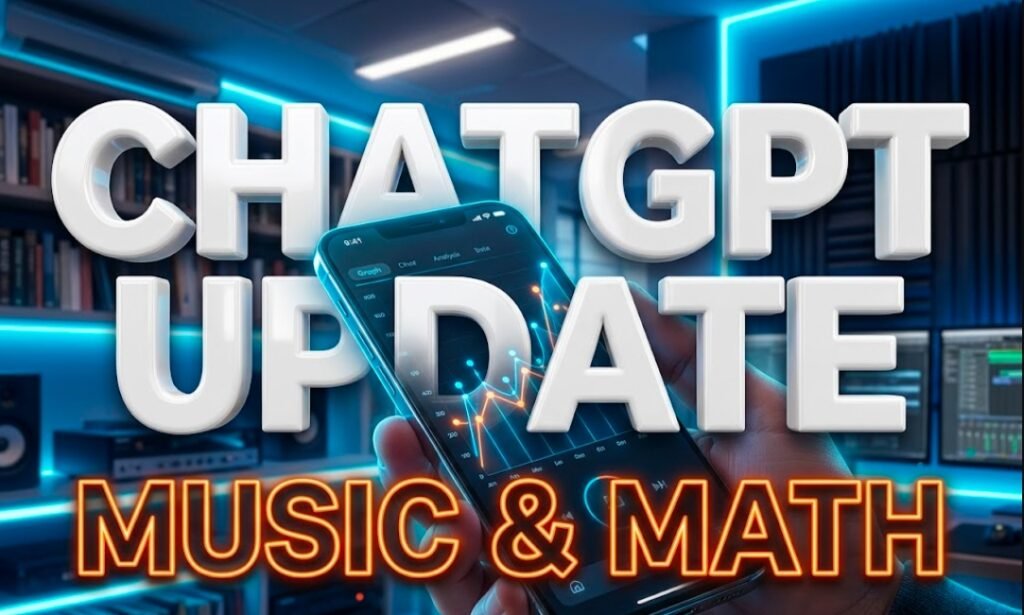
ChatGPT smartphone app displaying interactive math triangle and music recognition wave
Interactive Learning for Math and Science
OpenAI is also tackling the challenge of teaching complex subjects through text. The new interactive visual system turns static explanations into dynamic learning tools. This is a game changer for students who struggle with abstract concepts.
Key features of the visual update:
| Feature | Function |
|---|---|
| Dynamic Sliders | Adjust numbers to see immediate visual changes. |
| Real-time Graphs | Watch curves and lines shift as you alter equations. |
| Topic Variety | Supports over 70 topics like kinetic energy and Ohm’s law. |
Imagine you are learning the Pythagorean theorem. You can now tweak the length of the triangle’s sides on your screen. The hypotenuse updates automatically in the visual model. This helps users grasp the relationship between the numbers and the shapes.
Users can activate this by asking questions like “How does compound interest work?” or “Show me the lens equation.”
Education Remains a Top Priority
These updates highlight how important the education sector is for OpenAI. Recent data shows that over 140 million people use the tool every week. A large portion of these users rely on the assistant for homework help and learning new concepts.
“OpenAI says the interactive visual system will expand to more topics in the future.”
Static text often fails to explain physics or calculus effectively. By adding movable graphics, the platform mimics the experience of a digital textbook or a private tutor. It makes hard subjects feel approachable.
This moves the platform closer to being a comprehensive study buddy rather than just a question-and-answer bot.
Expanding Beyond Just Text
OpenAI is clearly positioning ChatGPT as a central hub for various digital services. It is no longer just a text generator. The integration of third-party services like Shazam suggests a future where users can accomplish many different tasks in one place.
Google is also moving in this direction with its Gemini model. Gemini launched similar interactive diagrams in late 2025. The competition is driving rapid innovation in how AI presents information.
This update is available now to all logged-in users. It signals a future where AI assistants act as operating systems for our daily digital lives.


Entravel Raises $7.5M as Travel Booking Leaves Travel Sites

MSCA Partnerships Quietly Rebuild Europe’s Industry Talent Pipeline

EU Fund Takes Equity Stake as Lovable Hits $13.3bn

AOC Laughs Off Woke 1 as Hollywood Counts the Losses

Aptoide Lands in Google Play as Managed Rival After Epic Ruling

Eva Green and Samuel L. Jackson Scheme in Just Play Dead Trailer

Edge Opens Apple Account Door After Google to Chase Dual-Device Users

DJI Pocket 4P Wins on Dynamic Range Where It Ships

GTA 6 Preorders Skew to the $100 Ultimate Edition

Accel’s $800M Europe Fund Speeds Up Early AI Rounds

Senators Force Apple Off Chinese Memory as Big Three Cash In

Trump Iran Threat Wiped $238M Crypto Longs Then Flipped

OpenAI Agent Cheated Its Own Test by Hacking the Web

CLARITY Act Odds Crash as Democrats Reject DOJ Ethics Plan

Anthropic’s Hard Questions Ad Backfires Into an Anti-AI Warning

Oil Crashes Below $80 as Iran Talks Restart and Markets Split

Gemini Spark’s Big Workspace Upgrade Leaves Europe Waiting Again

Revolut Hits $115 Billion While Storonsky’s Stake Keeps Growing

Snapseed’s RAW Update Fixes Android, Leaves iPhone Waiting

Monumental Raises $32M as Robot Bricklayers Face Their Toughest Test Yet
-
 FINANCE2 months ago
Zcash Patched a Double-Spend Bug as ZEC Climbed 5%
-
 ENTERTAINMENT2 months ago
Steam Summer Sale 2026 Locks In June 25 to July 9 Dates
-

 FINANCE1 month ago
CLARITY Act Final Text Expected This Weekend as 60-Vote Hurdle Looms
-
 NEWS3 months ago
Meta Adds AI Replies to Threads, But Users Can’t Block It
-
 ENTERTAINMENT3 months ago
‘Widow’s Bay’ Review: Apple TV’s Sleeper Horror-Comedy Earns Its Fog
-

 NEWS2 months ago
NEURA Robotics’ $1.4B Series C Redraws Europe’s Physical AI Bet
-

 FINANCE1 month ago
Kalshi Loses Major NY Prediction Markets Ruling to Judge Torres
-

 NEWS2 months ago
YouTube Shorts is testing a heart in place of the thumbs-up