
NEWS
Europe’s First Large-Scale Data Centre Microgrid Goes Live in Dublin

A data centre just outside Dublin is now running entirely on its own power. Pure Data Centres and AVK have switched on Europe’s first large-scale microgrid, a 110 MW system that bypasses Ireland’s strained national grid. The move could reshape how AI infrastructure gets built across the continent.
What Is the Dublin Microgrid and Why It Matters
Pure Data Centres Group, together with AVK, a provider of prime, standby and dispatchable power solutions for data centres and AI infrastructure, announced the launch of Europe’s first, large-scale, 110 MW on-site microgrid.1
The first microgrid-connected data centre in Europe, located just outside of Ireland’s capital, has been switched on, with investments worth around 1 billion euros ($1.2 billion).2
According to Gary Wojtaszek, Pure Data Centre’s Executive Chairman and interim CEO, “It’s a self-generated data centre that relies on its own power generation and fuel.” He added that “the master plan is to deliver 110 megawatts of data centre capacity, and that’s enough energy to basically power 100,000 homes.”3
This is the first time a data centre in Europe has gone fully operational on a privately powered microgrid. While several microgrids are already in operation in the US, none had been deployed in Europe until this announcement.1
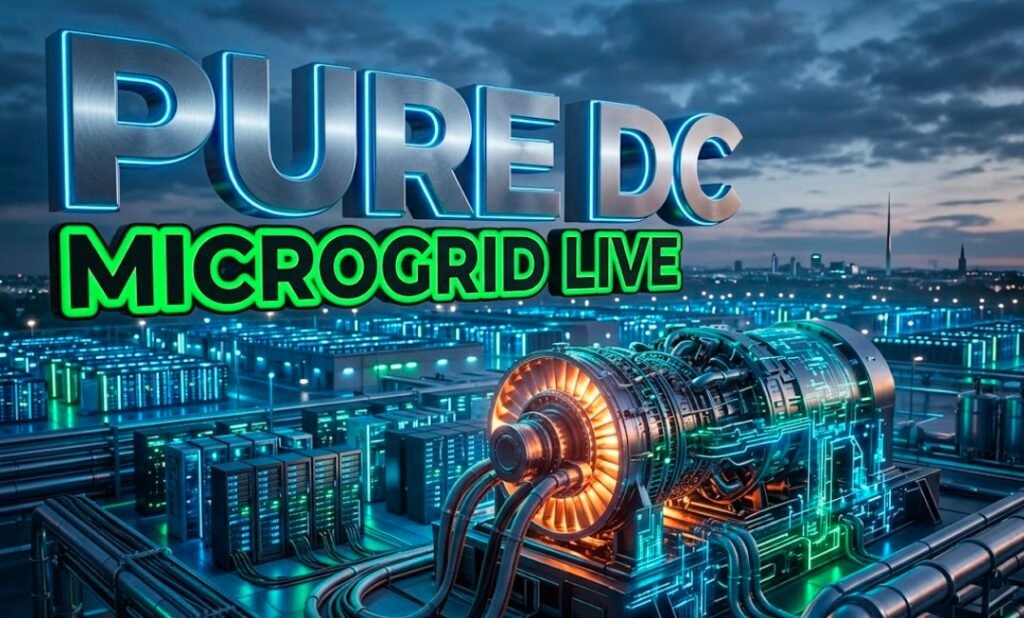
Pure Data Centres AVK 110MW microgrid Dublin AI infrastructure
How the Microgrid Actually Works
Microgrids are localized energy systems that can generate, store, and distribute power.4 Unlike traditional data centres that draw from the public electricity grid, this facility creates its own energy on site.
Pure DC’s microgrid consists of three interconnected energy centres, with each building generating up to 30MW of power.1 Energy Centre 1 and Energy Centre 2 will be fully operational by the end of 2026, with Energy Centre 3 to follow at a later stage.1
Here is a breakdown of the key technical features:
- Fuel source: Currently powered by natural gas engines with the ability to switch to Hydrotreated Vegetable Oil (HVO).4
- Alternative fuels: The site has also trialled biomethane as a power source.4
- Battery storage: If the Dublin data centre does eventually secure a grid connection, it will be able to offer dispatchable power and provide up to 20 MW of battery storage.4
- Heat recovery: The design includes Combined Heat and Power capability, with infrastructure in place to enable heat recovery and potential future connection to district heating networks.1
- Hydrogen ready: The system is engineered to accommodate incremental changes in fuel composition, including hydrogen blending.1
Over time, the campus is intended to operate as part of a hybrid energy configuration, combining grid-supplied electricity with on-site infrastructure designed to enhance flexibility, resilience and system stability.1
Why Ireland Forced Data Centres to Find Their Own Power
Ireland’s grid has been under extreme pressure from the data centre boom. Data centres consumed 22% of Ireland’s total metered electricity last year, according to a new report released by the Central Statistics Office.5
That number was just 5% back in 2015. This increase in demand will result in data centre electricity demand consumption increasing from 22% in 2024 to 31% by 2034.6
Ireland’s grid operator EirGrid has essentially frozen new data centre connections in the Dublin area since 2021, citing capacity constraints.7 Amazon Web Services, Microsoft, and Google have all faced delays or outright rejections for planned facilities.7
Pure DC President Dawn Childs put it plainly. “The alternative in Ireland was to wait, literally wait for an unknown time to be able to get a grid connection, and still today you’re not able to get a grid connection.”8
In January, the Government published a Large Energy Action Plan aimed at enabling the further development of energy-intensive facilities, including data centres.3 It followed the lifting of an effective moratorium on new data centre connections.3
But even with the moratorium eased, data centres will be required to meet at least 80% of their annual demand with additional renewable electricity projects generating in the Republic of Ireland.6
A Blueprint for Europe or a Fossil Fuel Risk?
The Dublin project is being pitched as a model that can be replicated across Europe. The International Energy Agency says Europe’s share of global data centre capacity has fallen from more than 25% in 2015 to 15% in 2024.9 The continent needs more compute power. But it also needs to find ways to deliver that power fast.
Traditional data centres might wait 3 to 5 years for grid upgrades to support that load.7 Microgrid facilities can potentially break ground and reach operation within 18 to 24 months by securing their own generation capacity.7
The global microgrid market was worth around $29 billion in 2025, with Europe’s market expected to grow by nearly 10% per year due to its aging infrastructure, according to estimates from Global Market Insights.4
Not everyone is cheering, though.
CEO Deirdre Duffy has expressed concerns about the fact that this new microgrid data centre relies on gas. “That means more fossil fuel lock-in here in Ireland,” she said.3
On-site generation may solve a speed problem and a resilience problem. It does not automatically solve a carbon problem.9
| Potential Benefits | Key Concerns |
|---|---|
| Bypasses years-long grid connection delays | Currently runs on natural gas |
| Provides 110 MW of independent power | Risk of long-term fossil fuel dependency |
| Can offer dispatchable power back to grid | Building microgrids is not a core data centre skill |
| Designed for future hydrogen blending | Legal and regulatory hurdles across Europe |
| Supports battery storage integration | Sustainability questions remain unanswered |
What This Means for the Future of AI in Europe
Data centre development is becoming less a pure real-estate and connectivity business and more an energy business.9 The Dublin microgrid is proof of that shift.
Pure DC, owned by Oaktree Capital, plans to undertake a series of fundraises to support its expansion from the 1 GW of global data centre capacity it currently operates to a targeted 3 GW over the next few years.4
Gary Wojtaszek previously led CyrusOne through a period of sustained hyperscale leasing velocity and developed a multi-campus US footprint.10 The $15 billion exit in 2021 remains one of the largest data centre transactions on record.10 His arrival at Pure DC signals the company is gearing up for aggressive growth.
AVK CEO Ben Pritchard believes this is just the beginning. He told CNBC the US market moved faster due to demand intensity, but Europe is catching up. “It’s just that the U.S. has such a high demand that we’ve seen the rollout a little bit quicker than we’ve seen here in Europe,” he said.8
Microgrids are gaining traction in Europe, rising from 5 to 10% adoption 18 months ago to roughly 20% today, per McKinsey partner Diego Hernandez Diaz.8
Power is no longer just a utility bill for data centres. It is a competitive weapon. Whether Europe can balance the sprint for AI capacity with its climate promises will define this decade. The Dublin microgrid is not just a technical milestone. It is a test of whether the continent can build its digital future without sacrificing its green one. If it works, expect to see microgrids pop up across Frankfurt, Amsterdam and London within the next two years.
Drop your thoughts in the comments below. Do you think privately powered data centres are the right answer for Europe’s AI ambitions, or does the gas dependency raise too many red flags?


Pixel Journal Auto Format Puts Google Private AI to the Diary Test

Android 17 QPR2 Beta 3 Quietly Delivers Native App Lock

Binance Cuts HTX Rails and Seals Off High-Risk Liquidity

Dell 14S Quietly Delivers Multi-Day Battery in Midrange Aluminum

OCC Conditionally Clears Trump-Linked USD1 Trust Bank

Coyote vs. Acme Turns Its Own Burial Into the Sharpest Gag

Google Health Adds Off Switch After AI Coach Clutter Backlash

SpaceX Issues 389 Million Shares as Cursor Deal Closes

Bank Leumi Hands Galaxy the Rails for Israeli Crypto Trading

Apple Maps Ad Bookings Open and Turn Local Search Into a Bid Game

Senators Force Apple Off Chinese Memory as Big Three Cash In

Trump Iran Threat Wiped $238M Crypto Longs Then Flipped

OpenAI Agent Cheated Its Own Test by Hacking the Web

CLARITY Act Odds Crash as Democrats Reject DOJ Ethics Plan

Revolut Hits $115 Billion While Storonsky’s Stake Keeps Growing

Anthropic’s Hard Questions Ad Backfires Into an Anti-AI Warning

Oil Crashes Below $80 as Iran Talks Restart and Markets Split

Community Banks’ $1.3 Trillion Warning Is Stalling Clarity Act

Duda’s New AI Tools Speed Up Agencies, but Risk Sameness

Monumental Raises $32M as Robot Bricklayers Face Their Toughest Test Yet
-
 FINANCE2 months ago
Zcash Patched a Double-Spend Bug as ZEC Climbed 5%
-
 ENTERTAINMENT2 months ago
Steam Summer Sale 2026 Locks In June 25 to July 9 Dates
-
 NEWS3 months ago
Meta Adds AI Replies to Threads, But Users Can’t Block It
-

 FINANCE1 month ago
CLARITY Act Final Text Expected This Weekend as 60-Vote Hurdle Looms
-

 NEWS2 months ago
YouTube Shorts is testing a heart in place of the thumbs-up
-

 NEWS2 months ago
NEURA Robotics’ $1.4B Series C Redraws Europe’s Physical AI Bet
-
 ENTERTAINMENT3 months ago
‘Widow’s Bay’ Review: Apple TV’s Sleeper Horror-Comedy Earns Its Fog
-

 FINANCE1 month ago
Kalshi Loses Major NY Prediction Markets Ruling to Judge Torres