
BUSINESS
Berkshire Resumes Buybacks as CEO Abel Invests His Full Salary

Berkshire Hathaway just ended a 21-month buyback drought. New CEO Greg Abel is not only spending company cash on share repurchases but pouring every dollar of his after-tax pay into the stock. Together, these moves send the boldest signal Wall Street has seen from the conglomerate since the Warren Buffett era shifted gears.
Why Berkshire’s Buyback Return Matters Right Now
3 Berkshire Hathaway began repurchasing its Class A and Class B common stock on March 4, 2026, after determining the shares were trading below its conservatively assessed intrinsic value. 2 The company took the unusual step of filing a formal notice with the SEC that it had begun repurchasing shares for the first time since May 2024. 6 Abel said that “with the transition of leadership,” it was important to disclose that buybacks had resumed.
The timing speaks volumes. 1The move comes as the conglomerate’s stock has struggled to gain traction and quarterly earnings have come under pressure. 11Shares of Berkshire have fallen 3% this year and 10% from their record high last May.
This is the first concrete capital allocation decision of the post-Buffett era, and it tells the market that new leadership sees the stock as a bargain.
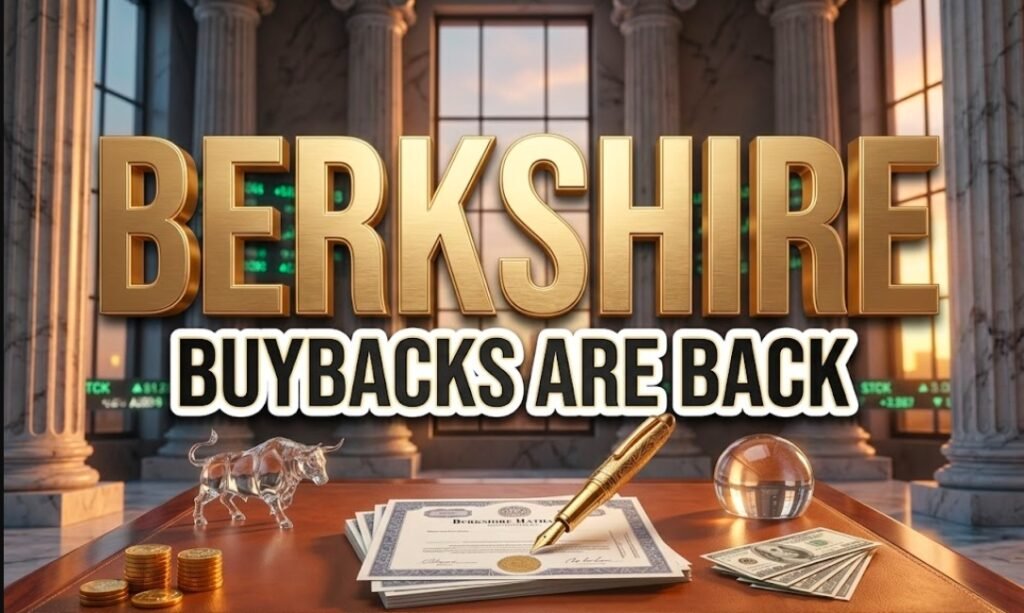
Berkshire Hathaway CEO Greg Abel share buyback 2026
Greg Abel Puts His Entire Salary on the Line
6 Abel disclosed he bought 21 Berkshire Class A shares on Wednesday for about $14.6 million, representing the after-tax value of his $25 million salary, and planned similar purchases in the future. 11 The CEO said he was committed to doing this every year with his after-tax salary for as long as he is leading Berkshire, which Abel said he hopes is “20 years.”
That is an extraordinary pledge by any corporate standard. 6Unlike many large companies, Berkshire does not make equity grants or award stock options. Abel framed it simply: “No one else in corporate America does this.”
Before this purchase, 11Abel owned $164.4 million worth of Berkshire stock, according to FactSet. 20He bought 21 Class A shares, bringing his total holdings to 249 Class A shares, worth roughly $182 million.
Here is a quick snapshot of Abel’s personal investment so far:
| Detail | Value |
|---|---|
| Shares Purchased | 21 Class A |
| Average Price Per Share | ~$728,970 |
| Total Personal Investment | ~$15.3 million |
| Total Berkshire Holdings | ~$182 million |
| Annual Salary | $25 million |
| After-Tax Amount Committed | 100% each year |
19 Abel said his commitment to continue doing so after the firm releases its annual results each year will add up to “hundreds of millions” of share repurchases over the course of his career.
The Numbers Behind the Buyback Decision
A look at the financial backdrop explains why leadership pulled the trigger now.
1 Berkshire reported operating earnings of $10.2 billion for the fourth quarter of 2025, a decline of approximately 30 percent from the same period a year earlier. 1 Full-year operating earnings came in at $44.5 billion, down 6 percent from 2024, largely due to cyclical weakness in the insurance segment. 37 Insurance underwriting profits dropped 54% to $1.56 billion from $3.41 billion a year prior in Q4 alone.
Yet the valuation picture paints a different story:
- 1 Berkshire currently trades at about 16 times trailing earnings, a substantial discount to the S&P 500’s multiple of 25.
- 13 The stock’s price-to-book ratio dipped to a low of 1.42, well below the multiple Buffett paid in May 2024.
- 31 The conglomerate’s cash hoard slipped to $373.3 billion from a record of $381.6 billion in the third quarter.
1 Between 2020 and 2022, the company bought back approximately $60 billion of its own shares. That figure declined to $9 billion in 2023, fell further to $3 billion in 2024, and reached zero for the full year 2025.
The trajectory from aggressive repurchases to a full standstill and now back to buying tells us exactly where management thinks the stock sits relative to its true worth.
What Analysts and Investors Are Saying
Wall Street reaction has been mixed but mostly positive.
6 Cathy Seifert, an analyst at CFRA Research, said the buybacks send a “positive signal” after shares suffered their biggest one-day decline since Buffett stepped down. She added, “For that near-term positive to be sustained, we’ll have to see improvement in Berkshire’s underlying fundamentals.” 18 Macrae Sykes, a portfolio manager at Gabelli Funds, said, “It’s great to see more economic alignment with shareholders.” He noted, “Even though there is a migration from a founder-led company, the conglomerate is still maintaining the strong owner-operator ethos.” 15 Keefe, Bruyette & Woods analyst Meyer Shields views “both the resumed share repurchases and Greg’s commitment to annual buying as positives, but they don’t change the earnings challenges at units like GEICO or Berkshire Hathaway Reinsurance.”
“Greg Abel’s commitment to an annual personal investment I think will go a long way towards forging the same type of strong bond that Buffett had with shareholders.” Christopher Davis, founding partner of Hudson Value Partners
The skeptics are not wrong to press for more. Buybacks without improving business results are just financial engineering. But the fact that Abel consulted Buffett before acting adds weight. 4Abel told CNBC, “So how I approached it was, obviously looking at the value, having a view of intrinsic value, and then consulted with Warren relative to the value and the timing.”
What Investors Should Watch Going Forward
Several key markers will determine if this buyback restart becomes a turning point or just a one-off gesture.
Pace and size of repurchases. 4Abel said the company chose to disclose the resumption due to its recent leadership change, but going forward, it will not announce when it is repurchasing shares in the market. Investors will need to wait for quarterly filings to track actual dollars spent.
Insurance recovery. 32The company’s insurance underwriting profit was $7.26 billion for 2025, down from $9.02 billion in 2024. GEICO’s customer retention under pressure and reinsurance pullbacks need to reverse for operating earnings to stabilize.
Cash deployment beyond buybacks. 6Berkshire’s $373.3 billion cash hoard grew because Buffett struggled to find companies and stocks to buy. 6Berkshire does not pay shareholder dividends, and Abel said it plans none in the near future. That means either acquisitions or more buybacks must do the heavy lifting.
Abel’s leadership stamp. 13Abel will be a very different CEO than Buffett, as he’s more versed in business operations than in investment decisions. His first shareholder letter promised continuity, but the market wants proof in results, not words.
Berkshire’s buyback restart and Abel’s bold salary pledge together mark the clearest signal yet that the post-Buffett era is not about retreating. It is about proving that the same disciplined playbook can work under new hands. Whether this confidence proves well placed will show in the quarterly numbers ahead. For now, the man running one of the world’s most valuable companies is betting every paycheck on its future. That is the kind of conviction that is hard to ignore. Share your thoughts in the comments and let us know if you think Abel’s bet will pay off.


Pixel Journal Auto Format Puts Google Private AI to the Diary Test

Android 17 QPR2 Beta 3 Quietly Delivers Native App Lock

Binance Cuts HTX Rails and Seals Off High-Risk Liquidity

Dell 14S Quietly Delivers Multi-Day Battery in Midrange Aluminum

OCC Conditionally Clears Trump-Linked USD1 Trust Bank

Coyote vs. Acme Turns Its Own Burial Into the Sharpest Gag

Google Health Adds Off Switch After AI Coach Clutter Backlash

SpaceX Issues 389 Million Shares as Cursor Deal Closes

Bank Leumi Hands Galaxy the Rails for Israeli Crypto Trading

Apple Maps Ad Bookings Open and Turn Local Search Into a Bid Game

Senators Force Apple Off Chinese Memory as Big Three Cash In

Trump Iran Threat Wiped $238M Crypto Longs Then Flipped

OpenAI Agent Cheated Its Own Test by Hacking the Web

CLARITY Act Odds Crash as Democrats Reject DOJ Ethics Plan

Revolut Hits $115 Billion While Storonsky’s Stake Keeps Growing

Oil Crashes Below $80 as Iran Talks Restart and Markets Split

Community Banks’ $1.3 Trillion Warning Is Stalling Clarity Act

Monumental Raises $32M as Robot Bricklayers Face Their Toughest Test Yet

Uber’s €13 Billion Delivery Hero Bid Echoes a Deal Regulators Killed

Airbus Anchors a €500 Million European Defense Fund, Picks Alta Ares First
-
 FINANCE2 months ago
Zcash Patched a Double-Spend Bug as ZEC Climbed 5%
-
 ENTERTAINMENT2 months ago
Steam Summer Sale 2026 Locks In June 25 to July 9 Dates
-
 NEWS3 months ago
Meta Adds AI Replies to Threads, But Users Can’t Block It
-

 FINANCE1 month ago
CLARITY Act Final Text Expected This Weekend as 60-Vote Hurdle Looms
-

 NEWS2 months ago
YouTube Shorts is testing a heart in place of the thumbs-up
-

 NEWS2 months ago
NEURA Robotics’ $1.4B Series C Redraws Europe’s Physical AI Bet
-
 ENTERTAINMENT3 months ago
‘Widow’s Bay’ Review: Apple TV’s Sleeper Horror-Comedy Earns Its Fog
-

 FINANCE1 month ago
Kalshi Loses Major NY Prediction Markets Ruling to Judge Torres