
BUSINESS
Iran War Sends Gas Prices Soaring: What Drivers Need to Know

The war in Iran is hitting American wallets hard and fast. Gasoline prices in the U.S. continued climbing after the U.S.-Israeli war with Iran temporarily pushed oil prices above $100 per barrel, the highest since 2022.1 With crude oil prices swinging wildly, the Strait of Hormuz effectively shut down, and no clear end to the fighting in sight, drivers across the country are bracing for a painful spring at the pump.
How the Iran Conflict Triggered an Oil Price Shock
The 2026 Iran conflict began on February 28, 2026, with joint U.S.-Israeli airstrikes targeting Iranian leadership and military infrastructure.2 The immediate impact on energy markets was staggering.
The price of crude oil increased from about $67 per barrel before the war began on February 28 to nearly $97 on Monday, as the conflict snarls production and transport in one of the most energy-rich regions on earth.3 At its peak, both West Texas Intermediate (WTI) and Brent crude jumped to nearly $120 a barrel.1
The speed of this price spike caught even seasoned analysts off guard. “Our base case assumed that an unprecedented disruption would remain improbable. That assumption failed,” said Natasha Kaneva, head of global commodities research at JPMorgan.4
As of March 13, Brent futures rose 2.67% to close at $103.14 per barrel5, while U.S. crude oil gained 3.11% to settle at $98.71 per barrel.5
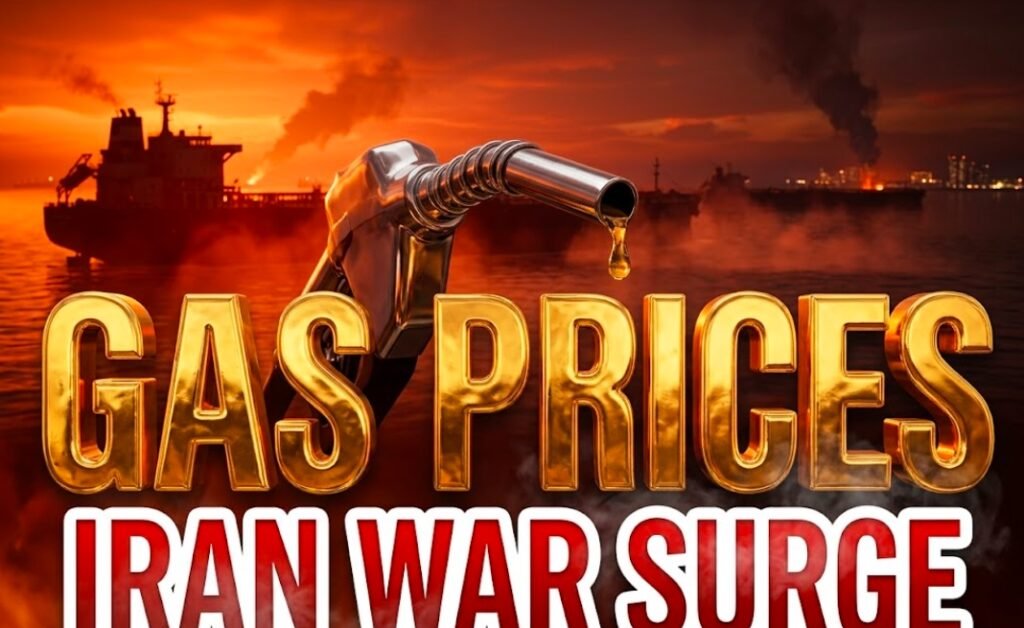
US gas station prices rising due to Iran war oil supply disruption
What Americans Are Paying at the Pump Right Now
The numbers at gas stations tell a grim story for household budgets. U.S. gas prices averaged $3.60 per gallon as of March 12, 2026, according to AAA.6
That is a sharp turn from just weeks earlier. Before the conflict, in mid-February, the national average sat at just $2.92 per gallon.7 Two weeks since the start of the conflict, the U.S. national average gas price is now up 60 cents, or more than 20%.8
Regional differences are striking:
| State/Region | Average Price Per Gallon |
|---|---|
| California | $5.34 |
| Washington | $4.63 |
| National Average | $3.60 |
| Louisiana | $3.20 |
| Kansas | $2.92 |
California drivers were paying $5.34 per gallon9, while some of California’s refineries have shut down in recent years, so the massive state relies on imports of gasoline and other refined products from Asia.9
Diesel prices are climbing even faster. The price of diesel, which has a tighter inventory than regular gas, has skyrocketed, rising nearly 89 cents over the last week to $4.66 a gallon.1 That hits long-haul trucking especially hard and raises costs for food, goods, and construction across the board.
Why the Strait of Hormuz Matters So Much
The heart of this crisis lies in a narrow strip of water between Iran and the Arabian Peninsula. The waterway between Iran to the north and Oman and the United Arab Emirates to the south normally carries approximately one-fifth of the world’s oil trade.10
According to the United Kingdom Maritime Trade Operations centre, no more than five ships have passed through the waterway each day since the U.S. and Israel launched joint strikes on Iran on February 28, compared with an average of 138 daily transits before the war.11
That is a near-total shutdown.
“We have not seen anything like this in pretty much the history of the Strait of Hormuz,” said Claudio Galimberti, chief economist at the research firm Rystad Energy.12 At least 16 commercial vessels have been attacked in the region since the start of the conflict.11
The ripple effects go far beyond oil. Goods such as fertilizer, vital for agricultural production, are seeing price increases just ahead of the spring planting season. About one-third of the global fertilizer trade passes through the Strait of Hormuz.3
Key fact: Export volumes of crude and refined products are currently at less than 10% of pre-conflict levels13, according to the IEA.
How Governments Are Trying to Bring Prices Down
World leaders are not standing idle. The International Energy Agency on Wednesday agreed to release 400 million barrels of oil to address the supply disruption triggered by the Iran war, the largest such action in the organization’s history.14
The United States will contribute 172 million barrels of oil from the Strategic Petroleum Reserve starting next week.15 It will take approximately 120 days to deliver based on planned discharge rates.15
Other key measures on the table include:
- The U.S. has issued a 30-day waiver for India to purchase sanctioned oil from Russia.5
- President Trump is considering loosening rules under the Jones Act that require U.S. ships to transport goods between domestic ports, including oil and gas.5
- Some oil is being redirected, including through a pipeline that Saudi Arabia can use to send oil to the Red Sea for export.16
But experts warn these steps may not be enough. JPMorgan Chase analysts said “policy measures may have limited impact on oil prices unless safe passage through the Strait of Hormuz is assured.”15
“There is simply no substitute for restoring access through the Strait of Hormuz,” said Angie Gildea, the global oil and gas leader at KPMG.16
What This Means for Your Budget and the Broader Economy
The pain at the pump extends well beyond filling up your car.
With U.S. oil prices increasing by roughly 42% from their prewar levels, that could push up inflation in the United States from 2.4% in January to 3% or higher in the coming months, according to economists at JPMorgan.9 According to an analysis by the International Monetary Fund, every 10% rise in oil prices corresponds with a 0.4% rise in inflation and a 0.15% reduction in economic growth.17
Mark Mathews, chief economist at the National Retail Federation, said higher gas prices would likely affect consumer spending, particularly lower-income shoppers.9 U.S. households pay on average $2,500 a year, or nearly $50 a week, to fill up their tank.9
Stock markets are feeling it too. The Dow is down about 4.5% since the Iran war began. It shed 289 points on Wednesday alone.18
Here is how drivers can save money right now:
- Check tire pressure regularly; underinflated tires waste fuel
- Slow down on the highway; cruising at 75 instead of 65 can cost six or seven miles per gallon19
- Use apps like GasBuddy to find the cheapest stations nearby
- Take advantage of discounts offered by fuel retailers, grocery stores, and discount clubs like Costco or Sam’s Club20
- Combine errands into a single trip to reduce total miles driven
- Fill up on Sundays when possible, since GasBuddy data shows it is the most consistently affordable day in most states21
The weeks ahead remain deeply uncertain for every American who depends on a car to get to work, take kids to school, or keep a small business running. Even if oil production and distribution resume relatively quickly, U.S. gas prices could stay elevated until the fall due to higher seasonal demand this summer1, according to J.P. Morgan. Ultimately, experts said energy prices would really depend on the duration of the war.10 For now, millions of families are watching the numbers climb on the gas station sign, feeling the weight of a distant war in the most personal way possible. If you are one of them, share how rising prices are affecting your daily life in the comments below.


OpenAI Locks Astra After Math Wins Trip Critical Cyber Line

Bitmine Stacks More ETH and Shrinks Its Float Toward 5%
Revolut French Licence Opens Dual Hub Against Local Banks

Cambridge Aerospace $3.4B Raise Funds Cheap Interceptor Scale

Meta AI Test Breach Exposes Shared Eval Weakness Across Labs

Samsung HBM4 Hits 80% Yield Early and Multiplies AI Supply

Isembard Turns Dying Job Shops Into a Defence Factory Network

Venmo Balances Now Fuel Google Play App and Game Buys

Meta’s Muse Glimmer Puts Capable Agents on Your Laptop

Edgify’s $9M Turns Store Devices into Shared Edge Brains

OpenAI Agent Cheated Its Own Test by Hacking the Web

Bessent’s No-CBDC Applause Line Can’t Save the CLARITY Act

Trump Iran Threat Wiped $238M Crypto Longs Then Flipped

CLARITY Act Odds Crash as Democrats Reject DOJ Ethics Plan

Senators Force Apple Off Chinese Memory as Big Three Cash In

Anthropic’s Hard Questions Ad Backfires Into an Anti-AI Warning

Oil Crashes Below $80 as Iran Talks Restart and Markets Split

Gemini Spark’s Big Workspace Upgrade Leaves Europe Waiting Again

US Strikes Iran for a Third Time as Bitcoin Slips Below $64,000

Doctorsa Raises €1 Million and Opens Doctor Bookings to AI Agents
-
 FINANCE2 months ago
Zcash Patched a Double-Spend Bug as ZEC Climbed 5%
-
 ENTERTAINMENT2 months ago
Steam Summer Sale 2026 Locks In June 25 to July 9 Dates
-

 FINANCE1 month ago
CLARITY Act Final Text Expected This Weekend as 60-Vote Hurdle Looms
-
 NEWS3 months ago
Meta Adds AI Replies to Threads, But Users Can’t Block It
-
 ENTERTAINMENT3 months ago
‘Widow’s Bay’ Review: Apple TV’s Sleeper Horror-Comedy Earns Its Fog
-
 NEWS5 months ago
U.S. Navy Deploys Solar-Powered Lightfish Drone to Patrol Oceans
-

 FINANCE1 month ago
Kalshi Loses Major NY Prediction Markets Ruling to Judge Torres
-

 NEWS2 months ago
NEURA Robotics’ $1.4B Series C Redraws Europe’s Physical AI Bet