
NEWS
Axelera AI Raises $450M to Challenge Nvidia With Local AI Chips

Dutch chipmaker Axelera AI just pulled off the biggest funding round ever seen by an EU AI semiconductor company. With over $450 million raised and BlackRock now on board, this Eindhoven startup is betting big that European businesses want to run AI on their own turf, not in distant data centers controlled by American tech giants.
What Axelera AI Is Building and Why It Matters
Axelera AI makes chips and software for inference, the computing process of running an AI model, as opposed to training one.1 This is a crucial difference. Training gets the headlines, but inference is where AI actually works in the real world.
The company’s chips are designed for use on edge devices, such as mobile phones and smart cameras, processing data directly on devices rather than relying on large data centers.1 That means faster results, lower energy bills, and most importantly for many European clients, data that never leaves the building.
Axelera AI is a Netherlands-based chip company founded in 2021 as a spin-off from imec.2 The team includes co-founders and engineers drawn from imec, IBM, Google, ETH Zurich, Intel and Qualcomm.3
The company currently has two chip families on the market:
- Metis: Delivers up to 214 TOPS (INT8) with an efficiency of approximately 15 TOPS per watt.2 Built for computer vision and embedded AI.
- Europa: Provides up to 629 TOPS (INT8) and incorporates second-generation digital in-memory-compute architecture across eight AI cores.2 This one can handle generative AI.
- Titania (coming soon): Received a $66 million EU grant as part of the DARE project.4 Expected in 20274, it targets data center and supercomputing workloads.
According to the startup, Europa delivers three to five times performance efficiency over leading industry solutions in the same product category.5 In an interview with CRN, the company said those comparisons related to recent Nvidia products used for edge computing, including the L40 GPU and Jetson products.5
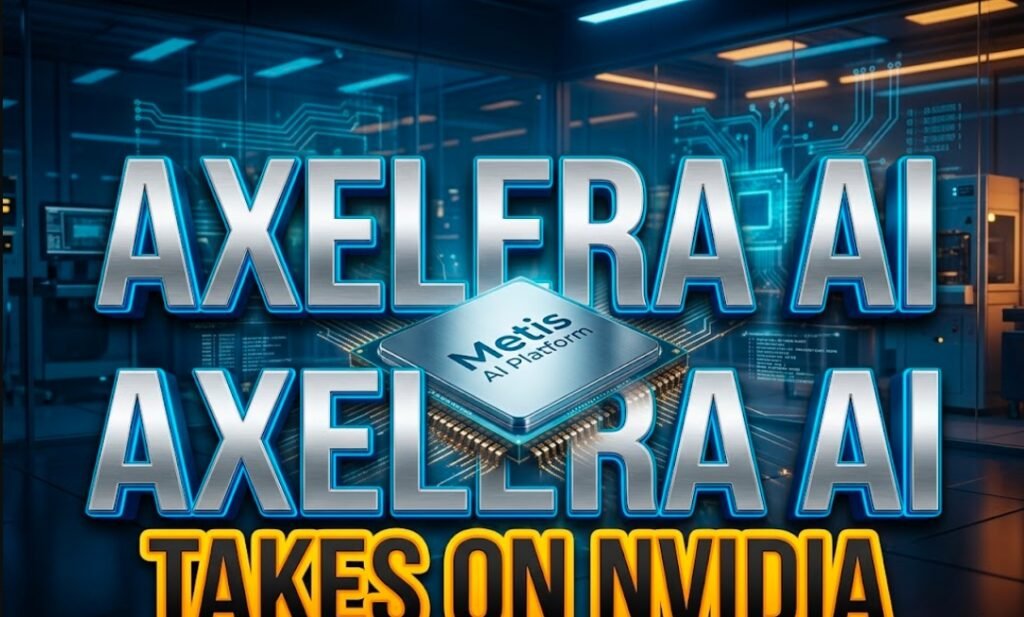
Axelera AI edge inference chip Europa challenging Nvidia in Europe
BlackRock-Backed $250M Round Breaks EU Records
The latest funding round was led by Innovation Industries, with participation from BlackRock and SiteGround Capital as new investors, along with existing backers including Bitfury, CDP Venture Capital, the European Innovation Council Fund, Samsung Catalyst Fund, and others.6
This marks the largest investment ever in an EU AI semiconductor company.6 The company has now attracted over $450 million in equity, grants and venture debt since incorporating in July 2021.6
“Investors increasingly recognize that Europe has world-class AI talent,” CEO Fabrizio Del Maffeo told EE Times. “Many of the people building Axelera helped create globally successful semiconductor companies over the past few decades.”7
Del Maffeo said the company would use the money to expand manufacturing of its Europa chip, which it plans to launch before June 2026, and to further develop software that makes using its chips easier for customers.4
Axelera’s manufacturing runs through partnerships with TSMC and Samsung.8 That puts it on the same production footing as many of its larger competitors.
Europe’s Push for AI Sovereignty Creates a Perfect Opening
The timing could not be better for Axelera. Geopolitical tensions, data privacy fears, and a growing push for European tech independence are all working in the company’s favor.
AI sovereignty has been a much talked-about topic in European policy circles, and concerns have been accelerated by the fear that Trump might weaponize critical technologies.9 In December 2024, the European Commission appointed Finland’s Henna Virkkunen as the first-ever commissioner for Tech Sovereignty, Security and Democracy.9
The EU has put serious money behind this vision. The EU’s €200 billion AI Continent Action Plan aims to establish European digital sovereignty.10 The European Chips Act, effective September 2023, is mobilizing €43 billion in public and private funding to double Europe’s chip production market share to 20% by 2030.11
Three major US hyperscalers control over 65% of the European cloud market, and US laws like the CLOUD Act allow American authorities to compel access to data held by US companies, regardless of where that data is stored.12 For defence contractors, hospitals, and government agencies, that is a deal-breaker.
CEO Del Maffeo acknowledged the sovereignty wave but was clear about something important. He said: “Sovereignty is extremely important, because we can answer the needs of Europe. But I started this company not because of sovereignty. A company can’t survive only on the concept of sovereignty.”
Defence, Drones, and the Case for Processing Data Locally
Axelera now ships to over 500 global customers across sectors including defence, public safety, industrial manufacturing, retail, agritech, robotics, telecommunications, and aerospace.6
Defence stands out as a sector where edge AI is not optional. It is a must. When military units operate in areas where communication links are jammed or cut, they cannot depend on a cloud server thousands of miles away. Drone swarms coordinating maneuvers need local chips that can think on the spot.
Del Maffeo put it this way: “There are some sectors where there is more sensitivity, like the defence sector. It’s a sector where more and more companies want to be free, have local technology, stay close to customers.”
Europe is ramping up defence spending to a record $402 billion, and the region’s semiconductor sector for aerospace and defence is expected to grow from $4.58 billion in 2025 to $6.11 billion by 2030.13
That growing defence budget represents real, immediate demand for exactly the kind of chips Axelera builds.
Why Europe’s Biggest Problem Is Not Technology, It Is Adoption
Perhaps the boldest part of Del Maffeo’s message was not about chips. It was about culture.
He called on European governments and businesses to stop waiting and start buying from homegrown tech firms. His comparison was striking: “It was the first customer of Intel, it was the first customer of SpaceX. The government is the first customer. Without the commitment of NASA, SpaceX would fail, it would just crash.”
He continued: “We don’t have the European DARPA. We don’t have the government as a first customer. And we don’t have corporations as the second customer. Corporations in Europe wait for the technology to mature. American corporations adopt technologies.”
That gap between European innovation and European adoption is something many founders across the continent have raised for years. European tech companies and industry groups have called on EU leaders to take radical action supporting homegrown digital infrastructure and reducing foreign tech dependence through procurement requirements.9
Meanwhile, the competition keeps moving. Nvidia made its largest purchase ever in December 2025, acquiring assets from inference chip startup Groq for about $20 billion.14 Large tech companies including OpenAI, Microsoft, Meta, Amazon and Google are also manufacturing their own custom AI chips.15
A future IPO for Axelera is not imminent, but Del Maffeo is keeping his options open. He said he would not feel tied to listing in Europe. “I think we should be very pragmatic and understand where we can create more value for our shareholders.”
From a startup born in the shadow of ASML’s Eindhoven headquarters to a company now backed by BlackRock and shipping chips to 500 customers worldwide, Axelera AI has grown faster than almost anyone predicted. Whether Europe’s governments and businesses will match that pace with real orders and real contracts may determine not just Axelera’s future, but Europe’s place in the global AI race. If you have thoughts on Europe’s path to AI sovereignty, drop them in the comments below.


OpenAI Locks Astra After Math Wins Trip Critical Cyber Line

Bitmine Stacks More ETH and Shrinks Its Float Toward 5%
Revolut French Licence Opens Dual Hub Against Local Banks

Cambridge Aerospace $3.4B Raise Funds Cheap Interceptor Scale

Meta AI Test Breach Exposes Shared Eval Weakness Across Labs

Samsung HBM4 Hits 80% Yield Early and Multiplies AI Supply

Isembard Turns Dying Job Shops Into a Defence Factory Network

Venmo Balances Now Fuel Google Play App and Game Buys

Meta’s Muse Glimmer Puts Capable Agents on Your Laptop

Edgify’s $9M Turns Store Devices into Shared Edge Brains

OpenAI Agent Cheated Its Own Test by Hacking the Web

Bessent’s No-CBDC Applause Line Can’t Save the CLARITY Act

Trump Iran Threat Wiped $238M Crypto Longs Then Flipped

CLARITY Act Odds Crash as Democrats Reject DOJ Ethics Plan

Anthropic’s Hard Questions Ad Backfires Into an Anti-AI Warning

Oil Crashes Below $80 as Iran Talks Restart and Markets Split

Gemini Spark’s Big Workspace Upgrade Leaves Europe Waiting Again

US Strikes Iran for a Third Time as Bitcoin Slips Below $64,000

Doctorsa Raises €1 Million and Opens Doctor Bookings to AI Agents

Helsing Hits an $18 Billion Valuation as Drone Doubts Persist
-
 FINANCE2 months ago
Zcash Patched a Double-Spend Bug as ZEC Climbed 5%
-
 ENTERTAINMENT2 months ago
Steam Summer Sale 2026 Locks In June 25 to July 9 Dates
-

 FINANCE1 month ago
CLARITY Act Final Text Expected This Weekend as 60-Vote Hurdle Looms
-
 NEWS3 months ago
Meta Adds AI Replies to Threads, But Users Can’t Block It
-
 ENTERTAINMENT3 months ago
‘Widow’s Bay’ Review: Apple TV’s Sleeper Horror-Comedy Earns Its Fog
-
 NEWS5 months ago
U.S. Navy Deploys Solar-Powered Lightfish Drone to Patrol Oceans
-

 FINANCE1 month ago
Kalshi Loses Major NY Prediction Markets Ruling to Judge Torres
-

 NEWS2 months ago
NEURA Robotics’ $1.4B Series C Redraws Europe’s Physical AI Bet