
NEWS
Alpine Eagle Scales Sentinel by Riding Dutch UAV Lines
Alpine Eagle is scaling Sentinel by plugging software into DeltaQuad’s Dutch UAV line and Origin’s BLAZE interceptors, targeting 1,000 units a month.

Alpine Eagle plans a 2,000-square-metre interceptor plant near Munich and says a Dutch UAV line can turn out more than 1,000 Sentinel units a month. The Munich counter-drone firm said on March 19, 2026, that European governments want airborne defences they can field in weeks, not in a decade-long missile programme.
The plant is the headline. The quieter change is the stack: Sentinel-OS is being written to run on other people’s airframes and other people’s interceptors, starting with DeltaQuad in the Netherlands and, from June, Origin Robotics in Latvia.
Sentinel Puts the Kill Chain in the Air
Sentinel is an airborne counter-UAS net, not a truck with a jammer. Radar and cameras fly with the sensors, so hills and trees do not blank the picture the way a ground mast does. Co-founder and CEO Jan-Hendrik Boelens, a former Airbus chief engineer who later ran technology at Volocopter and Quantum Systems, has described the whole kill chain as aerial: find, track, and kill without waiting for the threat to fly into a fixed bubble.
Benji Pauly, Alpine Eagle’s business development manager, put the design choice in plain terms in a January 12, 2026 DSEI briefing: ground radar picks up clutter and dies behind terrain, so the company put the radar on a drone and filtered the noise on the aircraft. Operators can launch about 50 km back, push the sensor ahead of friendly troops, and hand off a coordinate. They can watch, or they can shoot.
The in-house shooter is Sparrowhawk, carried under the mothership in what Pauly called a marsupial mount, loitering until it is sent. Company material also describes catapult and air-launch options, with the interceptor steered by Sentinel-OS plus its own electro-optical seeker. Eagle Watch is the ground-control layer. The software is built to speak SAPIENT, the UK-backed plug so detections can pass into a wider battle network with little extra setup.
THE SENTINEL STACK
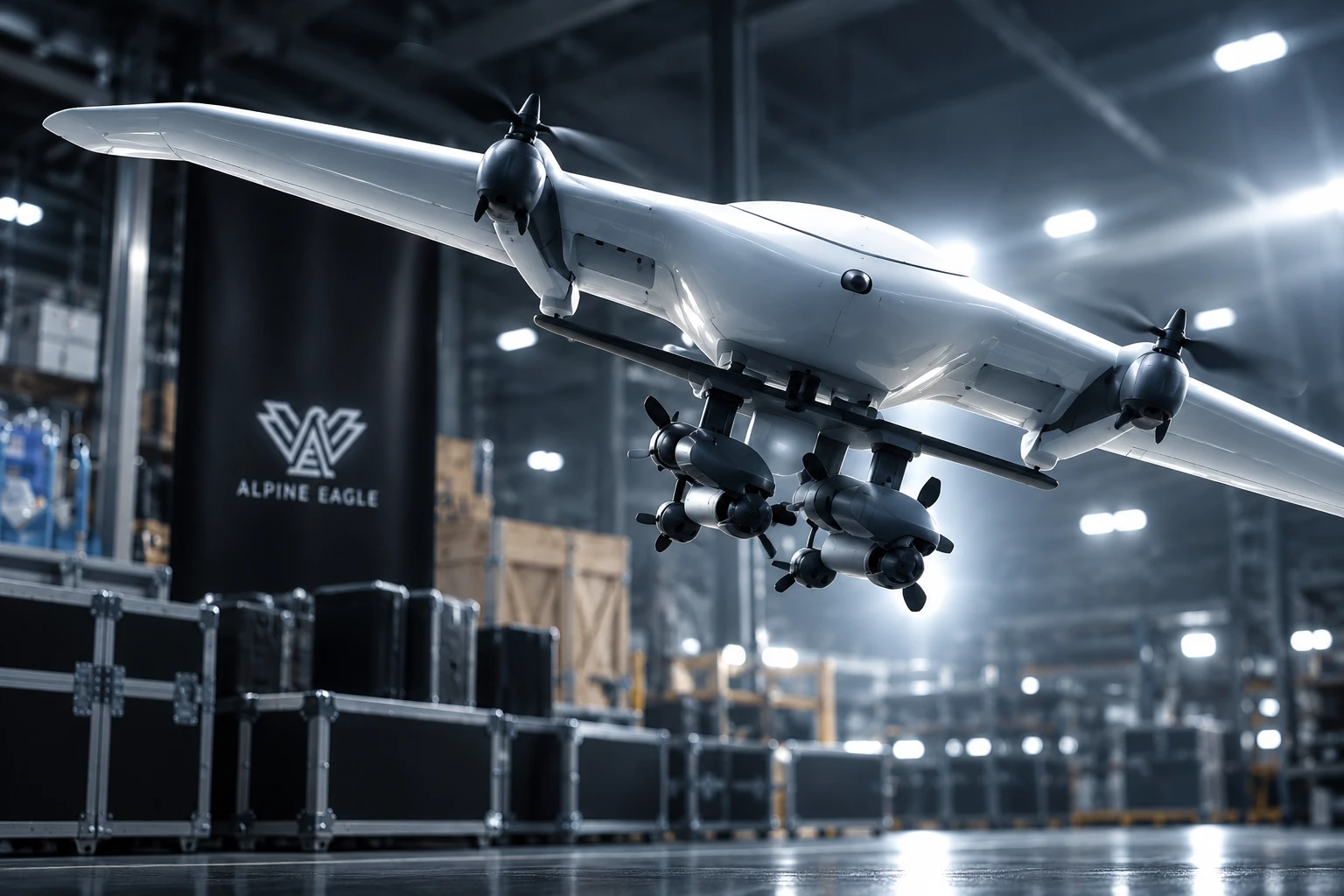
- Sensor mothership: A VTOL fixed-wing airframe carrying radar and cameras, flown as a moving picket rather than a mast.
- Sparrowhawk: Alpine Eagle’s own air-to-air interceptor, carried on the mothership until it is launched.
- Sentinel-OS: The software layer that fuses tracks, ranks threats, and can hand fire control to more than one effector.
- Eagle Watch: Browser-based ground control for planning, radar, and the live picture.
That split matters for output. The expensive, certified flying truck does not have to be invented in Munich. The thing Munich wants to own is the brain, the radar software, and the small killer it hangs underneath.
A Dutch Factory Already Has the Permits
On March 19 the company said it integrates Sentinel with the DeltaQuad Evo, a VTOL UAV built in the Netherlands. Boelens told an interviewer the point is industrial, not cosmetic. The plants, permits, and production steps already exist, so output can move from several hundred units to more than 1,000 a month without waiting for a new German factory to clear local rules.
DeltaQuad’s own spec sheet is why that mothership can stay on station. The Evo’s empty airframe weighs 4.8 kg, maximum takeoff weight is 10 kg, and the payload bay is rated at 3 kg, enough for a radar panel and a hanging interceptor. Dual-battery endurance is listed at 272 minutes, which is 4 hours 32 minutes, on DeltaQuad Evo’s 270 km flight range. Wingspan is 269 cm. The tactical kit adds anti-jam GPS, a radio quiet mode, and Silvus data links, the same mesh radios Alpine Eagle has used in Ukraine trials.
THE TWO PRODUCTION TRACKS
| Piece | Who builds it | What March 2026 actually said |
|---|---|---|
| Mothership airframe | DeltaQuad, Netherlands | Existing line, permits in place, several hundred to more than 1,000 units a month |
| Sparrowhawk interceptor | Alpine Eagle, Munich area | A 2,000-square-metre plant planned, not described as open |
| Sentinel-OS and sensors | Alpine Eagle | Software-defined layer meant to ride more than one airframe |
| BLAZE interceptor | Origin Robotics, Latvia | June 2026 MoU to plug into Sentinel; German assembly only a pathway |
Boelens has made European sourcing a talking point, saying the firm uses European partners wherever it can. That still leaves a mixed kit: Dutch airframe, German software, and, in 2025 product descriptions, U.S. Echodyne radar panels on the wing. The sovereignty story is the assembly line and the code, not every chip in the nose.
Why Million-Dollar Missiles Lose to Cheap Drones
Governments are buying this class of system because the old intercept math broke. In its March 19 statement, Alpine Eagle cited analyst estimates that defenders spent over $1.5bn intercepting drones that may have cost attackers around $250m to launch. The company used that Gulf imbalance, and the daily grind in Ukraine, as the reason ministries now want volume at a price that is closer to the attacker’s.
Boelens has been blunter about the unit that actually shows up over a trench. In the €10.25 million seed round in March 2025 note published by lead investor IQ Capital, he talked about $500 first-person-view drones that can wreck tanks worth millions, and about using cheap, mass-made systems to match that numbers game. High-end batteries such as Patriot and THAAD still matter against aircraft and ballistic missiles, he said later. They are the wrong tool, in cost and in magazine depth, against a swarm of small airframes.
The mothership in this design is not meant to be thrown away. It carries the radar. The expendable piece is the interceptor, which can ram, net, or otherwise kill, depending on the load. That is the symmetry the company is selling: spend something you can reprint, not a PAC-3, on a Shahed-class one-way drone.
Airborne intercept is no longer a one-firm idea. Ukrainian shops already turn out FPV hunters by the thousand, Anduril rams with Anvil, and another Munich firm, Tytan, is in the same city chasing interceptor volume. Alpine Eagle’s wager is the moving radar net and the software that can fire more than one kind of killer, not a slightly faster quadcopter.
First the Bundeswehr, Then Ukraine
The sales pitch only works if the kit has been flown. Pauly said first Bundeswehr trials ran in October 2024 and that units were going out by November, with deliveries still running into 2026. The launch-customer relationship is the one hard named deal. Alpine Eagle says it has since signed three more European customers and opened in the UK and the Netherlands. It has not named those three, and the Dutch innovation programme it joined is also unnamed in the March 19 text.
Detection numbers from those trials are modest on purpose, because the targets are small. Pauly said the Bundeswehr run showed tracks on airframes below 5 kg out to 4 km. Separate briefings put a DJI Mini-sized drone at about 1 km and a larger airframe at 4 km. Each sensor aircraft covers about 120 degrees; a small team of them is how the company claims a full circle. Company papers put the fielded system at TRL 7-8, meaning it is on sale, not a lab mock-up.
FROM LAB TO FIELD
- July 2023: Jan-Hendrik Boelens and Timo Breuer found Alpine Eagle GmbH in Germany.
- October 2024: First Bundeswehr trials of Sentinel.
- November 2024: Deliveries to the German armed forces begin.
- March 5, 2025: IQ Capital leads a €10.25 million ($10.96 million) seed, with HTGF, Expeditions Fund, Sentris Capital, General Catalyst, and HCVC. The firm says it already had seven-digit revenue in year one and planned to grow the team toward 40 people.
- 2025: Ukraine trials under jammed GPS, including work on fibre-optic drones that radios cannot spoof; Silvus mesh radios in the link. The same year, Sentinel flies in Project Vanaheim, the UK and US Army’s Class 1 counter-drone trial, among a much larger field of sensors, jammers, and guns.
- March 19, 2026: Alpine Eagle says the team is at 50, aims for 100 in 2026, and publishes the production plan.
- June 16, 2026: MoU with Origin Robotics at Eurosatory in Paris.
Boelens has said the company delayed a hard push into Ukraine until the system was mature enough not to waste a brigade’s time. Fibre-optic FPV, which ignores radio jamming, is one of the front-line problems those brigades asked it to look at. An airborne radar does not care that the attacker cut the radio. It still has to see a small, low, fast shape and put an interceptor on it.
Vanaheim is easy to over-read. The British Army used it to put many C-UAS kits in front of generalist soldiers, on Jackals and on foot, against the cheap FPV problem drawn from Ukraine. Alpine Eagle was in that mix. So were RF finders, jammers, and other hard-kill kits. There has been no public down-select that names Sentinel as the programme of record.
Origin Robotics Brings BLAZE Into the Stack
Three months after the production note, Alpine Eagle used Eurosatory, June 15 to 19, 2026 in Paris, to sign a memorandum of understanding with Origin Robotics, the Latvian maker of the BLAZE interceptor. The firms said they would integrate Origin Robotics BLAZE into Sentinel, starting with technical hookup, customer demos, and field checks, and that they would sketch a path to building BLAZE in Germany later.
BLAZE is a radar-guided interceptor that already carries NATO stock numbers and, Origin says, has been used by Latvia, Belgium, and Estonia. It is a ground-launched layer, which is the gap Boelens had been looking to fill beside Sparrowhawk. France separately picked BLAZE for its own forces at the same show, with local assembly through a French partner. That French order is Origin’s, not Alpine Eagle’s, and should not be read as a Sentinel sale.
Drone warfare is forcing militaries to rethink how they protect airspace. The challenge is to bring detection, tracking, and interception together into an integrated system that can respond quickly and scale with the threat. Integrating BLAZE into Sentinel expands our sensor-to-effector architecture and gives customers another effective layer within a broader counter-drone network.
Jan-Hendrik Boelens, co-founder and CEO, Alpine Eagle, June 16, 2026 partnership statement
Read that against the March production plan and the second-order bet is obvious. Munich does not have to win a monopoly on the interceptor. It has to own the picture and the software that can fire Sparrowhawk from the air, BLAZE from the ground, and whatever else a ministry already bought.
The Munich Plant Is Still a Plan
The March 19 text is careful on brick and mortar. Alpine Eagle said it was planning a 2,000-square-metre interceptor plant near Munich for the in-house shooter. It did not give an opening date, a town, or a unit-per-month figure for that hall. Some recaps still wrote as if the doors were already open. They were not, on the company’s own wording, and no later public note through early September 2026 has said the hall is running.
Staff numbers are firmer, and still incomplete. The team went from 12 people in 2024 to 50 by the March 2026 statement, after the seed round had aimed at about 40. Management said it planned to reach 100 employees in 2026 as production scaled. Whether that 100 landed by autumn has not been published. IQ Capital, General Catalyst, and HCVC remain the named backers, with the seed round still the last disclosed raise.
WHAT WE KNOW
- Launch customer: The Bundeswehr flew Sentinel in October 2024 and has been taking deliveries since November 2024.
- Dutch line: Boelens tied the 1,000-a-month figure to DeltaQuad’s existing plants, not to the Munich hall.
- BLAZE paper: The June MoU is real; it is an integration plan, not a joint product already on a flight line.
WHAT IS UNCONFIRMED
- The hall: No public confirmation that the 2,000-square-metre interceptor site has opened.
- The 100: Headcount at 100 in 2026 was a target, not a reported total.
- The three customers: Named only as additional European buyers; the Dutch programme is unnamed.
- Kill rates: Ukraine and Vanaheim participation is on the record; scores and contract values are not.
Pauly has also flagged a civilian door that is still half shut. Airports and stadiums look like customers on paper, but radar rules around existing air-traffic kit have been a brake. Incursions over European sites are changing the politics. They have not yet turned Sentinel into a routine civil product.
What Four Weeks to Delivery Buys
Boelens’ other number is speed. He said Alpine Eagle can put a working set in a customer’s hands about four weeks after a contract, because the Dutch line is already permitted and the kit is meant to travel small, with little training. “Rapidly deployable, for us, means weeks, not months,” he said. In the March 19 statement he tied that clock to the same idea as the factory:
By building on existing industrial capacity and integrating it with our own sensor and software architecture, we can provide counter-drone capability that is both deployable and scalable.
Jan-Hendrik Boelens, founder and CEO, Alpine Eagle, March 19, 2026 statement
Four weeks is a procurement claim, not a combat result. It assumes the motherships are on DeltaQuad’s floor, the interceptors are in stock, and export paperwork moves. It is still the opposite of a missile battery that spends years in qualification. For a ministry staring at cheap one-way drones, that clock is the product.
The open test is whether the Dutch line actually prints at four figures a month, whether Sparrowhawk leaves a hall that is still, on paper, a plan, and whether BLAZE becomes a live node on Sentinel-OS rather than a show-floor memorandum. Until those three things happen, Alpine Eagle is a 50-person Munich software house with a German launch customer, a Dutch airframe, and a Latvian interceptor on a letter of intent, selling a way to fight cheap drones without firing the last expensive missile in the rack.

UPI MDR Delay Hands Traders the Calendar After Paytm Falls

Google Messages Builds Nine In-Chat Games After Samsung’s Exit

Anthropic’s $100 Million Academy Trains the Firms That Bill Both Sides

Toyota’s Electric C-HR Leaves the Cheap Twin to Subaru

Markets Bet the Fed Skips October After Hawkish Minutes

The Orchard Bug Forced Zcash to Open an Empty Pool

The $5.99 Game That Won Steam’s 2026 Summer Sale

Don Lee Joins Hemsworth as Extraction 3 Starts Shooting

YouTube Shorts Retires Dislikes and Swaps Likes for Hearts

Atlantic City Turned WWE’s Return Into a Civic Night
-
 NEWS5 months ago
The Orchard Bug Forced Zcash to Open an Empty Pool
-
 GAMING5 months ago
The $5.99 Game That Won Steam’s 2026 Summer Sale
-
 ENTERTAINMENT7 months ago
Don Lee Joins Hemsworth as Extraction 3 Starts Shooting
-
 NEWS5 months ago
YouTube Shorts Retires Dislikes and Swaps Likes for Hearts
-
 NEWS5 months ago
Atlantic City Turned WWE’s Return Into a Civic Night
-

 NEWS5 months ago
NEURA Robotics Is Spending Its $1.4B on a Machine Stack
-
 AUTO6 months ago
Kawasaki Bets the New Z1100 Against Its Own Supercharger
-

 BUSINESS5 months ago
Norway’s Export Bank Backs Nscale’s $790 Million Narvik Loan