
ENTERTAINMENT
Tarantino and Stallone Team Up for a 1930s Gangster TV Series

Two of Hollywood’s biggest legends are about to do something nobody saw coming. 3Quentin Tarantino has picked his next project, and he’s bringing Sylvester Stallone on to co-direct a 1930s gangster series. The six-part limited series will be shot entirely in black and white using vintage cameras from the era, blending old school filmmaking with modern ambition in a way that could redefine prestige television.
And here is the twist that has fans buzzing: Stallone will stay behind the camera, not in front of it.
What TMZ Revealed About the Tarantino Stallone Series
3 Sources with direct knowledge told TMZ that the series is set in the 1930s and will be “super authentic,” shot in black and white using 1930s cameras. 3 It is a six-part series featuring gangsters, showgirls, boxing, and music. 3 It is unclear if the cast has been picked, but Stallone will be behind the camera, not in front of it. That decision alone makes this project feel different from anything either filmmaker has done before. 11 The new show will be Tarantino’s first time helming a TV series, despite previously directing episodes of ER and CSI. For Stallone, the stakes are equally high. 6 If this project happens as claimed, it would be Stallone’s first time directing since 2010’s The Expendables and his first time directing anything for television.
Here is a quick breakdown of what we know so far:
- Format: Six-episode limited series
- Setting: 1930s Depression-era America
- Visual Style: Black and white, filmed with authentic 1930s cameras
- Themes: Gangsters, showgirls, boxing, brass bands, shootouts
- Tarantino’s Role: Writer and co-director
- Stallone’s Role: Co-director only (not acting)
- Distributor: Not announced
- Release Date: Not announced
- Cast: Not revealed
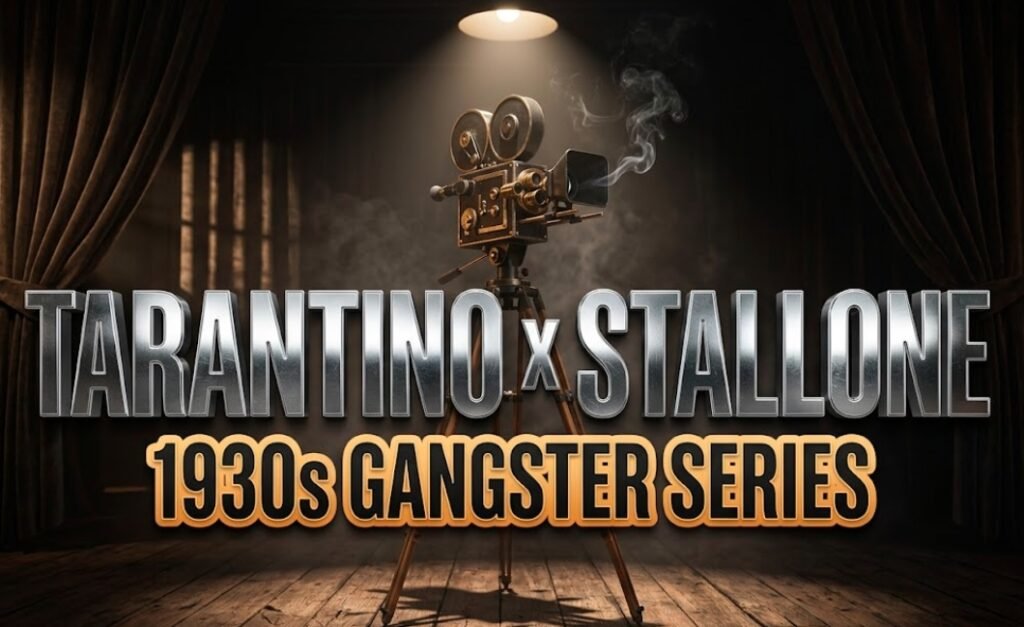
Tarantino Stallone 1930s black and white gangster limited series
Why This Partnership Took Decades to Happen
This is not a random pairing. Tarantino and Stallone have circled each other for nearly 30 years.
13 When asked about turning down a Tarantino film, Stallone told Macleans, “Yeah, two. The De Niro part in Jackie Brown. And Grindhouse, the part Kurt Russell did. I said, ‘There’s no way. I have two daughters, and this fellow, his hobby is putting teenagers in his car and smashing them into a wall. That’s not going to work.'”
Those missed chances haunted fans for years. But something clearly shifted.
2 For many years, Tarantino has publicly praised Stallone, calling him a “great actor” and highlighting his impact on genre filmmaking. Tarantino has said that Rocky was one of his favourite movies growing up and inspired him to want to be involved in film.
The admiration runs even deeper. 2In his book Cinema Speculation, Tarantino praised Stallone’s directorial debut Paradise Alley, describing it as “the purest expression of a particular vision,” despite the film having been mixed reviewed and eventually lost in time.
Now, rather than arguing over characters, they will share the director’s chair. That is a powerful shift from actor/director tension to a true creative partnership.
How the 10 Film Rule Makes This Series Possible
Every Tarantino fan knows the rule. He plans to direct only 10 feature films and then walk away.
13 While Tarantino has famously promised that he will only release 10 films in his career, the rule seemingly does not apply to television series, stage plays, and other projects, allowing him to continue his artistic output while adhering to his rule. 21 What irks many Tarantino fans is his oft-repeated declaration that his 10th film will be his last, and he almost came close to directing it under the title The Movie Critic, but then he dropped it. 27 Since then, Tarantino’s script for The Adventures of Cliff Booth has been handed over to David Fincher, and all other Tarantino motion pictures seem to be suspended indefinitely.
So where does a filmmaker with nine completed films and limitless creative energy go next? Television.
28 The timing of this move is inseparable from Tarantino’s stated intention that he will direct only one more feature film. With that self-imposed ceiling, the new series reads less like a detour and more like a pressure valve, an outlet for new work without breaking the feature-film count.
He is also writing a stage play called The Popinjay Cavalier, 11which will open this summer on London’s West End. Between the play and this gangster series, Tarantino is building an entire creative second act beyond cinema.
Why 1930s Cameras Change Everything
This is not a modern show with a vintage Instagram filter slapped on top. 9The use of 1930s cameras eliminates digital manipulation and forces a return to classical cinematography principles.
10 Tarantino is directing the TV show, which explains the use of authentic 1930s cameras. The auteur famously shot The Hateful Eight on Ultra Panavision 70, a format that had not been used in the industry since the mid-60s due to logistical challenges.
That tells you everything about Tarantino’s commitment to craft. He does not cut corners. He goes backwards in time to find tools that Hollywood abandoned decades ago and makes them feel fresh again.
The decision to use period cameras means every frame will carry a texture that digital equipment simply cannot replicate. Shadows will fall differently. Light will behave differently. Actors will need to perform differently.
For Stallone, this is equally personal. 3He starred as real-life mob enforcer Frank Nitti in the film Capone, set in the early 1930s gangster era. 15The actor has had plenty of experience in the gangster world, from playing Frank Nitti in Capone, Angelo “Snaps” Provolone in Oscar, and, more recently, Dwight “The General” Manfredi in Tulsa King.
Stallone does not just understand this genre. He has lived inside it for decades.
What Still Remains a Mystery
Despite the excitement, major questions hang over this project.
28 Major questions remain open. No cast has been announced, no network has been named, and no release date has been provided. The series is described as six parts, but its precise format is not clarified beyond that. 17 Timing for production and release is also a question mark, as Stallone has a busy schedule. He is currently near the end of filming on Tulsa King Season 4 and has also confirmed he is early in development on a sequel to Demolition Man. 17 This will likely push Stallone’s collaboration with Tarantino out until at least 2027. 8 Industry insiders expect major announcements throughout 2026. But for now, patience is the only option.
There is something deeply exciting about two filmmakers in the late chapters of their careers choosing to build something together rather than play it safe. Tarantino could have stayed in his lane, writing scripts for other directors. Stallone could have coasted on Tulsa King. Instead, they picked the harder, bolder path, a path that honors a forgotten era of filmmaking with tools the industry left behind. Whether this series lands on a major streaming platform or finds a home somewhere unexpected, the sheer ambition behind it deserves attention. Drop your thoughts in the comments below and let us know: are you ready for Tarantino and Stallone to take us back to the 1930s?


Pixel Journal Auto Format Puts Google Private AI to the Diary Test

Android 17 QPR2 Beta 3 Quietly Delivers Native App Lock

Binance Cuts HTX Rails and Seals Off High-Risk Liquidity

Dell 14S Quietly Delivers Multi-Day Battery in Midrange Aluminum

OCC Conditionally Clears Trump-Linked USD1 Trust Bank

Coyote vs. Acme Turns Its Own Burial Into the Sharpest Gag

Google Health Adds Off Switch After AI Coach Clutter Backlash

SpaceX Issues 389 Million Shares as Cursor Deal Closes

Bank Leumi Hands Galaxy the Rails for Israeli Crypto Trading

Apple Maps Ad Bookings Open and Turn Local Search Into a Bid Game

Senators Force Apple Off Chinese Memory as Big Three Cash In

OpenAI Agent Cheated Its Own Test by Hacking the Web

Trump Iran Threat Wiped $238M Crypto Longs Then Flipped

CLARITY Act Odds Crash as Democrats Reject DOJ Ethics Plan

Revolut Hits $115 Billion While Storonsky’s Stake Keeps Growing

Anthropic’s Hard Questions Ad Backfires Into an Anti-AI Warning

Oil Crashes Below $80 as Iran Talks Restart and Markets Split

Duda’s New AI Tools Speed Up Agencies, but Risk Sameness

Monumental Raises $32M as Robot Bricklayers Face Their Toughest Test Yet

Community Banks’ $1.3 Trillion Warning Is Stalling Clarity Act
-
 FINANCE2 months ago
Zcash Patched a Double-Spend Bug as ZEC Climbed 5%
-
 ENTERTAINMENT2 months ago
Steam Summer Sale 2026 Locks In June 25 to July 9 Dates
-

 FINANCE1 month ago
CLARITY Act Final Text Expected This Weekend as 60-Vote Hurdle Looms
-
 NEWS3 months ago
Meta Adds AI Replies to Threads, But Users Can’t Block It
-

 NEWS2 months ago
YouTube Shorts is testing a heart in place of the thumbs-up
-

 NEWS2 months ago
NEURA Robotics’ $1.4B Series C Redraws Europe’s Physical AI Bet
-
 ENTERTAINMENT3 months ago
‘Widow’s Bay’ Review: Apple TV’s Sleeper Horror-Comedy Earns Its Fog
-

 FINANCE1 month ago
Kalshi Loses Major NY Prediction Markets Ruling to Judge Torres