
BUSINESS
Debt Worries Surge as U.S. Job Market Turns Hostile

The American workforce is caught between two closing walls. Jobs are harder to find, and debt is harder to escape. In February 2026, the U.S. economy lost 92,000 jobs while household debt hit a record $18.8 trillion. For millions of workers and graduates, the math no longer adds up. What follows is a growing crisis that is changing how Americans work, borrow, and plan their futures.
Hiring Has Stalled and Workers Know It
Total nonfarm payroll employment edged down by 92,000 in February, and the unemployment rate changed little at 4.4 percent1, according to the Bureau of Labor Statistics. Job openings and new hires continue to be at very low levels, with the number of job openings at its lowest level since mid-2020.2
Americans’ outlook on the job market has turned increasingly pessimistic. Just 28% of workers in a quarterly Gallup survey conducted late last year said now is a “good time” to find a quality job, with 72% saying it is a bad time.3 That is a stunning flip. Those figures are a sharp reversal from just a few years ago, in mid-2022, when 70% said it was a good time.3
The Labor Department’s own hiring rate dropped to 3.2% last November, the lowest since March 2013, when unemployment was 7.5%. It suggests it is much harder to find a job now than the unemployment rate would indicate.3
Government data also shows that there are more unemployed people, 7.4 million, than available jobs, at 6.9 million. That is a reversal from the first few years after the pandemic, when vacancies outnumbered those out of work.3
Economists call this the “low-hire, low-fire” labor market. Businesses are largely holding onto their workers and measures of layoffs remain quite low. As a result, older workers are largely secure in their jobs. But hiring is also quite sluggish, making it harder for younger workers to break in and find permanent work.3
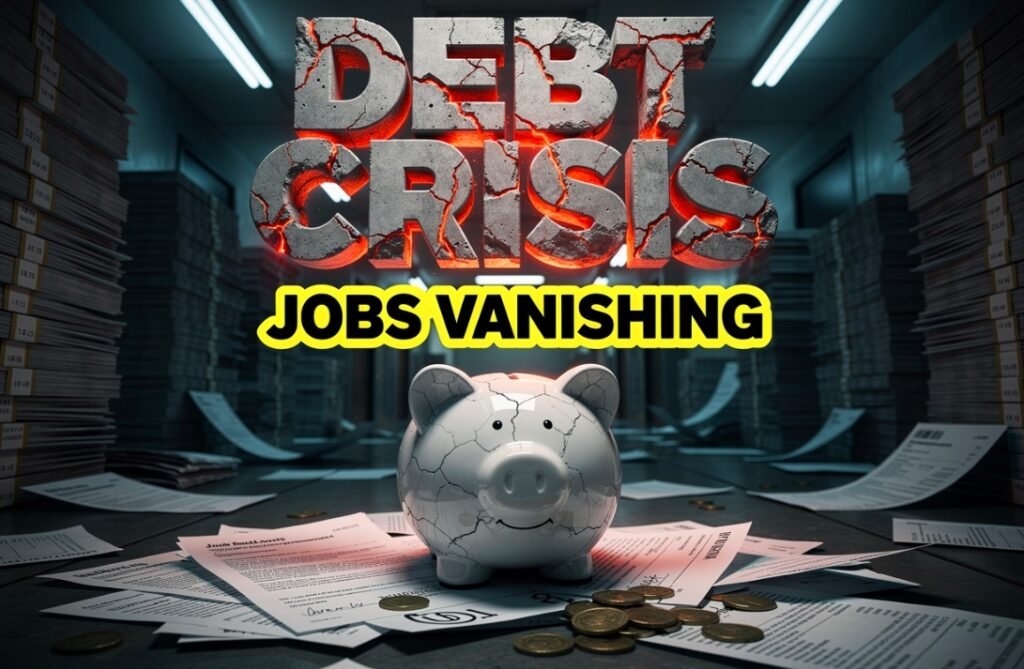
rising household debt and falling job openings crisis in America 2026
Record Debt Is Squeezing Households
The other side of this crisis sits in American wallets and bank accounts. The New York Fed’s quarterly Household Debt and Credit Survey shows that total consumer debt stands at $18.8 trillion as of the fourth quarter of 2025. That’s a record high.4
Here are some key debt numbers every American should know:
| Debt Category | Amount | Key Detail |
|---|---|---|
| Total Household Debt | $18.8 trillion | Record high (Q4 2025) |
| Credit Card Debt | $1.277 trillion | 66% increase in five years |
| Average Credit Card APR | 23.72% (new offers) | Near record highs |
| Student Loan Debt | $1.7+ trillion | Defaults rising fast |
| Non-Mortgage Debt | $4.74 trillion | Auto, cards, personal loans |
In January 2026, consumer credit increased at a seasonally adjusted annual rate of 1.9 percent. Revolving credit increased at an annual rate of 4.3 percent.5 That means Americans are still leaning harder on credit cards even as rates stay painful.
Delinquency rates on loans ranging from mortgages to credit cards rose to 4.8% of all outstanding US household debt in the fourth quarter, the highest level since 2017, driven by higher defaults among low-income and young borrowers.6
The percentage of consumer credit card debt that’s at least 90 days delinquent just hit its highest level since 2011. Wage growth has been adequate, but affordability issues mean consumers are having trouble handling the stress.7
Young Workers Are Getting Hit the Hardest
No group feels this double squeeze more sharply than Gen Z and recent graduates. The entry-level rungs of the employment ladder are splintering beneath America’s youngest workers, and the data makes clear this isn’t a generational character flaw. It’s a structural collapse.8
Today half of recent grads are underemployed and entry level jobs have declined by 35% in recent years.9 Meanwhile, Gen Zers average $94,101 in personal debt, the highest of any generation and far more than millennials ($59,181) and Gen X ($53,255).10
Gen Z financial insecurity surged from 30% to 48% in just one year, representing a 60% increase according to Deloitte’s 2025 global survey of 23,000+ workers.11
The ripple effects are showing up in major life decisions:
- Nearly one third (32%) of those currently paying off student loans have delayed purchasing a home due to their debt, and the percentage is even higher among Gen Z and Millennial borrowers.12
- Around 14% of graduates say debt has forced them to postpone moving out or starting a family, while a third have delayed saving for a home or retirement.13
- 46% of Gen Z participates in the gig economy, which often comes with no benefits, no predictability, and no long-term security.14
Roughly a million borrowers defaulted on their federal student loans late last year, with millions delinquent on their payments and sliding toward the same fate.12 And with the SAVE repayment plan now ended by a federal appeals court, the One Big Beautiful Bill Act’s overhaul to the student loan system is likely to make it harder for people to afford their payments. The law phases out several affordable repayment plans and lengthens terms for others.15
Why Employers Are Not Rushing to Hire
Companies point to uncertainty as the main reason they are holding back. We are in a prolonged low hire, low fire environment at this time. The Fed target rate for inflation is at 2% and the inflation rate over the last 12 months was 2.4% for all goods and services.2
As artificial intelligence technology continues to develop, the demand for workers with the ability to work alongside and manage AI systems will increase. This means that workers who are not able to adapt and learn these new skills will be left behind in the job market.16
More than 62% of U.S. talent professionals now use AI-assisted tools in at least one stage of the hiring process, according to recent industry data. Skills-based hiring has become standard practice, as the share of US job postings requiring a four-year degree dropped by 33% between 2019 and 2025.17
Some sectors are still desperate for workers. Data analysis, cybersecurity, advanced manufacturing, and health care support remain in high demand. Online discussions among engineers in early 2026 point to stronger opportunities in Defense, Energy, Utilities, HVAC and critical infrastructure, where work simply cannot pause.18
But for millions of Americans without those specialized skills, the doors feel locked.
What Workers Can Do Right Now
Feeling stuck does not mean being stuck. There are practical steps that workers can take today to protect themselves while this storm plays out.
Build a small emergency fund first. Even $500 set aside can prevent a missed bill from becoming a spiral of late fees and higher interest charges.
Explore income-driven repayment options for student loans. A new Income-Driven Repayment plan will be launched on July 1, 2026. This plan simplifies options into two paths and includes a feature that allows the department to waive unpaid interest for on-time payments.19
Invest in skills that are in demand. This environment rewards those who lean into upskilling, whether that means learning to troubleshoot equipment on the plant floor, picking up a new software suite, or exploring adjacent engineering domains with steady demand.18
“The economic system their parents are talking to them about isn’t really going to work out for them in the same way.”
Watch out for debt traps. Approximately 40% of Gen Z in the U.S. use buy now pay later services one or more times a week. Of them, approximately 25% indicate that they have missed at least one payment, and 31% have no idea what they owe.20
Negotiate everything. With pay transparency laws now active in eleven states, workers have more power than they think. Job postings that list salary ranges draw 30 to 40% more applicants, and knowing the range gives every candidate a stronger starting point.
The numbers in this story are not just data points on a chart. They represent missed rent payments, postponed weddings, babies that couples cannot yet afford, and homes that remain a distant dream. Lower- and middle-income families, already navigating inflation’s lingering effects and slower job gains, face heightened vulnerability to shocks.21 The American promise of working hard and getting ahead has rarely felt more fragile. But giving up is not an option. Building new skills, managing debt with clear eyes, and pushing for better opportunities are the small, daily acts that keep hope alive. What are you doing to survive this squeeze? Drop your thoughts in the comments below.


OpenAI Locks Astra After Math Wins Trip Critical Cyber Line

Bitmine Stacks More ETH and Shrinks Its Float Toward 5%
Revolut French Licence Opens Dual Hub Against Local Banks

Cambridge Aerospace $3.4B Raise Funds Cheap Interceptor Scale

Meta AI Test Breach Exposes Shared Eval Weakness Across Labs

Samsung HBM4 Hits 80% Yield Early and Multiplies AI Supply

Isembard Turns Dying Job Shops Into a Defence Factory Network

Venmo Balances Now Fuel Google Play App and Game Buys

Meta’s Muse Glimmer Puts Capable Agents on Your Laptop

Edgify’s $9M Turns Store Devices into Shared Edge Brains

OpenAI Agent Cheated Its Own Test by Hacking the Web

Bessent’s No-CBDC Applause Line Can’t Save the CLARITY Act

Trump Iran Threat Wiped $238M Crypto Longs Then Flipped

CLARITY Act Odds Crash as Democrats Reject DOJ Ethics Plan

Anthropic’s Hard Questions Ad Backfires Into an Anti-AI Warning

Oil Crashes Below $80 as Iran Talks Restart and Markets Split

Gemini Spark’s Big Workspace Upgrade Leaves Europe Waiting Again

US Strikes Iran for a Third Time as Bitcoin Slips Below $64,000

Doctorsa Raises €1 Million and Opens Doctor Bookings to AI Agents

Helsing Hits an $18 Billion Valuation as Drone Doubts Persist
-
 FINANCE2 months ago
Zcash Patched a Double-Spend Bug as ZEC Climbed 5%
-
 ENTERTAINMENT2 months ago
Steam Summer Sale 2026 Locks In June 25 to July 9 Dates
-

 FINANCE1 month ago
CLARITY Act Final Text Expected This Weekend as 60-Vote Hurdle Looms
-
 NEWS3 months ago
Meta Adds AI Replies to Threads, But Users Can’t Block It
-
 ENTERTAINMENT3 months ago
‘Widow’s Bay’ Review: Apple TV’s Sleeper Horror-Comedy Earns Its Fog
-
 NEWS5 months ago
U.S. Navy Deploys Solar-Powered Lightfish Drone to Patrol Oceans
-

 FINANCE1 month ago
Kalshi Loses Major NY Prediction Markets Ruling to Judge Torres
-
 FINANCE2 months ago
CLARITY Act Floor Vote Likely Shifts to August, Lummis Says