
BUSINESS
Bitcoin Depot Files Bankruptcy, CEO Reveals Why It Collapsed

North America’s largest Bitcoin ATM operator just went dark. Bitcoin Depot, which once ran more than 9,000 kiosks across 47 U.S. states, filed for voluntary Chapter 11 bankruptcy on Monday and pulled its entire network offline in one sweeping move. CEO Alex Holmes has now explained what really drove the company to this point, and the picture is far more alarming than most investors ever anticipated.
Over 9,000 Bitcoin ATMs Go Dark Overnight
Nasdaq-listed Bitcoin Depot, which once operated the largest network of Bitcoin ATMs in North America, filed for Chapter 11 bankruptcy protection and is shutting down. The Atlanta-based company filed voluntarily in the U.S. Bankruptcy Court for the Southern District of Texas, saying it would wind down operations and sell its assets in an orderly, court-supervised process. **Every single Bitcoin ATM kiosk in the company’s network has been taken offline.** Bitcoin Depot’s Canadian entities are included in the U.S. court-supervised process, with restructuring proceedings in Canada expected to commence in due course, while its other non-U.S. entities will wind down under applicable foreign law. All employees have received WARN Act notices, with executive terminations anticipated on July 17, 2026, underscoring the depth of the wind-down. Vinson & Elkins LLP is serving as legal advisor, Portage Point Partners is serving as restructuring advisor, and Joele Frank, Wilkinson Brimmer Katcher is serving as strategic communications advisor to Bitcoin Depot.
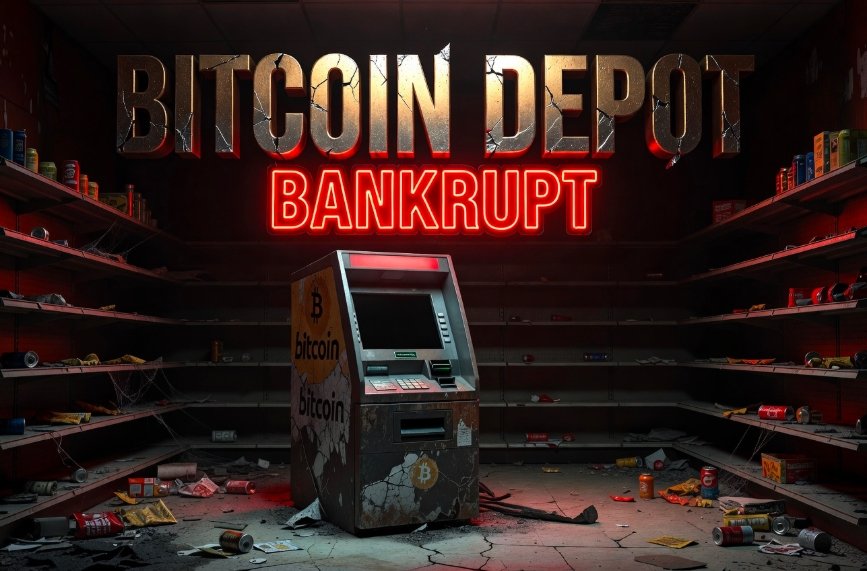
Bitcoin Depot Chapter 11 bankruptcy BTM stock crash 2026
CEO Alex Holmes Breaks Down Why the Business Failed
Alex Holmes, previously CEO of MoneyGram, replaced Scott Buchanan as chief executive officer in March 2026. He walked into a crisis already in motion, and on Monday, he laid out exactly what made it impossible to fix. “Over time, the Company has continued to strengthen its protocols and procedures to combat fraud and protect the customers who use its BTMs, including enhanced identity verification, customer fraud warnings, and its more recent adoption of lower transaction limits for its customers,” Holmes said. **But stronger fraud controls were not enough to survive what regulators brought next.** “The regulatory environment for BTM operators has shifted significantly: states have imposed increasingly stringent compliance obligations, including new transaction limits, and in some jurisdictions, outright restrictions or bans on BTM operations; and operators have faced increasing litigation and regulatory enforcement. These developments have materially affected Bitcoin Depot’s business and financial position. Under these circumstances, the Company’s current business model is unsustainable,” Holmes said. The core pressures Holmes identified were not abstract. They hit the business from every direction at once:
- Stricter state compliance obligations across multiple markets
- New transaction limits cutting into revenue per machine
- Outright bans on Bitcoin ATMs in several U.S. states
- Growing lawsuits and regulatory enforcement actions
- Over $20 million in accrued legal judgments in Q4 2025 alone
- A $3.7 million crypto wallet hack in April 2026
The Revenue Numbers Were Already in Freefall
The financial data leading up to this moment makes the collapse look almost inevitable in hindsight. **Bitcoin Depot reported a 49.2% year-over-year revenue decline in Q1 2026, with revenue falling to approximately $83.5 million from around $164 million the prior year.** The damage cut even deeper at the profit level. Gross profit collapsed 85.5%, from $31.2 million to $4.5 million, while the company swung from net income of $12.2 million to a net loss of $9.5 million.
| Metric | Q1 2025 | Q1 2026 | Change |
|---|---|---|---|
| Revenue | ~$164M | ~$83.5M | -49.2% |
| Gross Profit | $31.2M | $4.5M | -85.5% |
| Net Income/Loss | +$12.2M | -$9.5M | Swing to loss |
| Cash Reserves | $65.6M (Dec 2025) | $44.0M | -$21.6M |
Earlier in May, the company disclosed that it could not timely file its quarterly report due to additional review work related to a material weakness in its cash-in-transit reconciliation process. That was the loudest warning signal of all.
State Bans, Lawsuits and a Hack Sealed the Fate
The pressure did not arrive overnight. It built from multiple directions over months and left Bitcoin Depot with nowhere to turn. Indiana became the first state to ban Bitcoin ATM kiosks in March 2026, with Tennessee and Minnesota following. The firm had already lost its Connecticut money transmission license in March, the same month Holmes was appointed CEO. **Crypto ATM fraud became a national crisis.** The FBI logged 13,460 crypto-kiosk fraud complaints in 2025 alone, with reported losses of $389 million, a 58% jump from the prior year. In February 2026, Massachusetts Attorney General Andrea Campbell filed suit against the company, alleging it facilitated cryptocurrency scams targeting consumers. Iowa’s attorney general brought similar claims, asserting that Bitcoin Depot’s pricing was deceptive, that the company allowed known fraud transactions to proceed, and that its refund policies exploited victims. The legal and security problems did not stop there. In April 2026, the firm revealed that hackers had breached the company’s IT systems and stolen $3.7 million from its crypto wallets. Bitcoin Depot had also previously disclosed that a June 2024 external system breach had exposed the personal information of roughly 27,000 customers, including names, phone numbers, driver’s license numbers, and in some cases birth dates and email addresses, with a federal probe having delayed the public announcement for over a year.
BTM Stock in Freefall, Shareholders Warned of Total Loss
BTM shares were already bleeding before this moment. The stock had dropped more than 42% in the week prior to the filing, pulling year-to-date losses to 67%. In February 2026, Bitcoin Depot had already completed a one-for-seven reverse stock split just to maintain its Nasdaq listing. **After the bankruptcy announcement, BTM shares plummeted more than 70% in pre-market trading on Monday.** The company warned that trading in its Class A common stock is highly speculative and that shareholders could suffer a significant or complete loss, making this a materially negative development for existing equity holders. The contrast with where Bitcoin itself stands today could not be sharper. U.S. spot Bitcoin ETFs hold $104.29 billion in net assets, representing nearly 7% of Bitcoin’s total market cap, with cumulative net inflows of $58.34 billion since launch. The institutional route to Bitcoin has never been stronger. The cash-based, street-level route that Bitcoin Depot represented is now officially dead. Founded in 2016 with a mission to connect cash users to the bigger digital financial system, Bitcoin Depot had kiosks inside Circle K stores and gas stations across 47 states. Its customer, by design, had no brokerage account and often no bank account. That was the problem regulation never solved and ultimately chose to shut down instead. The fall of Bitcoin Depot is a defining moment for the entire crypto ATM industry, a sector that grew fast and loud during Bitcoin’s early adoption years, only to face a wall of regulatory opposition it simply could not overcome. Thousands of employees across the U.S. and Canada are now holding termination notices, shareholders are watching their investment head toward zero, and millions of unbanked Americans who relied on these machines to access crypto are left without a familiar on-ramp. The story of Bitcoin Depot does not end with a comeback. It ends in a Texas courtroom. What do you think this means for the future of Bitcoin ATMs in the U.S.? Drop your thoughts in the comments below.


Revolut Targets a 2027 US Bank Launch After Its First Bid Collapsed

Helsing Hits an $18 Billion Valuation as Drone Doubts Persist

Fusion Cash and Bank Debt Define Europe’s €2.8 Billion Tech Week

Doctorsa Raises €1 Million and Opens Doctor Bookings to AI Agents

Michael Saylor’s Bitcoin Post Leaves Strategy’s Next Move a Mystery

The Windows Identifier That Caught a Hacker Cannot Be Turned Off

US Strikes Iran for a Third Time as Bitcoin Slips Below $64,000

Musk Brands Altman a ‘Scammer’ as Apple Sues OpenAI Over Trade Secrets

SK Hynix’s CEO Warns the RAM Shortage Will Outlast Its Record IPO

Bessent’s No-CBDC Applause Line Can’t Save the CLARITY Act

CLARITY Act Final Text Expected This Weekend as 60-Vote Hurdle Looms

Fed Minutes Cite AI Demand as Inflation Risk, Put a 2026 Hike Back on the Map

Kalshi Loses Major NY Prediction Markets Ruling to Judge Torres

Marker AI Writing Startup Lands $13M Seed Led by Index Ventures

Dota 2 Esports World Cup 2026: Spirit Defends $2M Title In Paris

Meta’s Muse Spark 1.1 Beats Rivals on Price, Trails on Coding

CS2 Premier Season 5 Lands With Cache and a C4 Damage Rework

Backrooms Returns to Theaters as the Everything Must Go Edition

Trump Calls Iran ‘Islamic Republic of Japan’ as Ceasefire Ends

The Furious Stages Action Like Combat Choreographed by Ants
-
 FINANCE1 month ago
Zcash Patched a Double-Spend Bug as ZEC Climbed 5%
-
 ENTERTAINMENT1 month ago
Steam Summer Sale 2026 Locks In June 25 to July 9 Dates
-
 NEWS2 months ago
Meta Adds AI Replies to Threads, But Users Can’t Block It
-
 FINANCE1 week ago
CLARITY Act Final Text Expected This Weekend as 60-Vote Hurdle Looms
-
 ENTERTAINMENT2 months ago
‘Widow’s Bay’ Review: Apple TV’s Sleeper Horror-Comedy Earns Its Fog
-
 ENTERTAINMENT1 month ago
Amazon Scraps Its Stargate Revival After a 20-Week Writers Room
-
 FINANCE5 days ago
Fed Minutes Cite AI Demand as Inflation Risk, Put a 2026 Hike Back on the Map
-
 FINANCE1 month ago
Citigroup Says ETF Outflows Drove Bitcoin’s Crash, Not Strategy’s Sale