
NEWS
Amazon’s $60 Leaf Blower Poses Real Danger, Review Reveals

A $60 cordless leaf blower on Amazon looked like a smart buy. But once it was put to the test against a trusted name brand, things went very wrong, and the problems ran much deeper than just poor performance.
A Brand With Two Names and One Big Mystery
The Amazon listing says “Yuquesen.” The product that shows up at your door says “Zarimi.”
When you order the orange cordless leaf blower from the official Yuquesen Store on Amazon, you receive a tool branded with a completely different name. The product looks identical to the listing photos, but the logos stamped on the actual tool are not the same. That kind of brand switch is virtually unheard of with legitimate products sold by credible manufacturers.
It gets stranger from there.
A screenshot of the official Yuquesen website captured on May 8, 2026 shows a product press image where the brand name appears as “VIOLENCEN.” This appears to be the result of AI editing software misreading a low-resolution version of the word “YUQUESEN” in all caps. The product received by reviewers, however, does not carry either of those names. It carries “Zarimi.”
Digging into the Zarimi brand’s own website at MyZarimi.com reveals a cookie-cutter white-label template with the blanks filled in. The “Contact Us” address at the bottom of that site reads: 393 South Beltline Highway, Mobile, AL 56696. That same address links directly to another Amazon brand called “Dicekoo,” a separate product line running off the same boilerplate website layout. This is a classic marker of a white-label operation, where a single manufacturer sells the same or similar products under a rotating collection of brand names.
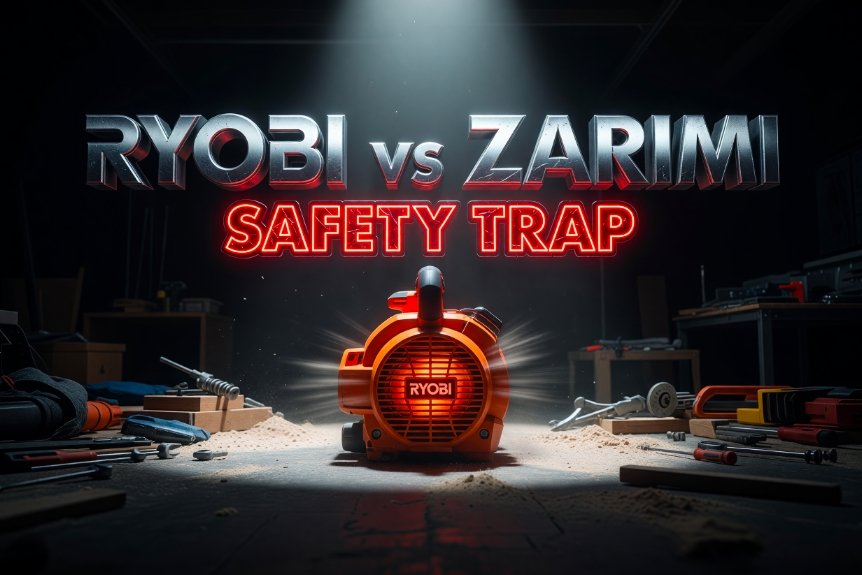
cheap Amazon cordless leaf blower safety hazard vs Ryobi
Three brand names. One shared address. Zero transparency for the consumer buying this product in good faith.
The Safety Problem Nobody Warned You About
Beyond the identity confusion, there is a more pressing issue. The Yuquesen handheld leaf blower has a physical design flaw that could genuinely hurt someone.
When the extension tubes are removed and the tool is used in its base form as it comes straight out of the box, the fan blade sits less than one inch behind the rear-facing protective plastic grill. That is an unusually shallow gap for a tool generating this level of airforce.
YouTube reviewer Scott from the channel Extreme Reviews discovered the hard way that this shallow-mounted fan and leaf-blower-grade wind power create a vacuum-like pull near the rear of the device. His loose hair was sucked into the machine more than once during testing. It happened on camera.
This is not a fringe case or a user error. Hair, loose fabric and small debris near the back of this device are all at risk.
- Fan blade sits less than one inch from the rear protective grill
- The rear of the device faces the user during normal operation
- No extended intake guard to create safe distance
- Documented hair-tangling incident captured on video during review
- Risk is higher for anyone with long hair, loose sleeves or children nearby
A power tool with rotating parts and this level of airforce should never ship with a design that puts users this close to the blade.
The U.S. Consumer Product Safety Commission has been actively cracking down on unsafe imported products in 2026, noting that bad actors are increasingly using counterfeit certification marks to move hazardous products through e-commerce platforms. The CPSC has even withdrawn accreditation from four China-based testing laboratories earlier this year after identifying falsified test results.
Why Ryobi Builds Its Blower the Right Way
The Ryobi 18V ONE+ HP Compact Brushless 220 CFM Blower (model PSBLB01K) takes a completely different approach to user safety.
The rear of the Ryobi blower is angled and designed with meaningful physical distance between the air intake and the spinning fan. That buffer is a standard safety feature found in most professional and semi-professional leaf blowers. It is not an innovation. It is the baseline expectation.
Ryobi built safety into the tool as a default, not something bolted on at the end.
The front of the Ryobi also features a long non-removable tube section. This makes the tool slightly larger and harder to pocket, but that additional length combined with more protective plastic components throughout keeps the user at a safe distance from the blade at all times. The Ryobi runs on the brand’s 18V ONE+ battery system, which is compatible with over 300 Ryobi products across the entire platform.
Powered by a high-efficiency brushless motor, it delivers 220 CFM of airflow at speeds up to 140 mph. Those numbers are not designed to impress at a spec sheet level. They are matched precisely to the jobs this compact tool was built for.
Performance Put to the Real-World Test
In head-to-head real-world use, the gap between these two tools is significant.
The Ryobi was used to clear sawdust from an outdoor workspace while resurfacing a wood piano. It handled the job cleanly and precisely, without blasting debris into a nearby street or onto people walking past. That kind of controlled, calibrated power is exactly what a compact worksite blower should deliver.
| Feature | Ryobi PSBLB01K | Yuquesen / Zarimi |
|---|---|---|
| Price | ~$150 (kit) | ~$60 |
| Motor Type | Brushless | Standard |
| Airflow | 220 CFM / 140 mph | Not independently verified |
| Battery Included | 4.0Ah 18V | 2x 21V 4.0Ah |
| Safety Design | Angled guard, deep intake | Shallow fan, open rear grill |
| Build Quality | Professional grade | Feels like a toy |
| Best Use | Worksite, deck, small spaces | Light sawdust only |
| Brand Clarity | Consistent | Two brands, one product |
The Yuquesen has just enough power to move light sawdust. That is essentially where its usefulness ends.
Where the Ryobi’s output borders on replacing a full-sized blower for most basic everyday jobs, the Yuquesen never quite gets there. One tool feels like professional equipment. The other feels like a toy that was packaged to look like something it is not.
Is the Price Tag Worth the Risk?
At $60, the Yuquesen comes with the blower itself, a few extension tubes, earplugs, two batteries, a charger and a carrying case.
The plastic on every single component feels like it was made just strong enough to survive the shipping trip and hold together long enough to clear the return window.
The Ryobi kit costs around $150 at Home Depot and includes the blower, a 4.0Ah battery, a charger, extension tubes and nozzle attachments. For those already in the Ryobi ONE+ ecosystem, the bare tool is available for around $100 without battery and charger. For a garage stall, an apartment balcony, a worksite corner or an entryway, the Ryobi is the clear choice.
The $90 price difference between these two tools is real money. But that gap buys you something the Yuquesen cannot offer: a tool that is safe to use, built to last and backed by a brand with a clear, consistent identity. In 2026, with the CPSC cracking down on fake-certified imports and Amazon itself acknowledging the scale of its marketplace fraud problem, stories like this serve as a reminder that a suspiciously cheap deal on a power tool almost always costs more than it appears.
The Yuquesen leaf blower is a product that raises serious questions at every level, from the brand name on the box to the design of the blade guard. The Ryobi, on the other hand, is simply a well-made, reliable compact tool that does what it promises. Sometimes paying more upfront is not just the smarter choice, it is the safer one. What do you think about buying budget power tools from lesser-known Amazon sellers? Drop your thoughts in the comments below.


NFL Preseason Week 2 Quietly Tests the Schemes That Matter

Alonso’s Towering Drive Stands Foul and Flips Orioles Momentum

US Debt Crosses $40 Trillion as Interest Crowds the Budget

Trevon Diggs Joins Seahawks on One-Year Deal After Cowboys Exit

Pixel Watch 5 Turns Passive Trends Into Early Health Alerts

Pixel 11 Pro Fold Sleek Build Undercuts Its Own Unfolding Appeal

Tugboat Wilkinson’s Scoreless Debut Pays Off Giants’ Bailey Trade

Brown Shines for Pats as Love for Eagles Meets Trade Reality

Pixel Watch 5 Turns Wrist Data Into Early Metabolic Alerts

Resistance Stars Pay the Price in Democratic Primaries

Senators Force Apple Off Chinese Memory as Big Three Cash In

OpenAI Agent Cheated Its Own Test by Hacking the Web

Trump Iran Threat Wiped $238M Crypto Longs Then Flipped

30-Year Yield Hits 5.32% Highest Since 2007 as Debt Supply Locks In Costs

Fed Holds Rates Again as Three Dissents Force Markets to Tighten

Oil Crashes Below $80 as Iran Talks Restart and Markets Split

Google’s Knowledge Panel Fix Risks Its Own Search Defenses

Agon Raises $30M to Build Europe’s AI Weapon Training Arenas

Legora Buys Wexler Fact Engine as Fifth 2026 Deal

Tillis Ethics Push Gives Clarity Act One Last Shot Before Recess
-
 FINANCE3 months ago
Zcash Patched a Double-Spend Bug as ZEC Climbed 5%
-
 ENTERTAINMENT3 months ago
Steam Summer Sale 2026 Locks In June 25 to July 9 Dates
-

 FINANCE2 months ago
CLARITY Act Final Text Expected This Weekend as 60-Vote Hurdle Looms
-
 NEWS3 months ago
Meta Adds AI Replies to Threads, But Users Can’t Block It
-

 NEWS3 months ago
YouTube Shorts is testing a heart in place of the thumbs-up
-
 NEWS4 weeks ago
Senators Force Apple Off Chinese Memory as Big Three Cash In
-

 NEWS2 months ago
NEURA Robotics’ $1.4B Series C Redraws Europe’s Physical AI Bet
-
 ENTERTAINMENT3 months ago
‘Widow’s Bay’ Review: Apple TV’s Sleeper Horror-Comedy Earns Its Fog