Heading to the Rockies for a powder day? You better check your tires before hitting the interstate or you might face a steep penalty. State troopers are cracking down on winter safety rules along the infamous I-70 corridor this season. Drivers operating two wheel drive vehicles now face stricter scrutiny and potential fines if they fail to carry specific traction equipment during snowy months.
Understanding The Passenger Vehicle Traction Law
Colorado Department of Transportation (CDOT) enforces strict regulations that catch many visitors off guard every winter. The specific statute involved is the Passenger Vehicle Traction Law. It is always active from September 1 through May 31 along the I-70 corridor between Dotsero and Morrison. This covers a massive 126 mile stretch of highway that serves as the main artery for ski traffic.
Many drivers mistakenly believe these rules only apply during active blizzards. This is false. The law remains in effect regardless of the sky conditions during these months. For two wheel drive (2WD) vehicles, the requirements are significantly more rigorous than for their four wheel drive counterparts. If you drive a front wheel or rear wheel drive car, you must have specialized winter tires or carry traction devices.
Your vehicle must meet one of these criteria to be legal on the mountain corridor:
- 4WD or AWD vehicle with 3/16 inch tread depth.
- 2WD vehicle with specialized winter tires (Mountain Snowflake symbol).
- 2WD vehicle with Mud and Snow (M+S) tires with 3/16 inch tread depth.
- 2WD vehicle with standard tires carrying chains or an alternative traction device.
The state takes this seriously because a single spun out sedan can shut down the interstate for hours. These closures cost the state economy millions and strand thousands of travelers in freezing temperatures.
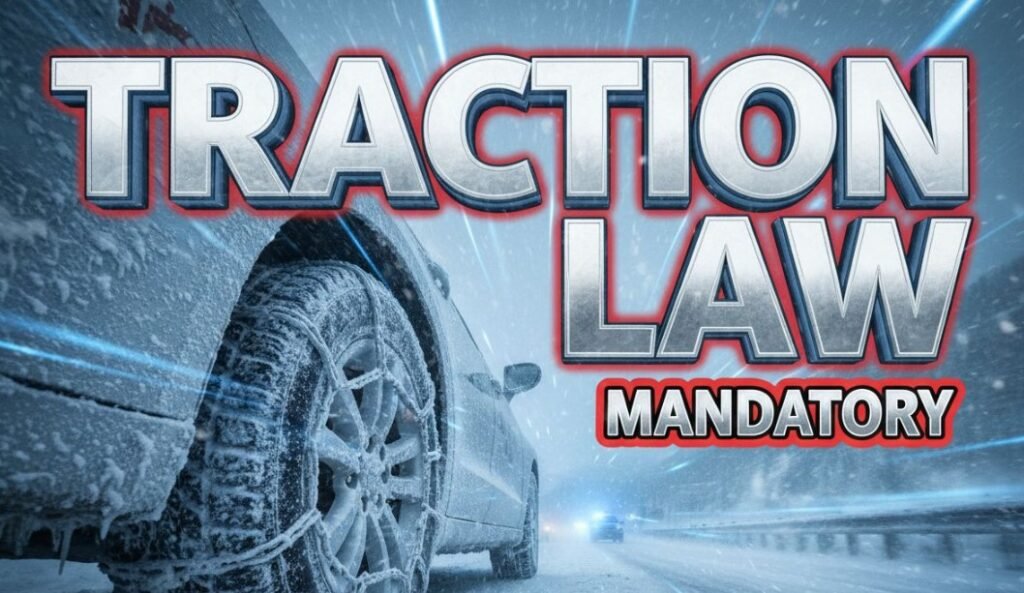
snowy interstate highway traffic jam colorado mountains winter tires
Mandatory Gear Requirements For 2WD Vehicles
If you insist on taking a two wheel drive car into the high country, you have a legal obligation to carry extra gear. Standard all season tires are often insufficient for the steep grades found near the Eisenhower Tunnel or Vail Pass. The rubber compound in standard tires hardens in freezing temperatures, which causes a loss of grip even on dry pavement.
Drivers of 2WD cars must carry traction devices if they do not have dedicated winter tires installed. This does not just mean heavy iron chains. CDOT approves several alternative traction devices that are easier to install and lighter to carry.
- Metal Chains: The classic option. They provide maximum grip but are heavy and difficult to install on the side of a highway.
- AutoSock: A fabric cover that goes over the tire. It provides friction on snow and is fully approved for passenger vehicles.
- Tire Cables: Lighter than chains and easier to store, though slightly less durable.
You must have these devices in your vehicle and know how to install them. Troopers may perform checkpoints to verify you are carrying the required equipment. If a storm hits and the Code 16 Chain Law goes into effect, every single vehicle on the road must have chains or devices installed, including 4WD vehicles in some extreme cases.
Financial Penalties And Safety Risks
The cost of ignoring these regulations goes beyond the price of a set of chains. Under the updated enforcement protocols, motorists found in violation of the traction law face immediate fines. The base fine starts at roughly $50 plus a surcharge, bringing the ticket to nearly $70. This applies just for being caught without the proper gear during a check.
The situation gets much more expensive if you cause a problem. If your inadequately equipped vehicle spins out and blocks a travel lane, the fine jumps drastically. You could face a citation of more than $650. This does not include the cost of the tow truck, which is often mandatory to clear the obstruction.
“It is not just about avoiding a ticket. It is about ensuring you and your family make it to your destination alive,” says a recent safety bulletin from state officials.
Safety data supports the strict fines. I-70 features steep grades and sharp curves that become ice rinks in minutes. A car without traction becomes an uncontrollable sled. This endangers the driver and everyone around them.
Rental Car Loopholes And Tourist Traps
Out of state visitors face the highest risk of non compliance. Travelers land at Denver International Airport and rent the cheapest available economy car. These are almost always two wheel drive sedans equipped with basic all season tires. While rental agencies are required to notify customers about the law, they are not necessarily required to provide the equipment for free.
It is the responsibility of the driver to ensure the vehicle is legal. Do not assume your rental car is mountain ready.
Use this checklist before leaving the rental lot:
| Check Item | Requirement | Action |
|---|---|---|
| Drivetrain | Ask if it is AWD/4WD or 2WD. | Upgrade to AWD if possible. |
| Tires | Look for “M+S” or the Snowflake symbol on the sidewall. | Request a different car if missing. |
| Tread Depth | Use a quarter. Insert Washington’s head down. | If you see the top of his head, tread is too low. |
| Chains | Ask the counter agent for chains or socks. | Buy them at a nearby auto store if needed. |
Many rental contracts prohibit the use of metal chains due to potential vehicle damage. In this scenario, verify if they allow fabric traction socks. If you drive a rental car into a ditch because you lacked the proper equipment, the insurance waiver you purchased might be voided due to negligence.
Navigating the winter roads of Colorado requires preparation and respect for the conditions. The state has made it clear that ignorance of the law is no longer an excuse. By ensuring your vehicle has the right tires or traction devices, you contribute to a safer flow of traffic for everyone. No one wants to spend their vacation stuck on the side of the highway waiting for a tow truck while facing a hefty fine. Double check your gear, drive slowly, and enjoy the mountains responsibly.