Imagine a Danish prince not in a castle, but in a Blockbuster Video store. He is not holding a skull but a camcorder. This is the world of Michael Almereyda’s Hamlet. As Ethan Hawke makes headlines again with his upcoming project Blue Moon, it is the perfect time to revisit his most daring role. This 2000 adaptation took Shakespeare’s words and crashed them into the turn of the millennium.
It remains a gritty, pixelated masterpiece that predicted our obsession with screens.
A Corporate Take on the Prince of Denmark
Most people think of Shakespeare in terms of tights and swords. Director Michael Almereyda had a different vision. He saw the rot in the state of Denmark as corporate corruption in New York City. The “Kingdom” is now the Denmark Corporation. The castle of Elsinore is a luxury hotel. This shift turns political intrigue into a cutthroat boardroom thriller.
The movie captures a very specific moment in history. It was the year 2000. The internet was booming, video cameras were shrinking, and technology felt cold and industrial. Hawke plays Hamlet as a film student obsessed with capturing truth on video.
This angle changes how we view the character. He is not just mad; he is a documentarian trying to expose a crime. The famous “To be or not to be” speech happens in a video rental store. He whispers “Action” to himself before delivering the lines. It grounds the high poetry in a setting everyone at the time understood.
Ethan Hawke Hamlet 2000 movie Blockbuster scene
“The film is less about a prince and more about a young man drowning in a sea of technology and corporate greed.”
The setting does more than just look cool. It answers the “why” of the play. Why is Hamlet so paranoid? Because in this world, everyone is watching everyone else through surveillance cameras and wiretaps.
Casting That Defied All Expectations
The cast of this film reads like a dream team of the late 90s indie scene. You have Ethan Hawke, fresh off his Gen-X stardom, bringing a slouchy and anxious energy to the role. He wears a wool cap and mumbles, making the ancient words sound like modern slang.
Then there is the supporting cast. The choices seemed strange on paper but worked perfectly on screen.
- Bill Murray as Polonius: He plays the character not as a fool, but as a tired corporate consultant. He is a father trying to manage his image.
- Julia Stiles as Ophelia: She captures the heartbreak of a young woman ignored by everyone. Her descent into madness is shown through erratic behavior in public spaces.
- Kyle MacLachlan as Claudius: He is the slick CEO who killed his way to the top. He looks great in a suit but has a soul of ice.
- Steve Zahn as Rosencrantz: He brings a slacker vibe that fits perfectly with Hawke’s energy.
The biggest surprise remains Bill Murray. He delivers Shakespearean lines with his trademark dry delivery. It makes Polonius feel like a real person you might meet in an office elevator. He strips away the theatricality and leaves only the sad reality of a man out of his depth.
The Tech Aesthetic and Visual Style
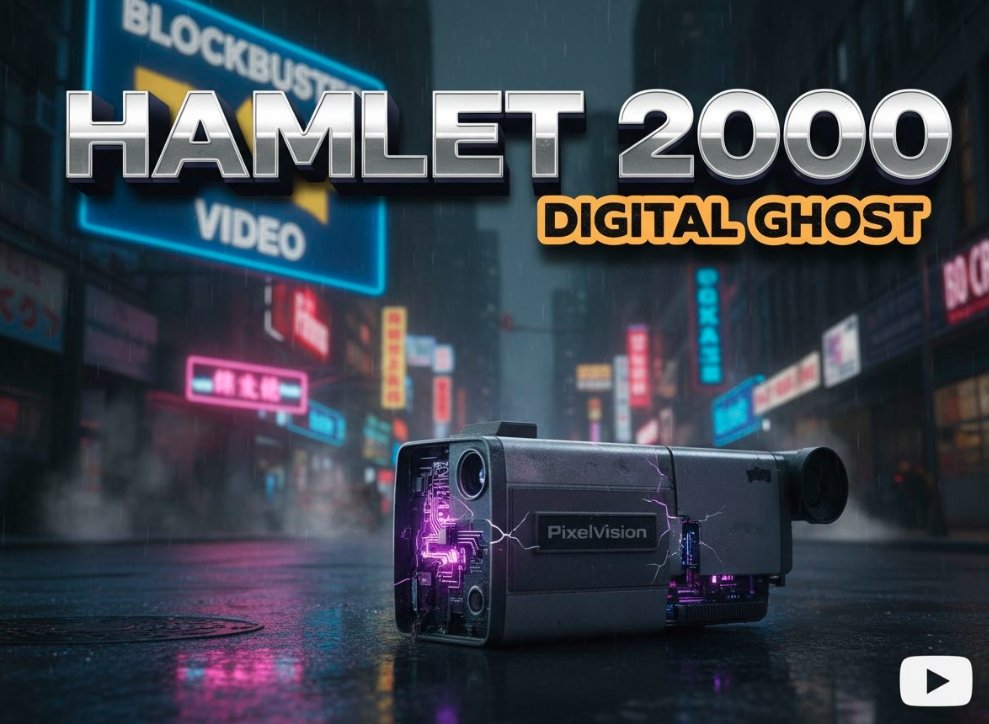
The look of the film is its most defining feature. Almereyda used a mix of high-quality film and low-quality video. This was a bold choice. It reflects Hamlet’s fractured state of mind. The “Pixelvision” camera used by Hamlet creates grainy and distorted images.
This visual style separates the truth from the lies. The glossy 35mm film represents the fake corporate world of Claudius. The grainy video represents Hamlet’s raw and ugly truth.
Here is how the film updates key plot points:
| Original Element | The 2000 Update |
|---|---|
| The Ghost | A shadowy figure on a security monitor and a presence near a Pepsi machine. |
| The Play Within a Play | A jagged, experimental video art collage shown in a theater. |
| The Duel | A fencing match on a rooftop that turns deadly with hidden weapons. |
| The Letters | Faxes and emails sent between the characters. |
The “Mousetrap” scene is particularly brilliant. In the play, Hamlet hires actors to reenact his father’s murder. In this movie, he edits together clips of old movies and footage of his uncle. It shows the power of editing to tell a story. It also predicts the rise of YouTube and social media activism.
Why This Adaptation Still Matters Today
We live in an era where screens dominate our lives. We record everything. We watch our friends through social media. This film predicted that our reality would eventually become inseparable from our technology.
When this movie came out, it was seen as a cool experiment. Today, it feels like a documentary of the past. It captures the anxiety of the dot-com era. It shows a New York City that was about to change forever.
It stands apart from other adaptations. Baz Luhrmann’s Romeo + Juliet was colorful and loud. Kenneth Branagh’s Hamlet was epic and traditional. Almereyda’s Hamlet is quiet, cold, and deeply personal. It does not try to be a blockbuster. It tries to be a mirror.
Critics at the time were divided. Some missed the grand castles. Others felt the modern setting was a gimmick. But time has been kind to this film. New audiences are discovering it and realizing how smart it actually is. It treats the audience with respect. It assumes you know the story, so it focuses on the mood.
Ethan Hawke’s performance anchors it all. He is vulnerable. He is not a hero. He is just a kid who lost his dad and does not know how to handle it. That emotion cuts through the fancy camera work and the Old English language. It connects emotionally.
As Hawke continues his incredible career with Blue Moon, we can look back at this role as a turning point. It proved he was not just a heartthrob. It proved he was an artist willing to take risks. This Hamlet is not for everyone. But for those who connect with it, it remains the definitive version for the digital generation.