Packing up a bedroom and saying goodbye to best friends is a painful ritual most people face perhaps once during childhood. For the children of U.S. service members, this heart-wrenching reset button is hit every two or three years. Mikayla McGhee knows this routine well. Her time in Bahrain during the global shutdowns of 2020 offers a stark look at how young Americans forge identities while living out of cardboard boxes thousands of miles from home.
These young people are often called “military brats” by the public and even themselves. They serve an invisible tour of duty alongside their parents. Their lives are a mix of high-stakes geopolitics and common teenage angst. They learn to sleep on planes and make friends in minutes. Yet behind the resilience lies a complex web of educational gaps and emotional fatigue that follows them long after the moving trucks depart.
Adapting to New Cultures and Schools
The term “Third Culture Kid” often applies to military children living overseas. They are not fully immersed in their host country culture like a local. They are also not fully connected to the American culture of their peers back in the states. They exist in a unique third space. This space is filled with other transient families who understand the code of military life.
Recent data from the Department of Defense indicates there are over 1.6 million military children. A significant portion of them live outside the continental United States. These children develop social skills that are distinct and powerful. They walk into a new cafeteria and scan the room for an empty seat with tactical precision. They learn to read social cues rapidly because they have to.
Common Traits of Military Youth:
- High Adaptability: They adjust to new time zones and climates quickly.
- Global Perspective: They understand geography and politics through lived experience.
- Social Speed: They form deep friendships faster than their civilian counterparts.
- Language Skills: Many pick up phrases or fluency in host nation languages.
However, this constant motion creates a sense of rootlessness. The question “where are you from” becomes the hardest one to answer. Home is not a location on a map for them. Home is usually wherever their parents are currently stationed or where their household goods are finally unpacked.
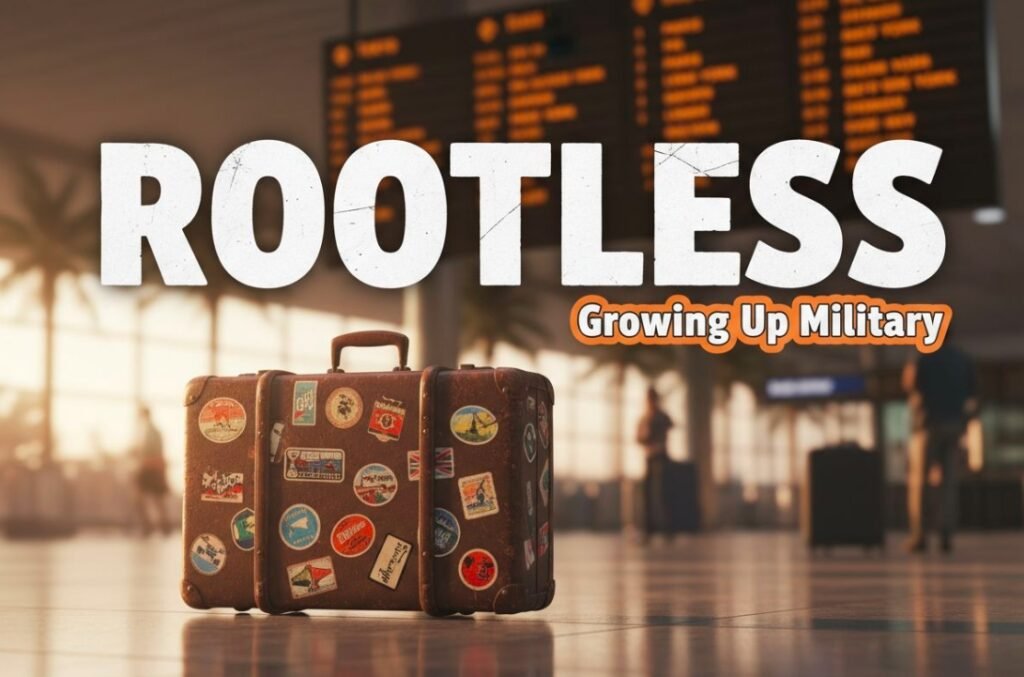
military family moving boxes airport terminal silhouette
Life Inside the Bahrain Strategic Outpost
Mikayla McGhee experienced a unique slice of this life in Bahrain. This small island nation in the Persian Gulf hosts the U.S. Navy Fifth Fleet. It is a critical strategic point for American interests in the Middle East. For families stationed there, life is a blend of strict security protocols and exotic cultural exploration.
Families living in Manama often describe a tight community. The base acts as a small American town dropped into a desert landscape. There are bowling alleys and movie theaters that play U.S. blockbusters. Yet just outside the gates, the call to prayer echoes from local mosques. The smell of spices from the souqs fills the air.
The 2020 Complication
McGhee arrived during a time of extreme global stress. The year 2020 brought the COVID-19 pandemic. This turned an already isolating experience into a severe lockdown.
- Flights back to the U.S. were grounded or severely restricted.
- Base access was tightened to prevent viral spread.
- Social circles shrank to immediate neighbors or online interactions.
Teenagers like McGhee had to navigate remote learning in a time zone eight hours ahead of their East Coast peers. They missed out on the physical exploration of the island that makes an overseas tour rewarding. This period highlighted the extreme isolation that can occur when military orders clash with global emergencies.
Education Hurdles for Overseas Students
Schooling remains the number one source of anxiety for military families moving abroad. The Department of Defense Education Activity (DoDEA) runs schools on bases worldwide. They aim to provide a high-quality American education. They generally succeed in standardized testing. But the cracks show when families transfer in or out of the system.
A student might leave a school in Virginia that requires four history credits and arrive at a base in Japan where the requirements differ. Gaps in curriculum appear instantly. Advanced Placement (AP) courses available at one location might not exist at the next. This can hurt college applications.
Educational Pain Points:
| Challenge | Impact on Student |
|---|---|
| Credit Transfer | Students may have to retake classes they already finished. |
| Sports Teams | Varsity spots are lost, and students must try out for new teams constantly. |
| Special Needs | Support services vary wildly between overseas bases and U.S. schools. |
| Graduation | Differing state requirements can delay graduation dates. |
Parents often have to fight bureaucratic battles to ensure their child stays on track. Counselors at base schools work hard to bridge these gaps. Yet the stress falls on the student to catch up or adapt to a harder workload. The Interstate Compact on Educational Opportunity for Military Children exists to help with this. However, its enforcement can be inconsistent when moving across oceans rather than just state lines.
The Hidden Cost of Constant Goodbyes
Resilience is the word most often used to praise military kids. It is a badge of honor. But experts are beginning to question if this label masks deeper issues. Constant separation from loved ones takes a toll. A parent is often deployed to a combat zone or a ship for months at a time. The remaining parent carries the load of the household alone.
The child learns to suppress sadness because “everyone else is going through it too.” This stoicism serves them well in a crisis. It can be damaging in the long run. Anxiety rates among military dependents are a growing concern for health professionals within the defense network.
The Emotional Cycle of a Move:
- Denial: Ignoring the upcoming move orders.
- Anger: Frustration at leaving friends and teams.
- Detachment: Pulling away from current friends to make leaving easier.
- Excitement: Looking up the new location online.
- Fear: The first day at the new school.
McGhee and thousands like her master this cycle. They learn that relationships can be temporary. They also learn that distance does not have to mean the end of a friendship. Social media helps maintain these bonds in ways that were impossible twenty years ago.
The military lifestyle shapes young people into flexible and worldly adults. They often go on to serve in the military themselves or work in international relations. They possess a maturity that is rare for their age. But we must not overlook the sacrifices they make to support the national defense mission.
We need to ensure that when they land in a new country, the safety net is there to catch them. This means better mental health resources in schools. It means smoother credit transfers. It means recognizing that while they are resilient, they are also still children.
McGhee’s story in Bahrain is just one chapter in a massive anthology of military life. Every suitcase packed represents a story of loss and a story of adventure. As global tensions require U.S. presence abroad, the next generation of military children will continue to pack their bags. They will continue to say goodbye. And they will continue to find their footing on shifting ground.
We want to hear from you. Did you grow up in a military family or are you raising military kids abroad? Share your experiences in the comments below. If you are currently navigating a move, use the hashtag #MilKidLife on social media to connect with others facing the same journey.