New York was poised to lead the nation in climate policy with a groundbreaking law banning gas stoves and furnaces in most new buildings starting in 2026. But that ambitious timeline has hit a significant legal snag that throws the entire plan into uncertainty. Following a federal lawsuit filed by building trades and gas companies, state officials face a difficult battle that could delay or even dismantle the first statewide gas ban in the United States.
Federal Laws Clash With State Climate Goals
The primary obstacle blocking New York’s “All-Electric Building Act” is a federal statute known as the Energy Policy and Conservation Act (EPCA). This federal law gives the U.S. government sole authority to set energy efficiency standards for appliances like stoves and furnaces. Opponents argue that by banning gas appliances entirely, New York is technically creating a standard that these products cannot meet, which violates federal law.
This legal argument is not new. It is the exact same strategy used to overturn a similar gas ban in Berkeley, California, earlier this year.
In the wake of that ruling by the 9th U.S. Circuit Court of Appeals, a coalition of plaintiffs including Mulhern Gas Co. and various construction unions filed suit against New York. They argue the state law is preempted by the federal EPCA. Because of this litigation, the state has had to agree to certain stipulations regarding enforcement while the courts decide the outcome. This effectively places the ban in a fragile limbo just as developers are trying to plan for the coming year.
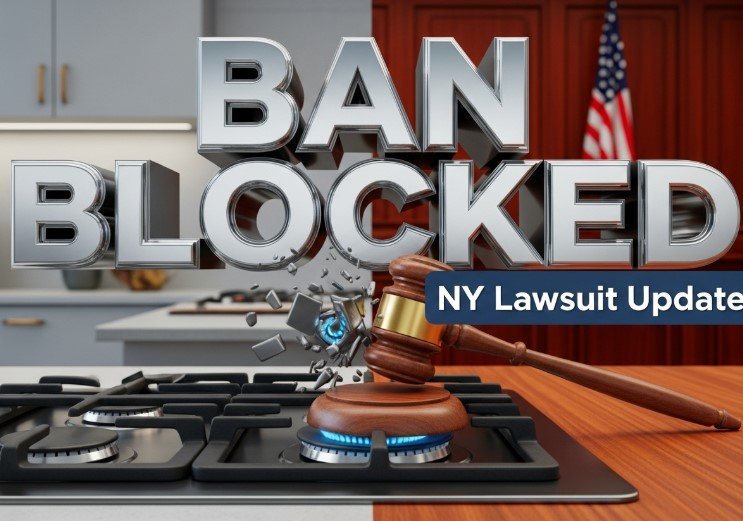
stainless steel gas stove burner with blue flame in modern kitchen
Understanding The All Electric Building Act
Before these legal hurdles arose, the roadmap for New York was clear. Passed in May 2023, the law was designed to phase out fossil fuels in new construction to combat climate change. The state identified buildings as a major source of greenhouse gas emissions and sought to transition the grid to electricity.
The law outlined a phased approach for implementation:
- January 1, 2026: Ban begins for new residential buildings under seven stories.
- January 1, 2029: Ban expands to larger residential and commercial buildings.
- Exemptions: Hospitals, laundromats, and commercial kitchens were spared.
- Flexibility: The law does not apply to existing buildings or appliance replacements in older homes.
Despite these specific parameters, the uncertainty of the lawsuit makes it difficult for architects and engineers. Builders need to know the rules years in advance to design infrastructure, and right now, those rules are clouded by litigation.
Economic Anxiety And Industry Pushback
While environmentalists cheer the law, the backlash from the industry has been fierce and organized. The lawsuit is not just about legal definitions. It is about the economic livelihood of gas delivery companies, plumbing unions, and developers who fear rising costs.
Critically, opponents argue that the electrical grid is not ready for the sudden spike in demand.
“Forcing an all electric transition before the grid is capable of handling the load puts New Yorkers at risk of blackouts and higher utility bills during our coldest months.”
Construction trade groups have also pointed out that electric heating systems, like heat pumps, can be more expensive to install initially compared to traditional gas furnaces. For developers working on tight margins in a housing crisis, these added costs are a major point of contention. They argue that consumer choice should dictate the market, especially when gas stoves are often preferred by home cooks for their precise temperature control.
Health Concerns vs Consumer Choice
Proponents of the ban argue that the snag is a dangerous delay for public health. Beyond the global impact of carbon emissions, recent studies have highlighted the indoor air quality risks associated with gas stoves. Burning natural gas releases nitrogen dioxide, a pollutant linked to childhood asthma and other respiratory issues.
For state lawmakers, the ban was never just about the environment. It was a public health initiative designed to make homes safer for the next generation.
However, the emotional connection people have to their cooking appliances is strong. Many homeowners view the ban as government overreach into their private lives. This sentiment has fueled political opposition, making the legal defense of the ban even more high profile.
As the case moves through the federal court system, the outcome will likely set a precedent for the entire country. If New York loses, it suggests that no state can ban gas hookups without an act of Congress changing federal law. For now, the 2026 deadline looms, but the path forward remains blocked by the gavel.