The dream of a truly modular smartphone has returned with a futuristic twist at MWC 2026. While the mobile industry has spent years refining foldable screens and invisible hinges, Tecno has taken a completely different route. The company just unveiled a concept that reimagines the phone not as a single device, but as a razor-thin core that grows with your needs.
This isn’t just another gadget behind a glass case. The new concept is a bold statement that challenges the stagnant “glass sandwich” design we have seen for a decade. By utilizing advanced magnetics and wireless data transfer, Tecno is attempting to solve the engineering puzzle that killed previous modular projects like Google’s Project Ara.
The Ultra Thin Core Architecture
At the heart of this innovation lies an incredibly slender chassis. The main device measures just 4.9mm in thickness. It feels less like a smartphone and more like a credit card made of glass and metal. To achieve this impossible profile, engineers had to remove something we all take for granted.
There are no traditional ports on this device. You will not find a USB-C charging hole or a headphone jack anywhere on the frame. Instead, the phone relies entirely on a sophisticated mix of Wi-Fi, Bluetooth, and millimeter-wave (mmWave) technology to communicate with the outside world.
This design choice serves a specific purpose. It transforms the phone into a digital canvas. It acts as the brain and display, waiting for you to attach the necessary organs based on what you are doing that day. This approach reduces electronic waste and allows users to upgrade specific parts of their phone without buying a whole new handset.
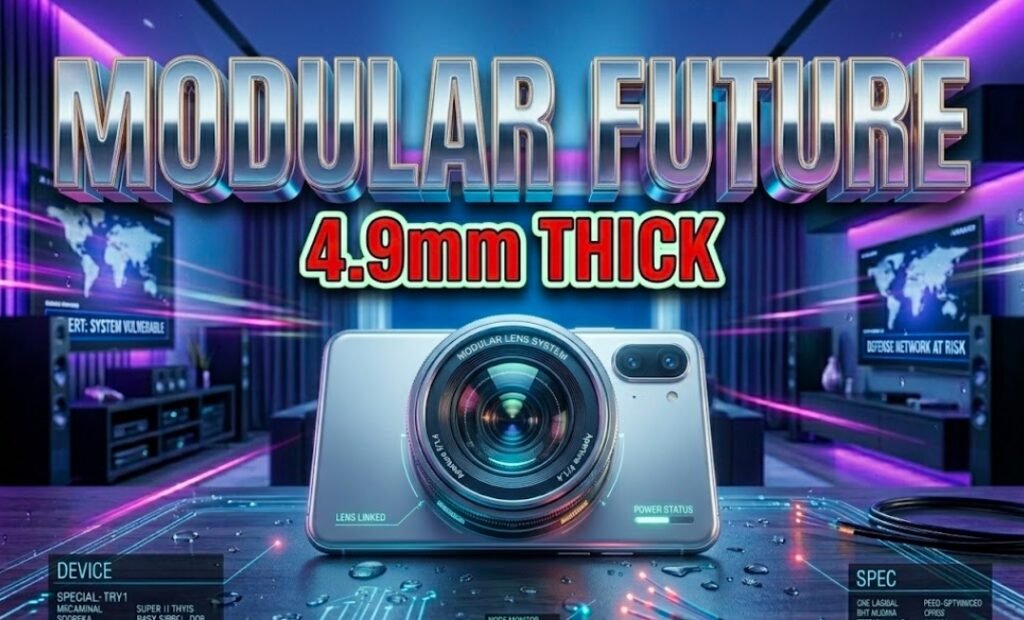
Tecno modular phone concept with telephoto lens attachment on table
Magnetic Expansion System
The magic happens on the rear panel. Tecno calls it the Modular Magnetic Interconnection Technology. The back of the device features a complex array of eight distinct magnetic zones coupled with pogo-pin connectors. These are not your standard refrigerator magnets.
These connectors allow for immediate, high-speed data transfer and power sharing. You can snap on a module, and the phone recognizes it instantly. The physical connection is strong enough to hold heavy attachments securely, yet easy enough to swap out in seconds.
Here is what makes this system different from previous attempts by other brands:
- Simultaneous Stacking: You do not have to choose just one mod. You can stack them.
- Power Sharing: The modules can share battery power with the main unit.
- Wireless Data: High-bandwidth data moves via mmWave, keeping latency near zero.
Professional Grade Attachments
Tecno brought several working prototypes to the show floor in Barcelona to demonstrate the ecosystem. The most impressive demonstration involved photography. Mobile photographers often complain about the physics limitations of thin phones, but this concept bypasses that entirely.
Users can snap on a massive Telephoto Lens grip. This module features optical image stabilization and extends the zoom range from 10x all the way to 20x. Because the lens is an external module, it can be physically larger and higher quality than anything that could fit inside a standard phone body.
The software integration impressed attendees just as much as the hardware. When the lens snaps on, the camera interface on the screen autonomously adjusts. It unlocks pro-level controls and viewfinder options that do not exist in standard mode.
Other modules showcased during the event included:
- 3,000mAh Power Bank: Adds days of battery life without cables.
- Studio Microphone: For high-fidelity audio recording.
- Selfie Mirror: Includes integrated ring lighting for content creators.
- Gaming Grip: Adds physical triggers and cooling fans.
Why This Concept Matters
The smartphone market has felt repetitive lately. Most “new” phones are just slightly faster versions of last year’s model with better cameras. Tecno is trying to break that cycle. By separating the core phone from its features, they are offering a device that adapts to the user, rather than forcing the user to adapt to the device.
We have seen modular phones fail before. LG tried it with the G5, and Motorola had the Moto Mods. Those systems failed because they were clunky, expensive, or required restarting the phone to swap parts. Tecno seems to have learned from history. Their use of mmWave technology means the phone acts as a viewfinder for the lens with zero lag, creating a seamless experience.
This device is currently a concept, meaning you cannot buy it in stores tomorrow. However, it won the “Best of MWC 2026” award for a reason. It shows us a future where our phones are not static objects, but fluid tools that change shape to fit our lives.
If Tecno can bring this technology to mass production at an affordable price, it could disrupt the entire industry. It challenges the planned obsolescence model by suggesting we should upgrade our cameras and batteries, not throw away perfectly good screens and processors.