A prominent YouTuber’s attempt to drive across the country using only Tesla’s Full Self-Driving software has crashed into a harsh reality just sixty miles from the start line. What was meant to be a showcase of futuristic autonomous technology quickly turned into a five-figure repair bill and a serious debate about driver responsibility. The incident exposes the expensive risks lingering behind the wheel of today’s smartest cars.
Metal Ramp Shatters Self Driving Dreams on Highway
Justin Demaree is known online as the Bearded Tesla Guy. He set out from Orlando with a simple goal. He wanted to reach San Diego using his Tesla Model Y’s advanced driver assist features.
The experiment faced a catastrophic failure almost immediately. The vehicle was traveling at highway speeds of 70 mph when a large metal ramp appeared in the lane. The Full Self-Driving system failed to identify the hazard or slow down before impact.
Video footage captures the jarring moment the electric SUV plowed over the debris. The collision was violent enough to rip off a sway bar bracket and destroy sections of the plastic bumper. Demaree later admitted he expected the car to handle the situation better.
This highlights a known limitation in current driver-assist technologies.
damaged tesla model y bumper after highway collision
“Traffic-Aware Cruise Control may not detect all objects and, especially when cruising over 50 mph, may not brake/decelerate when a vehicle or object is only partially in the driving lane.” — Tesla Model 3 Owner’s Manual
The car simply plowed through. It left the driver and his passenger scrambling to assess the damage on the side of the road.
Battery Failure Leads to Shocking Service Center Visit
The physical damage to the bodywork was only the beginning of the trouble. The vehicle soon began displaying critical error messages related to its high-voltage battery pack.
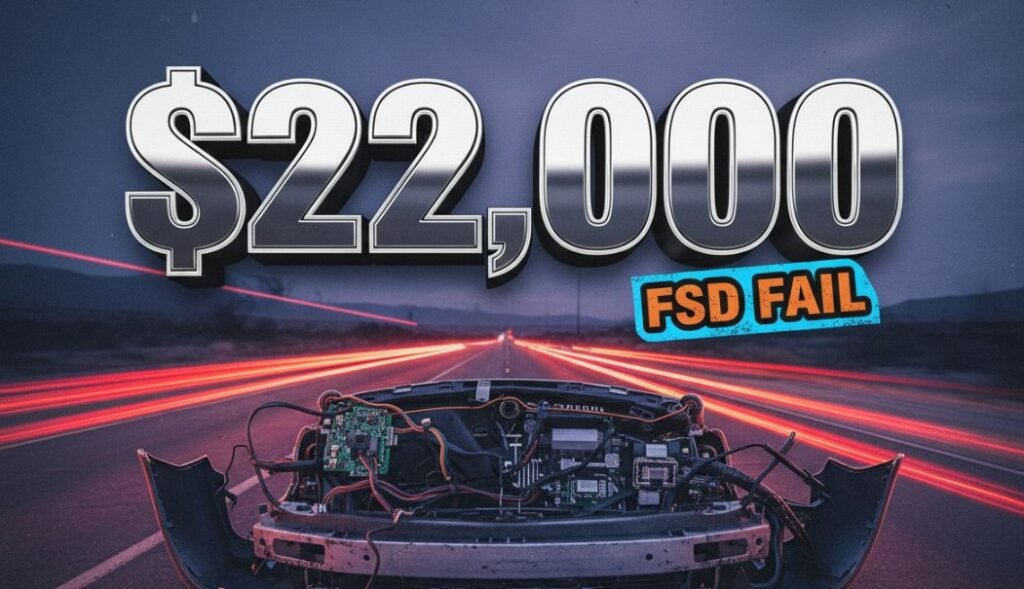
Demaree diverted to a service center in Arizona to diagnose the problem. The financial reality of fixing a modern electric vehicle became immediately apparent. The total estimate for repairs skyrocketed to over $22,000.
The majority of this cost was attributed to a complete battery replacement valued at $17,000.
The service center report provided a fascinating twist to the story. Technicians discovered that the battery pack suffered from a cell imbalance. This issue likely existed before the impact with the metal ramp.
Demaree received a stroke of luck regarding the bill. Because the battery fault was determined to be a manufacturing defect rather than impact damage, Tesla covered the replacement under warranty.
If the battery failure had been caused solely by the collision while on FSD, the YouTuber would have been liable for the full amount. Insurance claims for accidents involving semi-autonomous features remain a complex gray area for many owners.
Driver Responsibility During Autopilot Use
This incident reignites a fierce debate about who is actually in control when FSD is active. The system name implies full autonomy. The legal reality is very different.
Law enforcement and regulators view the human in the driver’s seat as the captain of the ship. Viewers criticized Demaree for his interaction with police following the incident. He allegedly did not explicitly state that the computer was driving at the moment of impact.
State laws are currently scrambling to catch up with this technology.
- Legal Liability: Drivers are responsible for all moving violations.
- System Limits: Tesla requires drivers to keep hands on the wheel.
- Insurance: Reckless reliance on FSD can complicate claims.
Trusting a beta software program to safeguard you against stationary highway debris is a dangerous gamble.
Studies continue to show that human reaction times drop significantly when drivers become complacent behind the wheel of automated vehicles. The car operates smoothly for hours. Then it encounters a split-second edge case that requires immediate human intervention.
If the driver is checking their phone or simply too relaxed, the result is often twisted metal.
Is Technology Ready for Coast to Coast Travel
The vision of a robotaxi capable of driving while you sleep is still out of reach. Tesla has made massive strides with software updates. The cars can handle complex city streets and roundabouts better than ever before.
Yet, highway driving presents unique challenges. Radar and vision systems sometimes struggle to distinguish between a harmless shadow, a bridge overpass, or a deadly metal ramp lying on the asphalt.
Demaree’s experience serves as a costly warning to other EV enthusiasts. The technology is impressive. It is also imperfect.
Investors and fans are waiting for the day FSD becomes truly hands-free. Until then, drivers must treat the system as a junior learner driver rather than a chauffeur. You must be ready to grab the wheel at any moment.
The dream of a zero-intervention cross-country road trip remains just that. A dream. For now, the reality involves keeping your eyes on the road and your credit card ready for unexpected repairs.