Logan Paul’s record $16.5 million Pikachu Illustrator sale just shook the collecting world. But one of America’s top financial advisors says the hype is hiding a dangerous truth. Tom Ruggie believes “artificial scarcity” is inflating prices, FOMO is driving buyers, and a speculative bubble could be forming right under everyone’s nose.
Record Pikachu Sale Sparks Fresh Debate
Logan Paul’s rare Pikachu Illustrator card sold for $16.5 million at Goldin Auctions after 41 days of bidding.1 A Guinness World Records official confirmed the price was a record not just for a Pokemon card, but for any trading card sold at auction.1
The card was first created in 1998 by artist Atsuko Nishida for a drawing contest.2 Only a small number of these cards exist, and Paul’s is the only one to receive a perfect grade of 10, making it even more valuable.2
The winning bidder was A.J. Scaramucci, a venture capitalist and son of former White House communications director Anthony Scaramucci.2 He has big plans for the card. Scaramucci described it as the cornerstone of a “planetary treasure hunt” to collect the world’s rarest and most culturally significant objects.3
The sale price alone tells a story. Paul had originally bought the card in 2021 for $5.275 million, which at that time was a Guinness World Record for a Pokemon card.2 That means the card tripled in value in less than five years.
More than $14 million was bet on the final price of the card’s auction on prediction markets PolyMarket and Kalshi.4 The frenzy around this single card shows just how far the trading card world has come from dusty binders and neighborhood trades.
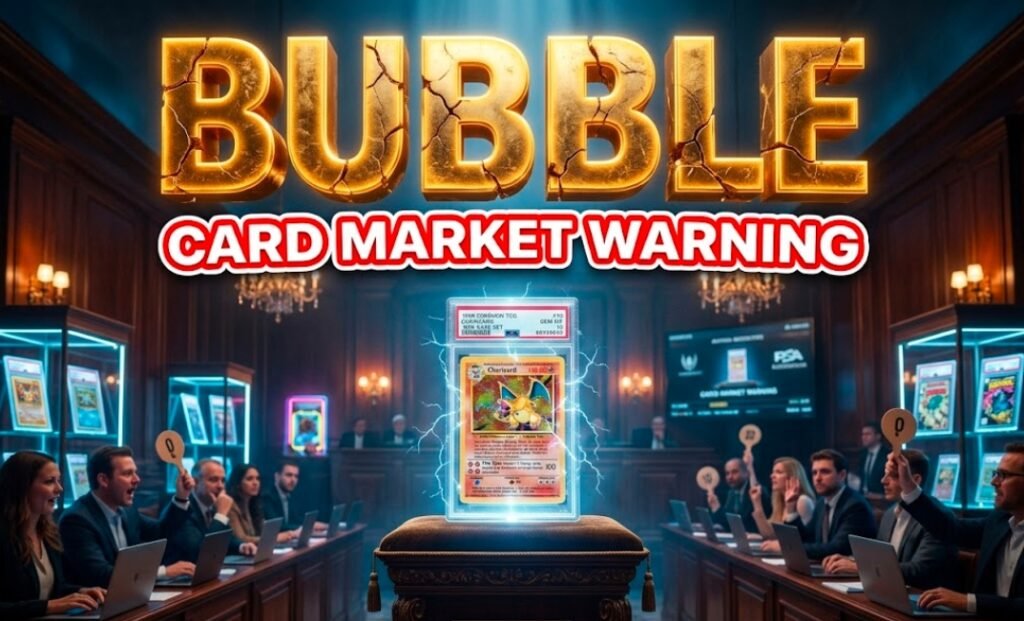
trading card market bubble risk Pikachu Illustrator record sale
Tom Ruggie Sounds the Alarm
Not everyone is celebrating. Tom Ruggie warned that “the artificial scarcity is creating a bubble in the industry that ultimately is going to burst.”5
Ruggie is not some outsider shouting from the sidelines. He has been named to Barron’s Top 1200 Financial Advisors 13 times and was the InvestmentNews 2025 Advisor of the Year for Alternative Investments.6 His firm, Destiny Family Office, is part of Destiny Wealth Partners, an independent, SEC-registered investment advisor with more than $1.5 billion in assets under management.7
Ruggie sees an overlap between the Pokemon frenzy and other speculative manias of the past decade, from Bitcoin to meme stocks and NFTs, pointing to “relatively younger people that have made a lot of money on Bitcoin” who now “have the type of money to throw at things like this.”5
His core concern is simple. Limited runs, exclusive variants, serialized cards, and surprise “chase” inserts create urgency. Social media amplifies the effect, pushing buyers to act fast before the next price jump. “You see all these people in these pack wars opening cards, looking for that holy grail of something that is going to sell for a ton of money,” Ruggie said.5
When prices rely on momentum instead of true long-term demand, corrections can be sharp and painful.
A Booming Market With Real Numbers
The numbers behind the trading card industry are staggering.
The global trading card games market was estimated at $8.4 billion in 2025 and is expected to grow to $16.9 billion by 2035 at a CAGR of 6.9%.8
Here is a snapshot of how the market breaks down:
| Segment | 2025 Value | Projected Growth |
|---|---|---|
| Global TCG Market | $8.4 billion | $16.9 billion by 2035 (6.9% CAGR) |
| U.S. TCG Market | $2.2 billion | 8% CAGR through 2035 |
| Asia Pacific TCG Market | $3.5 billion | 6.6% CAGR through 2035 |
| Sports Trading Cards | $1.67 billion | $4.24 billion by 2035 (9.8% CAGR) |
A major factor driving growth is the increasing number of adult collectors, specifically those aged 25 to 45, who have become the largest proportion of trading card purchasers.8
According to market data, the overall value of Pokemon cards has grown by over 830% between March 2020 and October 2025, five times more than the S&P 500 over the same period.9 That kind of return grabs attention fast.
But growth alone does not mean the market is healthy at every price level. Certain segments of the trading cards market have shown extreme price volatility, with some modern cards experiencing 300% price swings within months.10
Signs of Trouble Beneath the Surface
Several warning signs suggest parts of the market may be overheating.
The 1980s and early 1990s saw billions of cards printed, and values stayed depressed for decades. Production patterns are repeating in 2025-26 flagship releases, which produced over 429 million cards for NBA products alone.11
Many special illustration rares from recent sets that spiked immediately upon release are now settling at 40 to 60 percent of their peak prices.12
Prices are driven by scarcity perception, influencer attention, and speculative buying, where a single surge of interest can rapidly inflate values before settling back toward historical norms, according to Bloomberg.13
“If you are looking at this as an investment and there’s that fear of missing out kind of allure, my opinion would be: don’t put all your eggs in one basket.” Tom Ruggie urged investors and the advisors who work with them to remember the cardinal rule of investing: avoid concentrated, leveraged bets on a single asset class.5
Key risk factors every collector and investor should watch:
- Overproduction: Mass print runs are flooding lower-tier card segments with supply.
- Grading dependency: Card values hinge heavily on third-party grades from PSA, CGC, or Beckett.
- Influencer-driven spikes: A single YouTube video or social media post can temporarily inflate a card’s price by hundreds of percent.
- Sentiment shifts: If younger buyers move on to the next trend, demand can dry up fast.
- Liquidity risk: Unlike stocks, you cannot sell a rare card instantly at market price.
What Collectors and Investors Should Do Now
The debate is not really about whether trading cards have value. They clearly do. Pokemon is the world’s highest-grossing media franchise, surpassing even Disney and Star Wars.14 Cultural icons like the Pikachu Illustrator carry real weight.
The real question is how much of today’s pricing reflects lasting demand versus short-term hype.
Industry insiders believe manufacturers are smarter now than the sports card companies were in the late 1980s and early 1990s, focusing on differentiation, rarity, and keeping it about the gameplay.15 eBay reports 11 straight quarters of accelerating growth in trading cards.15
For collectors, the advice is straightforward. Buy what you love. If you also want financial upside, focus on truly rare cards with low population counts and clear provenance. Avoid chasing hype-driven modern releases that are printed in massive quantities.
For investors treating cards as an asset class, Ruggie’s framework is worth following. He advises people to “continue to diversify and understand that there are inherent risks with things like this that also offer potential for significant return.”5
The $16.5 million Pikachu sale will be remembered as a turning point, whether it marks the peak of a bubble or the beginning of a new era for collectibles as a serious asset class. Either way, anyone putting real money into trading cards today should do so with open eyes, a clear plan, and the understanding that what goes up in a frenzy can come back down just as fast. If you are a collector, an investor, or simply someone watching from the sidelines, drop your thoughts in the comments below.