Chip stocks rose after Nvidia’s latest earnings because investors got three forms of relief at once: record artificial intelligence demand, a paused Samsung Electronics strike, and tentative signs that limited shipping could move around the Strait of Hormuz. That mix made the rally broader than a single megacap beat, but more fragile because two supports came from supply risks easing.
The iShares Semiconductor ETF closed May 22 at $537.33, up 2.4%, even as Nvidia slipped late in the session. The split matters. Traders were buying the chip complex, not simply chasing the company that reported.
The Beat That Set the Price
The cleanest number came from Nvidia’s first quarter fiscal results. The company reported $81.6 billion in quarterly revenue for the period ended April 26, up 85% from a year earlier. Data center revenue reached $75.2 billion, up 92%, and management guided for $91.0 billion in revenue for the current quarter, plus or minus 2%.
Wall Street had set a lower bar. The FactSet analyst consensus reported by AP called for $78.91 billion in revenue for the quarter and $87.29 billion for the current period. That gap gave investors the beat they wanted, even if the stock itself did not hold the whole move.
The extra detail was capital return. Nvidia added an $80.0 billion share repurchase authorization and raised its quarterly dividend to $0.25 a share from $0.01. For a company still treated as the purest read on artificial intelligence (AI, software and hardware systems built to perform tasks that once required human judgment), the payout shift says cash generation is catching up with the growth story.
The Three Relief Valves That Moved the Tape
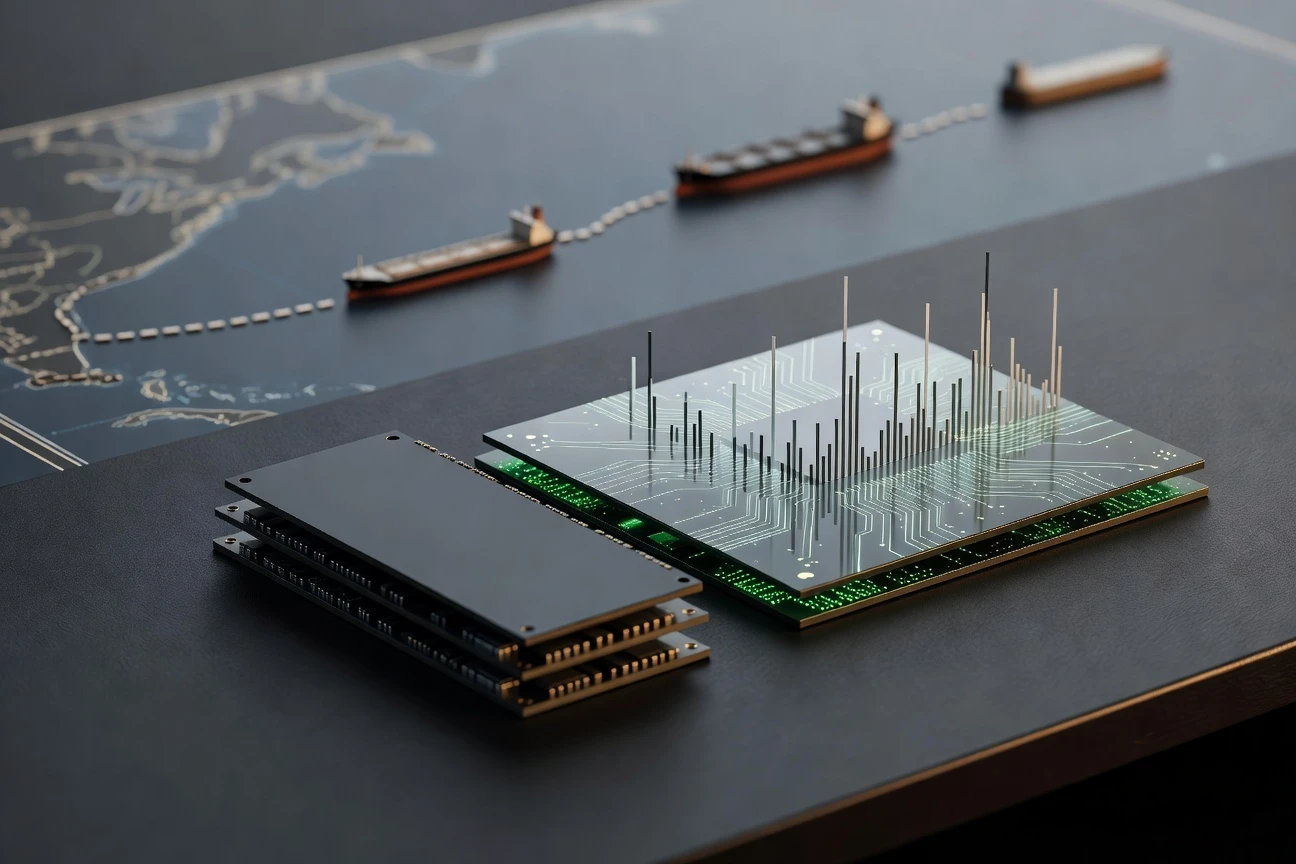
The rally made more sense when the three catalysts were placed side by side. One was demand. One was memory supply. One was energy transit. Together, they cut across the income statement for chip companies: revenue growth, input availability, and macro risk.
| Relief Valve | Main Signal | Why Chip Investors Cared |
|---|---|---|
| Nvidia earnings | Revenue and guidance cleared expectations | Confirmed that hyperscaler AI spending has not cracked |
| Samsung labor talks | Planned strike was suspended while members vote | Reduced near term fear around memory chip output |
| Strait of Hormuz shipping | Limited passage appeared possible, but visibility stayed low | Lowered the immediate oil shock risk hitting rates and margins |
That is why the move was not only about graphics processing units (GPUs, accelerator chips used for AI workloads). The market was also repricing high bandwidth memory (HBM, stacked memory paired with advanced AI processors), dynamic random access memory (DRAM, the working memory used in servers and computers), and the cost of moving fuel through one of the world’s most sensitive waterways.
Samsung Took One Supply Shock Off the Table
Samsung Electronics mattered this week because its chip plants sit in the memory side of the AI buildout. The company’s Device Solutions division reported KRW 81.7 trillion in first quarter revenue and KRW 53.7 trillion in operating profit, while the memory business set records as prices rose and AI demand pulled in high value products, according to Samsung’s first quarter results.
That made the labor dispute more than a local wage story. The Samsung union strike delay reported by AP put an 18 day walkout on hold while members vote on a tentative wage deal from May 22 to May 27. Choi Seung-ho, a Samsung Electronics labor union leader, said the agreement followed about six months of conflict.
For investors, the narrow point was production continuity. The broader point was pricing power. If the largest memory makers are already selling into tight AI demand, a labor shock can move from a corporate headache to a sector cost problem fast. That is why a suspended strike helped memory names and not only Samsung shares.
Thunder Tiger Europe has been tracking the same bottleneck from the device side, including Samsung’s HBM push into phone chips. The message is consistent: memory is leaving the background and becoming a front row factor in how AI hardware gets priced.
Hormuz Kept the Chip Trade Tied to Oil
The Strait of Hormuz looks far away from a server rack, but it still feeds the discount rate investors put on chip earnings. The U.S. Energy Information Administration says oil flows through the channel averaged 20 million barrels per day in 2024, equal to about 20% of global petroleum liquids consumption, and that Hormuz also carried around one fifth of global liquefied natural gas trade.
Few alternate routes exist at full scale. The EIA’s Hormuz oil chokepoint analysis estimated only about 2.6 million barrels per day of available bypass capacity from Saudi and UAE pipelines in the event of a disruption. That imbalance explains why even partial shipping relief can move equities.
Still, the shipping signal was not an all clear. Maersk’s Middle East shipping advisory said public statements suggested commercial passage through Hormuz may again be possible for a limited period, but that information remained limited. It also said passage criteria were unclear and commercial navigation stayed greatly restricted after earlier statements from Iran.
Investors have seen this setup before in different form. Earlier coverage of Asia Pacific stocks and oil price relief showed how quickly equity risk appetite can turn when energy costs stop pressing on margins. Chip stocks are growth assets, but they still trade inside the same macro machine.
Memory Became the Second Earnings Season
The market is no longer treating memory as a quiet supplier category. Gartner, the technology research firm, now forecasts global semiconductor revenue will exceed $1.3 trillion in 2026, with memory revenue rising from $216.3 billion in 2025 to $633.3 billion this year. Its semiconductor revenue forecast also says AI semiconductors should account for about 30% of total industry revenue.
- $81.6 billion – Nvidia’s latest quarterly revenue.
- $75.2 billion – Its data center revenue in the same period.
- KRW 53.7 trillion – Samsung Device Solutions operating profit in the first quarter.
- $633.3 billion – Gartner’s 2026 memory revenue forecast.
TrendForce, the market research firm, adds the pricing pressure. Its second quarter memory pricing survey projects conventional DRAM contract prices to rise 58% to 63% quarter over quarter and NAND flash contract prices to rise 70% to 75%. NAND flash is nonvolatile storage used in solid state drives, phones, and servers.
This is the second order effect behind the rally. A great GPU quarter tells investors demand is strong. Rising memory prices tell them that demand is squeezing the supply base in ways that can help some chip suppliers and hurt downstream hardware buyers.
The Winners Are Not All Selling GPUs
The first instinct is to put every AI trade under Nvidia. That misses how the profit pool is spreading. A server accelerator needs advanced logic, HBM stacks, substrates, networking gear, power components, and enterprise solid state storage before it can ship into a data center.
- Memory makers gain when HBM and server DRAM capacity stays tight and buyers sign long term supply deals.
- Chip equipment firms benefit when foundries and memory producers add capacity, especially at advanced nodes.
- Regional AI chip challengers get a better audience when customers want supplier diversity and local capacity.
That last point is especially relevant in Europe. Thunder Tiger Europe recently covered Axelera AI’s $450 million raise, a reminder that the Nvidia trade has also pushed capital toward companies promising cheaper or more local AI inference hardware. Those firms still have to prove volume, software support, and customer retention. But the funding window is open because the incumbent’s numbers keep expanding the addressable market.
There is a catch. If memory inflation gets too severe, some non-AI device demand gets delayed. Gartner warned that memflation can delay demand in non-AI markets into 2028. That means the same tightness lifting memory suppliers can pressure PC makers, smartphone brands, and smaller electronics firms.
The Fragile Math Behind the Bounce
The best case for chip bulls is simple: Nvidia’s guidance holds, Samsung workers approve the tentative deal, and Hormuz traffic keeps improving without a new oil shock. In that path, the sector gets a rare combination of strong demand and lower near term tail risk.
The weaker path is just as clear. A renewed labor fight would bring memory supply fears back. A new shipping disruption would push energy prices and inflation expectations higher. A softer cloud capital spending signal from Alphabet, Amazon, Microsoft, or Meta would challenge the revenue forecasts now embedded in chip shares.
That is why Friday’s tape deserves a careful reading. The broader chip basket gained while Nvidia itself slipped. Investors were not rejecting the AI thesis. They were spreading the trade across the companies most exposed to the new bottlenecks.
If the next data points confirm stable memory output and calmer energy transit, this rally can broaden beyond one name. If either support breaks, chip stocks will have to stand on the earnings beat alone.
Disclaimer: This article is for informational purposes only and does not provide investment advice. Semiconductor, technology, energy, and equity markets carry financial risk, including loss of principal. Consult a qualified financial professional before making investment decisions. Figures are accurate as of publication.