
NEWS
ASUS Enters the RAM Market Without a Memory Fab
ASUS denied a memory fab, then sold 48 GB ROG RAM in China for 5,999 yuan, made by BIWIN with SK hynix dies.

ASUS entered desktop RAM on May 15, 2026 with a 48GB ROG kit that BIWIN builds on SK hynix dies. The sticks list at 5,999 yuan in China, about $880, and the company has not confirmed a worldwide sale.
That is the version of the rumor that survived. ASUS had already said it would not fund a memory wafer fab. The kit still buys the same scarce DRAM everyone else is fighting over, then sells it back with a ROG heatspreader and a BIOS switch that only ROG boards can use.
Did ASUS Start Making Its Own RAM Chips?
No. On December 26, 2025, after a late-year claim that the company would build its own memory chips by 2026 if the shortage held, ASUS said it had “no plans to invest in a memory wafer fab.” It said it would deepen ties with memory suppliers and handle the crunch by changing product specs and life cycles, which is the work PC brands already do when DRAM gets scarce.
A DRAM plant is a multi-year bet with process IP ASUS does not own. Analysts who looked at the rumor said a production-ready line would take at least two years even if the company already had that know-how, which it does not. The original leak also mixed up two different businesses: cutting silicon, and assembling DIMMs from someone else’s chips.
FROM RUMOR TO ROG KIT
- December 3, 2025: Micron says it will stop selling Crucial-branded RAM and SSDs to consumers and keep shipping through February 2026.
- December 26, 2025: ASUS says it has no plan to invest in a memory wafer fab and will work through existing suppliers.
- February 2026: Crucial consumer shipments end. Warranties on kits already sold stay in force.
- May 15, 2026: At ROG Day in China, ASUS shows the ROG DDR5 RGB Edition 20, built with BIWIN on SK hynix M-die.
- Late June 2026: China sales of that kit are scheduled. A global date is still missing.
ASUS has been near module work before. ASint, a Taiwan memory-module firm set up with Silicon Integrated Systems around 2008, still sells DDR5 kits under its own name. That was never a path into Samsung, SK hynix, or Micron’s wafer business, and the 2026 kit does not change that line.
The ROG Kit That Arrived Instead
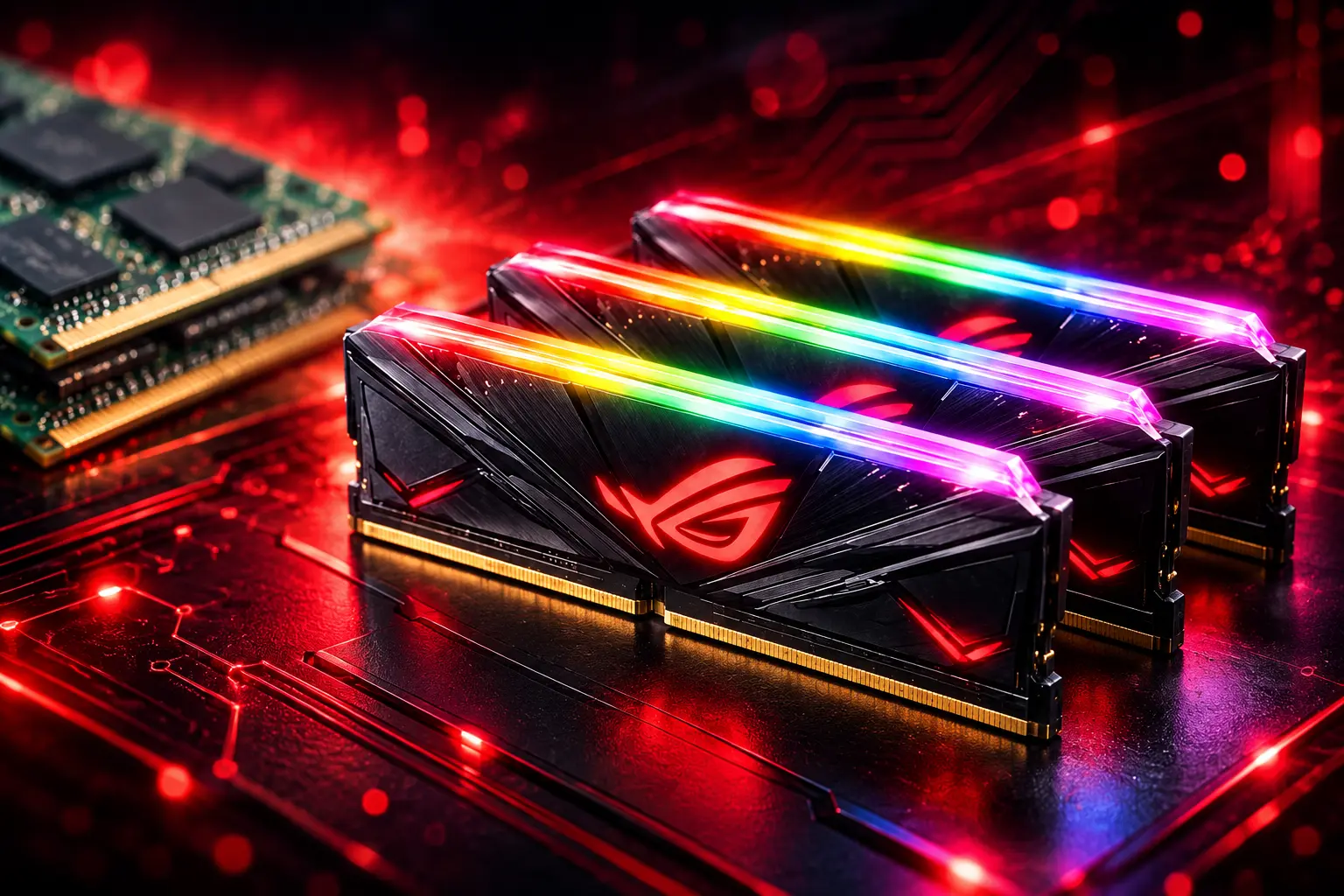
The first ASUS-branded desktop memory is a 20th-anniversary ROG piece, shown in black, gold, and red. BIWIN, a Shenzhen module house already on the new ROG Certified list, builds it. The silicon inside is SK hynix M-die, the same overclock-friendly IC a dozen other premium kits already use.
ROG DDR5 RGB EDITION 20
| Item | Spec |
|---|---|
| Capacity | 48GB (2x24GB) |
| Rated speed | DDR5-6000 |
| Timings / voltage | CL26-36-36-76 at 1.45V |
| ICs | SK hynix M-die |
| Profiles | Intel XMP and AMD EXPO, plus ROG Mode on ROG boards |
| RGB / warranty | Aura Sync / lifetime |
| China price | 5,999 yuan (about $880, €755) |
| Builder / sales window | BIWIN / late June 2026 in China |
At $880, the kit sits above a GeForce RTX 5070 Ti’s $829 starting price, which is the comparison that stuck when the photos landed. This is not extra consumer DRAM. It is a scarce Hynix die in a taller heatsink, sold as a limited ROG object, with a lifetime warranty and no confirmed shelf date outside China.
ASUS in-house overclocker Safedisk later ran the same 48GB pair to 8800 MT/s at CL34 and 1.70V on a ROG Crosshair X870E Apex under water cooling. That is a demo on a flagship board, not the box spec, and it does not change who poured the silicon.
ROG Mode Works Only on ROG Boards
The feature ASUS is selling next to the RGB is a dual profile it calls ROG Mode, in the BIOS on Crosshair, Maximus, and Strix boards. One path keeps the low-latency 6000 MT/s kit at CL26-36-36-76 and 1.45V. The other jumps to 8000 MT/s at CL36-48-48-110 and 1.40V for more bandwidth. On any other brand’s board, the sticks fall back to ordinary XMP and EXPO, like every other tuned DDR5 kit.
That is a motherboard lock, not a memory breakthrough. ASUS already spent years putting DRAM tools on those boards. Its January 6, 2026 AMD 800-series refresh pushed NitroPath DRAM technology and DIMM Fit, plus a closer tie-up with G.SKILL on 4-rank UDIMMs for the Crosshair X870E Apex. The new kit extends that habit: the valuable part is the BIOS handshake, and it only fires if you already bought the board.
Builders who do not run ROG get a pretty 48GB Hynix kit at a China luxury price. Builders who do run ROG get a second profile and a reason to stay inside one brand’s stack while DRAM is short.
Branded DIMMs Do Not Add a Single Wafer
Consumer DDR5 is tight because the three merchant DRAM makers moved wafer starts toward high-bandwidth memory for AI accelerators. HBM uses more silicon per bit than a standard DDR5 die. That reallocation is why a PC brand putting its logo on a DIMM cannot loosen the market. The bottleneck is the fab, and ASUS does not run one.
WHERE CONSUMER DRAM STANDS
- Spot print: TrendForce’s DDR5 16Gb spot session average on September 10, 2026 was $54.333, down 0.31% on the session and still at crisis levels.
- Contracts: TrendForce’s mid-year outlook had 3Q26 memory contract prices still rising, with conventional DRAM up 13% to 18% quarter on quarter as PC and phone buyers hit a ceiling.
- Industry take: The same research house put Q2 DRAM revenue at $154.73 billion, up 59.5% from the prior quarter, on those higher contract prices rather than a flood of extra bits.
ASUS’s practical workaround on notebooks is quieter than the ROG launch. The company has increased use of CXMT DRAM in some PCs sold in mainland China and other emerging markets, while keeping Western SKUs on the usual suppliers. That is a sourcing split, and it still leaves the dies coming from a foundry ASUS does not own.
Fourteen Partners Fill the Hole Crucial Left
The larger move at ROG Day was not one anniversary kit. It was the ROG Certified memory program, with 14 DRAM partners on the list: ADATA, Apacer, ASGARD, BIWIN, Corsair, G.SKILL, GeIL, Kingston, KLEVV, Lexar, Silicon Power, TeamGroup, V-Color, and Viper Gaming. Silicon Power followed on May 26, 2026 with an XPOWER Cyclone R kit carrying the badge, rated up to 6000 MT/s and shown at Computex.
Micron, on December 3, 2025, chose the other door. It would exit the Crucial consumer business so it could feed “larger, strategic customers in faster-growing segments.” Shipments through the consumer channel ran to the end of fiscal Q2 in February 2026. Enterprise product under the Micron name stayed in the commercial channel.
The AI-driven growth in the data center has led to a surge in demand for memory and storage. Micron has made the difficult decision to exit the Crucial consumer business in order to improve supply and support for our larger, strategic customers in faster-growing segments.
Sumit Sadana, EVP and Chief Business Officer, Micron press release
WHAT THE CERTIFIED PROGRAM ACTUALLY DOES
- Validation: Partner kits are tested on ROG boards so the QVL argument sits on ASUS’s own logo.
- Lighting: Certified sticks pick up Aura Sync, which keeps the case look inside the ROG stack.
- Profiles: The extra ROG Mode sub-timings are the incentive to pair those kits with Crosshair, Maximus, or Strix boards.
- Supply: None of the 14 names pours DRAM wafers; they assemble and brand ICs from the same three makers, plus, in some China kits, CXMT.
So the “hole” Crucial left on retail shelves is being filled with more brands on the same short pile of dies. ASUS is one more label in that pile, with a BIOS hook its motherboard line can collect on.
Liao Yi-hsiang Still Had to Raise Laptop Prices
The original case for an ASUS RAM line was protecting notebooks. Liao Yi-hsiang, general manager of ASUS’s systems business, spent 2026 explaining why that did not happen. In March he said Taiwan PC prices would rise 25% to 30% in the second quarter, by model, on DRAM, SSD, and CPU cost. He used a 32GB module that had cost about 3,000 NTD the year before and was approaching 20,000 NTD.
By June 24 he was talking about the bill after those hikes. Taiwan ASUS PCs were about 30% above end-2025 levels through the second quarter of 2026. A further rise in the third quarter would be a single-digit move, he said, because memory and storage costs had eased a little and buyers were walking away from another large jump.
That sequence is the tell. A company that had just put its name on a 5,999 yuan desktop kit still had to lift whole-system prices in its home market. The ROG sticks do not feed a Zenbook line. They sit in the same allocation fight as every other Hynix M-die kit, and the notebook P&L still takes the hit.
ASUS now sells a memory kit. It does not make DRAM. The 48GB Edition 20 is a China-first anniversary object on borrowed silicon, and a worldwide listing still has not been posted.
Frequently Asked Questions
Did ASUS Start Manufacturing DRAM Chips in 2026?
No. ASUS ruled out a memory wafer fab on December 26, 2025, and a plant of that kind would have taken at least two years to bring up even with process IP the company does not hold. The nearest in-house path is still module work, the same route ASint took after ASUS and Silicon Integrated Systems set that firm up around 2008.
Who Makes the ASUS ROG DDR5 RGB Edition 20?
BIWIN in Shenzhen assembles the kit and puts SK hynix M-die ICs under the ROG heatspreader. BIWIN already builds memory for other PC brands, including Acer’s Predator line plus HP and Lenovo programs, so the ASUS sticks sit in an existing OEM line rather than a new ASUS factory.
What Is the ASUS ROG Certified Memory Program?
It is a validation badge, not a fab. ASUS’s ROG site listed 17 certified DDR5 kits from those 14 brands after the May 15 event, with Aura Sync and ROG Mode as the extras when the sticks sit in a ROG board. Partner factories still buy DRAM from the same merchant suppliers.
When Did Micron Stop Selling Crucial RAM to Consumers?
Micron cut off Crucial consumer shipments at the end of fiscal Q2 in February 2026, after 29 years of the brand, and said it would keep honoring warranties. It still sells Micron-branded enterprise memory through the commercial channel and said it would try to move affected staff into other open jobs.

UPI MDR Delay Hands Traders the Calendar After Paytm Falls

Google Messages Builds Nine In-Chat Games After Samsung’s Exit

Anthropic’s $100 Million Academy Trains the Firms That Bill Both Sides

Toyota’s Electric C-HR Leaves the Cheap Twin to Subaru

Markets Bet the Fed Skips October After Hawkish Minutes

The Orchard Bug Forced Zcash to Open an Empty Pool

The $5.99 Game That Won Steam’s 2026 Summer Sale

Don Lee Joins Hemsworth as Extraction 3 Starts Shooting

YouTube Shorts Retires Dislikes and Swaps Likes for Hearts

NEURA Robotics Is Spending Its $1.4B on a Machine Stack
-
 NEWS5 months ago
The Orchard Bug Forced Zcash to Open an Empty Pool
-
 GAMING5 months ago
The $5.99 Game That Won Steam’s 2026 Summer Sale
-
 ENTERTAINMENT7 months ago
Don Lee Joins Hemsworth as Extraction 3 Starts Shooting
-
 NEWS4 months ago
YouTube Shorts Retires Dislikes and Swaps Likes for Hearts
-
 NEWS4 months ago
NEURA Robotics Is Spending Its $1.4B on a Machine Stack
-

 NEWS5 months ago
Atlantic City Turned WWE’s Return Into a Civic Night
-

 AUTO6 months ago
Kawasaki Bets the New Z1100 Against Its Own Supercharger
-

 BUSINESS5 months ago
Norway’s Export Bank Backs Nscale’s $790 Million Narvik Loan