
ENTERTAINMENT
Composers Rank Blade Runner First Among 101 Movie Soundtracks
Film composers ranked Vangelis’s Blade Runner first among 101 movie soundtracks, putting world-building ahead of the albums that sold tens of millions.

Working composers ranked Vangelis’s Blade Runner as the best movie soundtrack, ahead of Ennio Morricone and John Williams. In April 2024 they helped assemble a 101-title list that put music written for the screen first, and named two misses in the introduction: Dimitri Tiomkin’s score for It’s a Wonderful Life, and Elton John’s songs for The Lion King.
The Bodyguard soundtrack, certified in June 2025 for 19 million US shipments, does not appear at all.
Blade Runner Wins Because It Builds a World
The number 1 slot went to a 1982 synth score that Ridley Scott wrapped around rain, neon and Harrison Ford, not to the brass fanfare that still fills concert halls. Emilie Levienaise-Farrouch, the French composer of All of Us Strangers, has said the record is what first showed her what film music could do.
The score that opened my mind to the potential of film music was Vangelis’s synth-heavy creations for Blade Runner. A family friend lent me the DVD when I was 13, and its impact was immediate. It was the first score that took me far away from the heritage of classical music and into the dimension of world-building.
Emilie Levienaise-Farrouch, composer, on Blade Runner
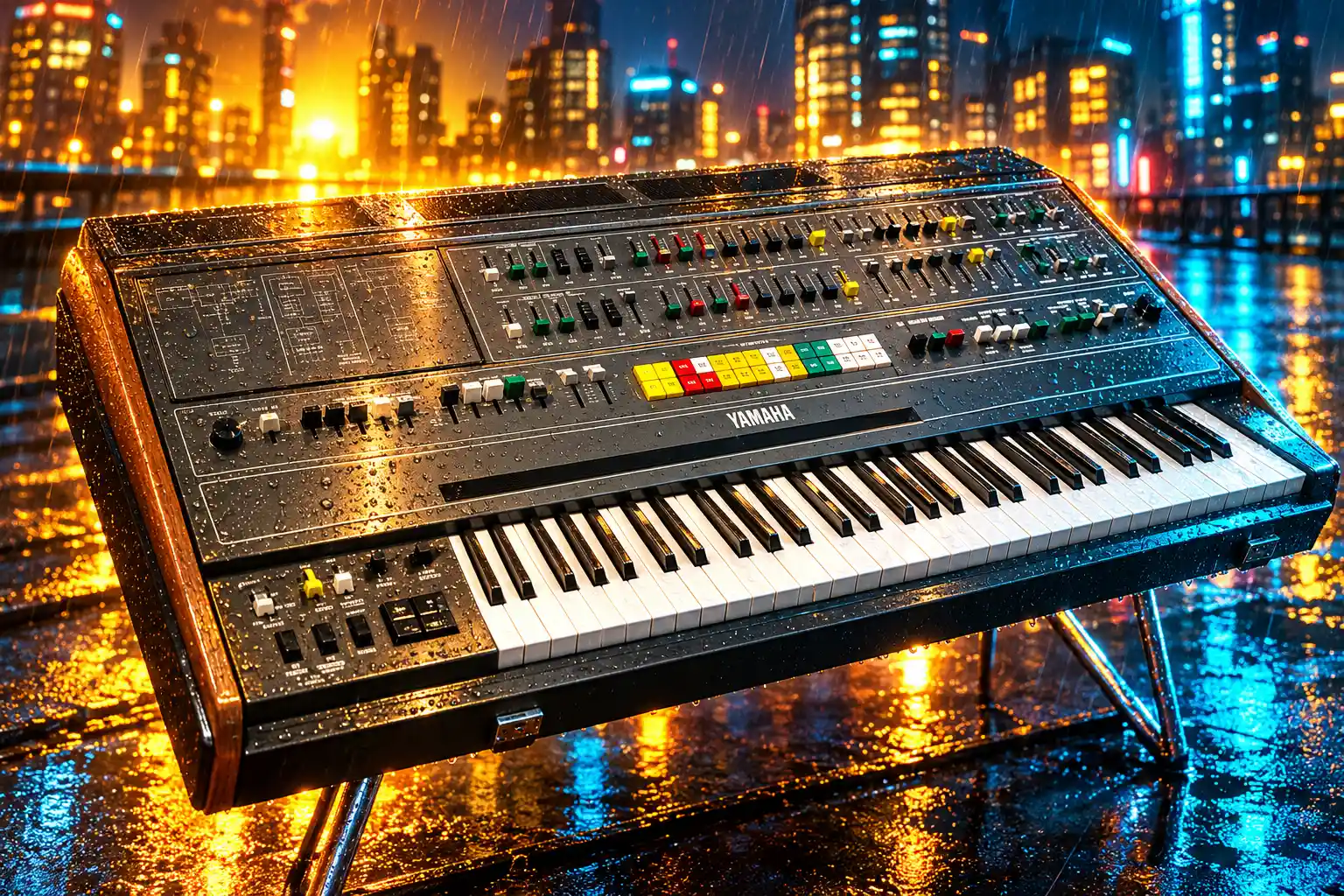
Max Richter, who scored Waltz with Bashir and Ad Astra, calls the same cues inseparable from the pictures. He hears the rain and the dread in the instrument Vangelis actually played, the Yamaha CS-80 at Nemo Studios in London, and he groups that colour with Morricone’s harmonica in Once Upon a Time in the West. The official album did not even reach shops until 1994, after a rights fight. Composers still filed it first.
Put working composers in a room and this is the pattern that keeps returning. Blade Runner beats the fanfare that sells tickets because it does not sound like other scores. It sounds like a city.
Eight John Williams Scores Share the Ballot
Williams still dominates the arithmetic. He has eight entries, more than anyone else, from Star Wars: Episode IV at 3 through The Witches of Eastwick at 81. Morricone, Hans Zimmer and Bernard Herrmann have three each. James Horner has two, Aliens and Star Trek II: The Wrath of Khan, and still could not get Titanic in.
JOHN WILLIAMS ON THE 101
| Rank | Film | Year |
|---|---|---|
| 3 | Star Wars: Episode IV, A New Hope | 1977 |
| 11 | Jaws | 1975 |
| 18 | Jurassic Park | 1993 |
| 24 | E.T. the Extra-Terrestrial | 1982 |
| 29 | Schindler’s List | 1993 |
| 39 | Raiders of the Lost Ark | 1981 |
| 42 | Close Encounters of the Third Kind | 1977 |
| 81 | The Witches of Eastwick | 1987 |
The ranking’s own write-up still calls the Star Wars album the best-selling symphonic record of all time. In 2005 an American Film Institute jury of more than 500 artists, composers, musicians, critics and historians named Star Wars the top film score among 25 titles, with Jaws at 6 and E.T. at 14. Nineteen years later the same composer is everywhere on the new ballot, and he is not number 1.
The list’s note on The Adventures of Robin Hood, ranked 5, treats Erich Wolfgang Korngold’s 1938 fanfares as the template Williams revived. Those eight cues now sit with the soundtracks that defined movie history in a narrower way. They are the lessons later composers keep citing when they talk about how to write for the screen.
The Diamond Albums the 101 Would Not Rank
US certifications tell a different job. In June 2025 the RIAA had seven film soundtracks at diamond level, 10 million shipments or more. Four of those seven are absent from the 101. The editors had already named one of them, The Lion King, as a miss. They did not mention The Bodyguard, Forrest Gump or Titanic.
THE RIAA DIAMOND SOUNDTRACKS
| Album | US shipments | Place on the 101 |
|---|---|---|
| The Bodyguard (1992) | 19 million | Not listed |
| Saturday Night Fever (1977) | 16 million | 55 |
| Dirty Dancing (1987) | 14 million | 98 |
| Purple Rain (1984) | 13 million | 8 |
| Forrest Gump (1994) | 12 million | Not listed |
| Titanic (1997) | 11 million | Not listed |
| The Lion King (1994) | 10 million | Named miss |
Guinness World Records still lists The Bodyguard as the biggest-selling soundtrack album, with more than 44 million copies worldwide as of 2012. On this ballot it is invisible. Purple Rain, the one diamond album the composers truly rated, lands at 8. Saturday Night Fever, which the same write-up notes is no longer the US sales leader, sits at 55. Dirty Dancing, 14 million shipments, is 98, two rungs above a 2023 pop jukebox.
Barbie is 97. Titanic, James Horner’s 11 million-seller with Celine Dion, is not on the page, even though Horner already had two other scores in. Forrest Gump, a double album of 1960s and 1970s hits, is out. The ranking is not allergic to songs. It is allergic to the idea that a shipment total is an argument.
Working Composers Voted for Their Teachers
The pickers were Philip Glass, Carter Burwell, Max Richter, Anne Dudley, AR Rahman, Levienaise-Farrouch, Edgar Wright and Mark Kermode. Several of them voted, in print, for the records that taught them the job rather than the records that moved units.
Burwell, who has scored most of the Coen brothers’ films, has said that when his budgets and his skills were both tiny, Morricone’s spaghetti-western cues showed him how four or five instruments that do not usually share a room can still make a style. The Good, the Bad and the Ugly is 2. Once Upon a Time in the West is 30. The Mission is 52. Rahman, a picker, also put his mentor Naushad’s Mughal-e-Azam at 57 and his own Slumdog Millionaire work at 80. Glass, another picker, has Mishima: A Life in Four Chapters at 22 and then, in his own words, praises Rachel Portman’s melody for The Cider House Rules at 69 as the sort of writing that carries a film’s feeling.
The same ballot keeps returning to cheap, odd tools. Anton Karas scored The Third Man on a zither, his only film score, then bought the restaurant where Carol Reed used to hear him play; that album is 6. Jerry Goldsmith ran Planet of the Apes, 14, through mixing bowls, a slide whistle and a cuica. John Carpenter wrote the Halloween motif in less than an hour on synths after test audiences failed to jump, and the film is 51. Miles Davis improvised Lift to the Scaffold, 10, in front of a screen in Paris. The through-line is not prestige. It is a sound nobody else had yet.
Film music is so bland and tasteful these days that it’s hard to imagine Herrmann’s dense score making it past all the nervous execs. I’ve worked with some brilliant execs, but it’s hard to shake the feeling that film and TV music has been dragged towards the beige.
Matthew Herbert, composer and producer, on Psycho
Psycho is 25. Herbert’s complaint is the quiet thesis under the ranking. The 101 is a guild document filed against beige.
Songs Got a Separate 101 in September
Five months later, in September 2024, a rock-magazine ranking of 101 soundtrack albums did the other job on purpose. It set original scores aside and counted song albums and curated mixtapes. Purple Rain was 1. Help!, The Harder They Come, A Hard Day’s Night, Saturday Night Fever, Super Fly, Pulp Fiction, The Graduate, American Graffiti and Wild Style filled out the top 10. The Bodyguard was 101, a last-place nod to the sales leader.
Prince had the number 1 film, album and single in August 1984, and that month is the whole argument of the song list. The composers’ list had already given him 8, which is generous by their own standard, then gone back to Vangelis. A Hard Day’s Night is 13 on the composers’ ballot and 4 on the song ballot. Super Fly is 47 versus 6. The Graduate is 58 versus 8. Pulp Fiction, 7 on the song list, does not appear on the composers’ 101 at all; Reservoir Dogs, where the radio is a character, is 78.
Chariots of Fire, the Vangelis theme that won the Oscar and went to number 1 as a single, is missing from the composers’ 101 too. They chose the withheld Blade Runner album over the hit that made his name in shops. That is the same instinct as leaving The Bodyguard off. Hits are someone else’s department.
Who Gets in When Sales Do Not Matter?
Once shipment totals stop deciding the order, a different set of tests takes over. The ranking keeps rewarding the same four things, and it is consistent about them from 1 to the last original score.
WHAT THIS BALLOT REWARDS
- A timbre you can name: the CS-80, a zither, a pipe organ in London’s Temple Church on Interstellar (20), mixing bowls, a harmonica, Lisa Gerrard’s voice on Gladiator (59).
- Music as character: Morricone writing Once Upon a Time in the West before the shoot, Howard Shore building 50 leitmotifs for The Lord of the Rings: The Return of the King (37), Jonny Greenwood using only 38 minutes of score inside Paul Thomas Anderson’s 158-minute There Will Be Blood (48).
- A record that stands alone: Kermode bought Eiko Ishibashi’s Drive My Car album (88) after the screening and still plays it in the car. Super Fly, the write-up notes, outgrossed its own film.
- Songs only when they make a world: Prince at 8, The Beatles at 13, Trainspotting at 44, O Brother, Where Art Thou? at 67, Barbie at 97, Singles at 101. A hits compilation with no other idea does not get that courtesy.
Mica Levi is named in the introduction as one of the people currently “knocking it out of the park.” Under the Skin is not on the 101. The editors also cut Tiomkin’s Wonderful Life score, the one they went out of their way to mention. The ballot is personal, and it is not trying to be a census.
Joker, Barbie, and the Bottom of the 101
Only three titles on the list are billed to women as composers: Portman at 69, Ishibashi at 88, and Hildur Guðnadóttir at 99. The write-up on Joker calls it a Hollywood shame that she is still one of the few women to score a blockbuster, and notes that Todd Phillips played her dark cues on set when scenes were dying. Joaquin Phoenix has credited “Bathroom Dance,” with her cello and a halldorophone, for the bathroom transformation. Anne Dudley and Levienaise-Farrouch were in the room as pickers. They still could not get a fourth woman onto the page as a composer of record.
The tail is where the 101 stops pretending it is only about written scores. Marie Antoinette’s New Wave mixtape is 89. Donnie Darko is 91. Pretty in Pink is 95. Drive, Cliff Martinez and Johnny Jewel, is 96. Barbie is 97. Dirty Dancing is 98. Then Guðnadóttir’s Joker score, then Eden’s French-house stack, then Cameron Crowe’s Seattle sampler. Tangerine Dream’s The Keep, 90, and Lalo Schifrin’s Bullitt, 92, and Danny Elfman’s Batman, 93, sit in that same stretch as proof that the guild still slips its own people into the cheap seats.
The last original score on the list is Guðnadóttir at 99. After that come a house mixtape and a grunge sampler. Whitney Houston is not in the room.

UPI MDR Delay Hands Traders the Calendar After Paytm Falls

Google Messages Builds Nine In-Chat Games After Samsung’s Exit

Anthropic’s $100 Million Academy Trains the Firms That Bill Both Sides

Toyota’s Electric C-HR Leaves the Cheap Twin to Subaru

Markets Bet the Fed Skips October After Hawkish Minutes

The Orchard Bug Forced Zcash to Open an Empty Pool

The $5.99 Game That Won Steam’s 2026 Summer Sale

Don Lee Joins Hemsworth as Extraction 3 Starts Shooting

YouTube Shorts Retires Dislikes and Swaps Likes for Hearts

NEURA Robotics Is Spending Its $1.4B on a Machine Stack
-
 NEWS5 months ago
The Orchard Bug Forced Zcash to Open an Empty Pool
-
 GAMING5 months ago
The $5.99 Game That Won Steam’s 2026 Summer Sale
-
 ENTERTAINMENT7 months ago
Don Lee Joins Hemsworth as Extraction 3 Starts Shooting
-
 NEWS5 months ago
YouTube Shorts Retires Dislikes and Swaps Likes for Hearts
-
 NEWS4 months ago
NEURA Robotics Is Spending Its $1.4B on a Machine Stack
-
 NEWS5 months ago
Atlantic City Turned WWE’s Return Into a Civic Night
-

 AUTO6 months ago
Kawasaki Bets the New Z1100 Against Its Own Supercharger
-

 BUSINESS5 months ago
Norway’s Export Bank Backs Nscale’s $790 Million Narvik Loan