
BUSINESS
Co-reactive’s Erkrath Plant Bets on Europe’s SCM Shortage
Co-reactive’s Erkrath line is running, turning CO2 and slag into a drop-in cement substitute as fly ash and blast-furnace slag grow scarce in Europe.

Co-reactive opened a 1,000-ton-a-year plant in Erkrath that turns captured CO2 and mineral waste into a carbon-negative cement substitute. The climate-tech firm, founded in 2024 as an RWTH Aachen spin-off, closed a January seed round of €6.5 million to get from lab kit to a continuous line.
The money was a wager on a shortage the cement trade already feels. Coal plants and blast furnaces, the old sources of fly ash and slag, are shutting or changing, and the Erkrath line is trying to sell a drop-in powder into that hole.
A 1,000-Ton Line Is Already Running in Erkrath
North Rhine-Westphalia’s economics and climate minister, Mona Neubaur, attended the 27 April 2026 opening in Erkrath at Ludenbergerstraße 44. Co-reactive later posted its own opening note on 7 July 2026. The unit is rated at about 1,000 tonnes a year of CO-SCM, the company’s name for the powder.
That is still a demo, not a cement works. The firm says it is now preparing first-of-a-kind plants at tens of thousands of tonnes with industrial partners, meant from 2027 to sit on biogenic or process CO2 at cement and steel sites. Later units are sketched at 100 to 300 kilotonnes.
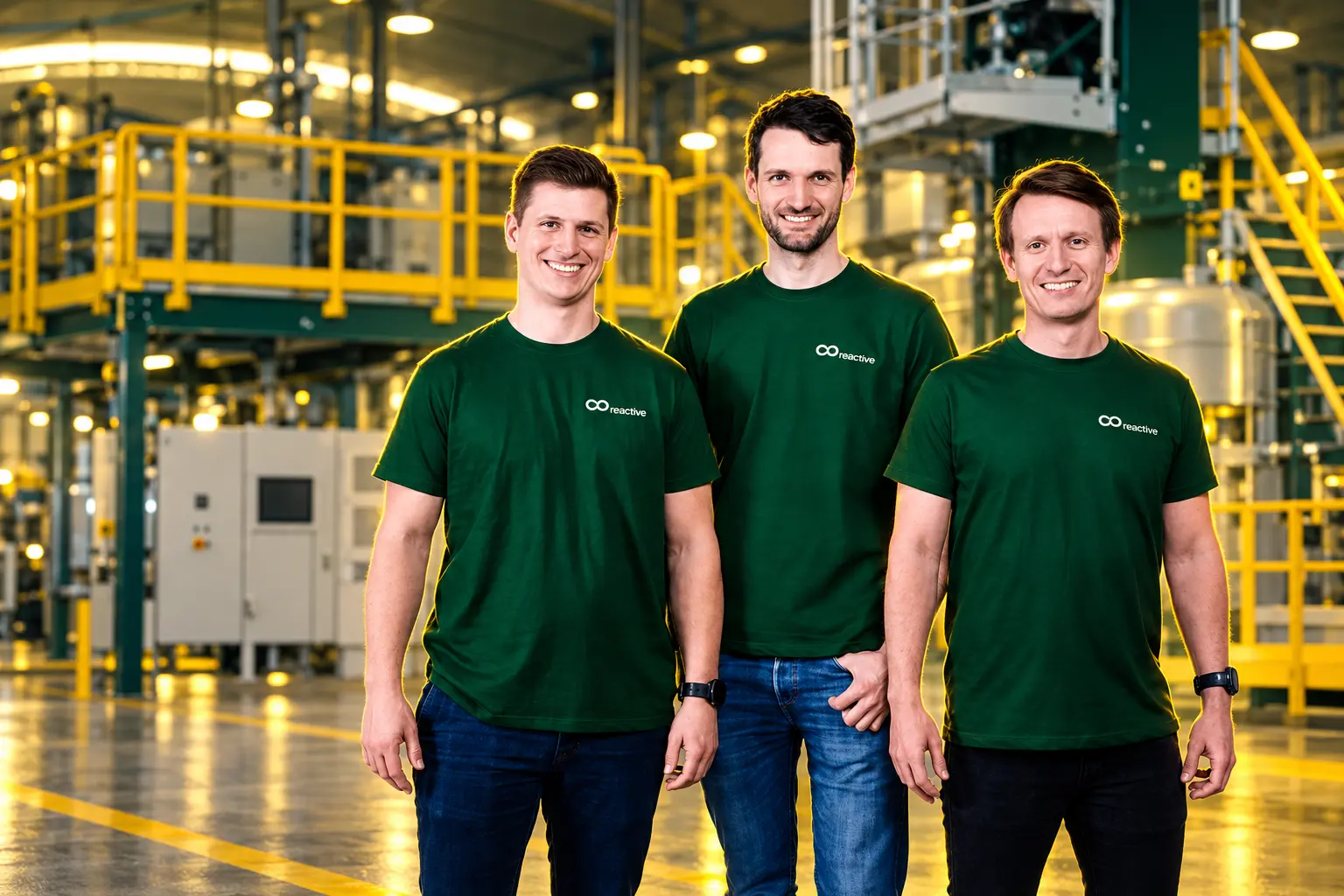
Dr.-Ing. Andreas Bremen, co-founder and chief executive, built the science in a RWTH consortium that included Heidelberg Materials from 2017, then worked in copper metallurgy at Aurubis before founding the company with Orlando Kleineberg, the chief technology officer and a plant engineer, and Willi Peter, the chief commercial officer.
ERKRATH AT A GLANCE
- Output: About 1,000 tonnes a year of CO-SCM on a continuous line.
- Site: Ludenbergerstraße 44, 40699 Erkrath, near Düsseldorf.
- Claimed sink: Around 330 kg of CO2 stored per tonne of product, the company says.
- Next step: Plant-gate units at tens of thousands of tonnes, pitched from 2027.
Staff from Sabancı Technology Center, including a Çimsa group, have already walked the line as part of work on carbonated electric-arc-furnace slag. A visit is not an offtake. It does show who the company wants standing next to the reactor.
Coal Closures Left Cement Short of Fly Ash
The Global Cement and Concrete Association puts cement and concrete at about 8 percent of global greenhouse gas emissions. Clinker, the kiln product inside ordinary cement, is the heavy share of that. The cheap way to cut it has been to blend in industrial leftovers: coal fly ash and ground granulated blast-furnace slag.
Those leftovers are shrinking as a side effect of other climate policy. McKinsey’s cement team wrote in November 2024 that Europe already faces tight domestic supply of slag and fly ash as coal ramps down and steel moves away from blast furnaces. In one of its cases, European clinker demand falls from 145 million metric tons in 2023 to 122 million metric tons in 2035, a 23 million ton drop, while the region’s SCM and filler pool could reach €8 billion to €10 billion by 2035.
Anna Stetter, investment manager at High-Tech Gründerfonds, said at the January close that fly ash prices had in some cases quadrupled over the previous two years, and that Co-reactive’s powder is meant as a drop-in that existing plants can take without ripping out kit. The January comment and 2026 spot tickets are not the same series. Expert Market Research put German fly ash at $151 per metric ton in the second quarter of 2026, up 4.1 percent from $145 in the first quarter, still the dearest region it tracks.
THE BINDER SQUEEZE
| Measure | Figure | Period |
|---|---|---|
| Cement and concrete share of GHGs | About 8 percent | GCCA 2025/26 report |
| Europe clinker demand | 145 million metric tons | 2023, McKinsey |
| Europe clinker demand | 122 million metric tons | 2035, McKinsey case |
| Europe SCM and filler pool | €8 billion to €10 billion | 2035, McKinsey |
| Global SCM revenue | $15 billion to $30 billion now, $40 billion to $60 billion | 2035, McKinsey |
| SCM already in cement mixes | 24 percent | McKinsey |
| Germany fly ash | $151 per metric ton | Q2 2026 |
| Czech energy by-products | About 7.5 million tons, possibly 8 percent of that by 2030-31 | ASAM, Pavel Sokol |
Pavel Sokol, president of the Czech Association for Alternative Building Materials, warned in April 2026 that fly ash, slag and gypsum from power plants could fall to 8 percent of 2025 output, about 0.6 million tons, as coal units close. McKinsey’s own map still gives most of the next decade to calcined clay, natural pozzolans, limestone filler and imports. New mineral SCMs, including ones that use basic-oxygen and electric-arc slag, sit further out on that chart. Erkrath is trying to arrive early.
What the Powder Has to Match in a Mixer
CO-SCM is a fine powder, shipped in big bags or silos, designed to go into existing cement and concrete recipes. Co-reactive says a Strength Activity Index above 100 under EN 450-1, a fly-ash test, meaning the mortar with the substitute is at least as strong as the control. Bremen has said the product can replace up to 50 percent of high-emission cement, depending on the job.
The carbon math is published on two bases and should stay that way. The company site claims around 330 kg of CO2 locked per tonne of finished CO-SCM. In a March 2026 interview with NRW.Global Business, Bremen said tests stored about 500 kg of CO2 per tonne of raw material. Those are not the same denominator.
Mix-injection systems already put small doses of CO2 into fresh concrete at hundreds of plants. That is a different product. Co-reactive is selling a clinker stand-in, closer in job to slag or fly ash than to a truck-mounted injector. Other olivine mineralization projects are still earlier. The Erkrath choice is a continuous tubular reactor, not the batch autoclave most lab papers use.
HOW THE LINE TURNS GAS INTO POWDER
- Feed: Olivine, already mined at scale, or calcium- and magnesium-rich slag from electric-arc and basic-oxygen furnaces, milled to powder.
- Carbon: Captured CO2 from cement kilns, power, waste burners, biogas, direct air capture or a pipeline, with the plant meant to sit next to the stack.
- Reactor: The powder is slurried in water and run through a tubular reactor at high pressure and temperature until it becomes carbonates plus amorphous silica.
- Finish: A filter press then a rotary dryer leave a dry powder ready for silos.
Bremen and Kleineberg say they filed for a patent on that reactor layout after a prototype proved the flow, not just the chemistry. Continuous operation is the part most mineralization firms never reach. A running line still has to publish mass and energy balances at this scale before a carbon-negative label should be treated as settled.
Funding and scientific research form the foundation, but real transformation only happens through entrepreneurial action. With the right co-founders and an interdisciplinary team, we are taking CO2 mineralization from the lab into continuous industrial operation. The support of our financing partners, with the HTGF as lead investor, gives us the strength to deliver proof of performance with a 1,000-ton demonstration plant and to prepare large-scale deployment together with industry.
Dr.-Ing. Andreas Bremen, co-founder and CEO, Co-reactive
€6.5 Million, Then an EIC Accelerator Slot
The seed round led by HTGF closed on 28 January 2026. NRW.Bank put in €500,000. HBG Ventures, AFI Ventures (the early-stage impact arm of Ventech), Evercurious VC and a group of climate-tech business angels joined. On top sat seven-figure support from Germany’s Federal Funding for Industry and Climate, run by the Federal Ministry for Economic Affairs and Energy, after an EXIST research-transfer grant that got the company started.
Johanna Antonie Tjaden-Schulte, an NRW.Bank board member, said at the close that this kind of building-materials work is a lever for making North Rhine-Westphalia Europe’s first climate-neutral industrial region. HTGF, a public-private early-stage fund, has backed about 800 startups since 2005, recorded 200 exits, and holds more than €2 billion of fund volume.
In March 2026 Co-reactive said it had been selected for the EIC Accelerator, the European Innovation Council’s grant-and-equity programme for startups. That round took 61 firms from 121 that reached interview, with about €467 million of proposed support across the group. The programme’s grant slice sits below €2.5 million, with optional equity on top. Co-reactive has not published its own cheque.
FROM LAB GRANT TO A RUNNING LINE
- 2017: Bremen begins CO2 mineralization research at RWTH Aachen in a consortium that includes Heidelberg Materials.
- 2024: Co-reactive is founded in North Rhine-Westphalia on an EXIST research-transfer grant.
- October 2025: GeoCRM starts, with Co-reactive as the mineralization partner, on EFRE/JTF money.
- January 28, 2026: €6.5 million seed closes, HTGF leading, NRW.Bank in for €500,000.
- March 16, 2026: The company posts EIC selection and its GeoCRM role.
- April 27, 2026: Neubaur attends the Erkrath opening; the line is rated at about 1,000 tonnes a year.
- July 7, 2026: Co-reactive publishes its own plant-opening note.
Bremen told NRW.Global Business that investors have to put money into hardware, because software favorites do not cut kiln gas. He also argued that the EU emissions trading system should not be reopened every season, because plants this size are built on a carbon price that holds still.
Steel Slag Feeds the Binder and a CRM Project
NRW still has heavy industry in a short radius. Bremen said the state holds about one-third of Germany’s roughly 30 clinker plants, plus steel, plus the plant-builders who can visit several partners in a day. Co-reactive’s pitch is to tie those two trades together: unused electric-arc and converter slag becomes binder, and the cement plant next door takes the powder.
That is also why the firm joined the GeoCRM research consortium. VDEh-Betriebsforschungsinstitut GmbH coordinates, with FEhS, Institut für Baustoff-Forschung, RWTH’s Advanced Mineral Processing Technologies unit, thyssenkrupp MillServices & Systems, and Co-reactive. The project, funded by EFRE/JTF, started in October 2025 on a three-year clock. It wants iron oxide, vanadium, phosphorus and chromium out of steel slag, then a calcium-silicate fraction that can bind CO2 and go into construction.
A RWTH project note puts German steel-slag output at 2.73 million tonnes a year. Broken slag still sells at €3.5 to €5 a tonne for road base, or is dumped if chromium and vanadium leach. The same note says the calcium-silicate fraction can bind up to 275 kg of CO2 per tonne of slag, a national sink of about 0.76 million tonnes a year if the route works, and a notional product value around €570 a tonne against today’s road price. Those figures are project targets, not Erkrath invoices.
GeoCRM also treats the leftover fines as a stand-in for olivine-rich rock. If steel keeps making slag even as it shifts toward hydrogen and electric furnaces, the feedstock does not vanish with the blast furnace. If slag chemistry changes, the reactor recipe has to change with it. That is the industrial risk hiding under the climate headline.
First-of-a-Kind Plants Are Pitched for 2027
A 1,000-tonne demo is a process proof. A cement mill thinks in hundreds of thousands of tonnes. Co-reactive says it is lining up plant-gate units at tens of thousands of tonnes from 2027, then 100 to 300 kilotonnes. McKinsey still assigns most near-term SCM growth to clay, pozzolans and imported slag, with novel mineral powders a later wave. The Erkrath bet is that a drop-in with a negative carbon ticket can jump that queue once EN testing and offtake exist.
WHAT WE KNOW
- Hardware: A continuous Erkrath line rated at about 1,000 tonnes a year is open.
- Capital: €6.5 million of seed, including €500,000 from NRW.Bank, plus seven-figure federal industry-and-climate money and an EIC selection.
- Product claims: SAI above 100 under EN 450-1, about 330 kg of CO2 per tonne of powder, up to 50 percent cement replacement on some jobs.
WHAT IS UNCONFIRMED
- EIC cash: The company’s own grant and equity amounts are not public.
- Offtake: No named cement mill has published a volume contract for CO-SCM.
- 2027 sites: Host plants, exact tonnes and CO2 sources for the first industrial units are still undescribed.
- Demo balance: A third-party mass and energy balance at Erkrath scale has not been released.
McKinsey also notes that in Europe, carbon will become the largest cost lever if free allowances keep falling and the carbon border adjustment holds. It has cement prices in some markets above €200 a tonne by 2035, and it has said decarbonizing clinker could more than double the cost of cement. A powder that cuts clinker and stores CO2 is priced against that future ticket, not against last decade’s fly ash.
The Erkrath line now has to throw off the boring numbers, tonnes in, tonnes out, kilowatt-hours, certified strength, that a mill will put in a mix pack. Until those sit in a folder, 2027 is still a drawing.
Disclaimer: This article is news reporting and analysis of Co-reactive’s funding, plant and technology claims, and it is for information only. It is not investment advice, an offer to buy or sell securities, or a recommendation to back any climate-tech round. Readers who may invest, supply, or buy from the company should consult a qualified financial adviser and, where relevant, an independent materials or emissions specialist before acting. Figures, plant ratings, grant status and commercial plans reflect the named company, investor and research sources as dated in the piece and may change as Erkrath runs and later plants are scoped.

UPI MDR Delay Hands Traders the Calendar After Paytm Falls

Google Messages Builds Nine In-Chat Games After Samsung’s Exit

Anthropic’s $100 Million Academy Trains the Firms That Bill Both Sides

Toyota’s Electric C-HR Leaves the Cheap Twin to Subaru

Markets Bet the Fed Skips October After Hawkish Minutes

The Orchard Bug Forced Zcash to Open an Empty Pool

The $5.99 Game That Won Steam’s 2026 Summer Sale

Don Lee Joins Hemsworth as Extraction 3 Starts Shooting

YouTube Shorts Retires Dislikes and Swaps Likes for Hearts

NEURA Robotics Is Spending Its $1.4B on a Machine Stack
-
 NEWS5 months ago
The Orchard Bug Forced Zcash to Open an Empty Pool
-
 GAMING5 months ago
The $5.99 Game That Won Steam’s 2026 Summer Sale
-
 ENTERTAINMENT7 months ago
Don Lee Joins Hemsworth as Extraction 3 Starts Shooting
-
 NEWS4 months ago
YouTube Shorts Retires Dislikes and Swaps Likes for Hearts
-
 NEWS4 months ago
NEURA Robotics Is Spending Its $1.4B on a Machine Stack
-

 NEWS5 months ago
Atlantic City Turned WWE’s Return Into a Civic Night
-

 AUTO6 months ago
Kawasaki Bets the New Z1100 Against Its Own Supercharger
-
 BUSINESS5 months ago
Norway’s Export Bank Backs Nscale’s $790 Million Narvik Loan