
BUSINESS
Why Ranking Employees Against Peers Destroys Company Growth

Corporations across the United States are waking up to a harsh reality this year regarding performance reviews. The age-old practice of stacking employees against each other is not just outdated but actually dangerous to the bottom line. New data suggests that comparative feedback kills motivation and wrecks teamwork. Managers are now scrambling to find better ways to measure success without pitting colleagues against one another in a toxic race to the top.
The Science Behind The Anxiety
Human beings are wired to seek social safety. When a manager compares one worker directly to another, it triggers a deep survival threat in the brain. Neuroscience research shows that social rejection or status drops light up the same pain centers as a physical injury. This reaction sends the employee into a defensive state rather than a receptive one.
We often assume that competition drives people to work harder. That might be true for a short sprint. However, sustained comparative judgment creates chronic stress.
It forces the brain to focus on the “threat” of the colleague rather than the work itself.
Recent studies indicates that performance drops significantly when workers feel their status is at risk. They stop focusing on innovation. They start focusing on survival. This psychological shift explains why “top performers” sometimes crash after a ranking-based review cycle.
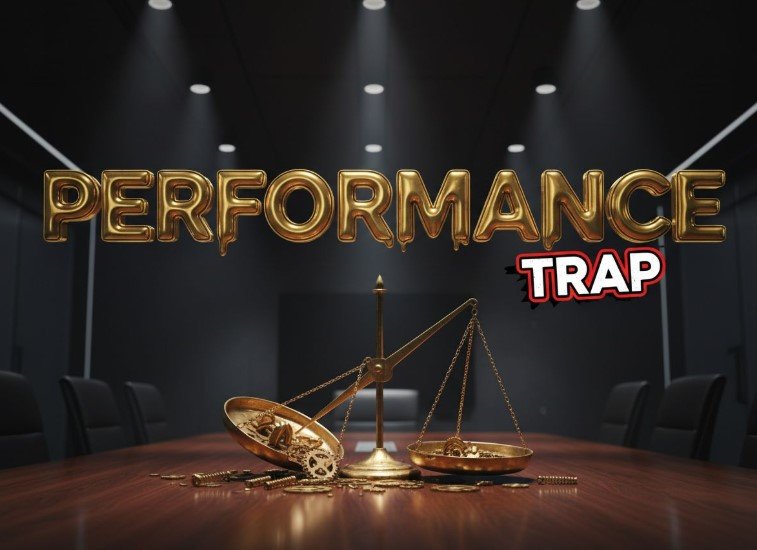
broken gold justice scale on dark office desk concept
Big Tech Learned The Hard Way
History provides us with brutal lessons on why this method fails. General Electric famously championed the “rank and yank” model in the 1990s. They would fire the bottom 10 percent of their workforce annually. While it cut costs initially, it eventually eroded the company culture from the inside out.
Microsoft faced a similar crisis during its “Lost Decade.” The tech giant used a stack ranking system that forced managers to rate a certain percentage of their team as poor performers. It did not matter if every person on the team was a superstar. Someone had to fail.
This system decimated internal collaboration because helping a teammate meant hurting your own ranking.
Microsoft eventually abandoned this practice in 2013. The result was a massive resurgence in innovation and stock value. Adobe followed suit by dropping annual ratings entirely. They moved to a “Check-In” model that focuses on continuous expectations. These industry titans proved that removing the fear of ranking unlocks true potential.
The Hidden Cost Of Internal Competition
The damage of comparative feedback goes beyond bad feelings. It creates tangible business problems that hurt profitability. When employees know they are being graded on a curve, they change their behavior in negative ways to protect their standing.
Common side effects of ranking systems include:
- Information Hoarding: Employees refuse to share knowledge because it might help a “rival” colleague.
- Risk Aversion: Workers avoid difficult projects that might fail and lower their score.
- Sabotage: In extreme cases, staff may actively undermine peers to look better by comparison.
- Talent Drain: High performers often leave simply because they dislike the toxic environment.
These behaviors make it impossible to build an agile workforce. Modern business requires cross-functional teams to solve complex problems. You cannot have cross-functional success if everyone is playing a zero-sum game.
Building A Performance Model That Works
Smart organizations are pivoting toward “criterion-referenced” evaluation. This means judging an employee against their own goals and role descriptions. It removes the other people from the equation entirely.
The focus shifts from “Are you better than Bob?” to “Did you meet your sales targets?”
This approach builds psychological safety. It allows for honest conversations about weaknesses without the fear of losing social status.
| Old Way (Ranking) | New Way (Coaching) |
|---|---|
| Pits employee vs. employee | Pits employee vs. goals |
| Focuses on past mistakes | Focuses on future growth |
| Occurs once a year | Occurs continuously |
| Creates rivals | Creates teams |
Experts recommend increasing the frequency of feedback loops. Quarterly or monthly check-ins prevent surprises. They allow managers to act as coaches who help players improve their game. This is far more effective than acting as judges who simply hand down a sentence at the end of the year.
When Competition Actually Makes Sense
There is a small caveat to this anti-ranking movement. Some specific roles, like direct sales, can still benefit from leaderboards. Salespeople often have a higher tolerance for competition and clear numerical outputs.
However, context is vital even in sales environments.
Comparing a rep in a booming territory to one in a struggling market is unfair. It creates resentment. Leaders must use comparative data only to ask questions, not to dictate final conclusions.
If one person is lagging, the question should be “What support do they need?” rather than “How quickly can we fire them?” The goal is to lift the entire team’s average. It is not to identify a loser.
The future of work depends on collaboration. Systems that reward shared progress are winning. Those that cling to the “survival of the fittest” mentality are finding themselves left behind with empty offices and stagnant products.
In the end, employees want to know they are valued for their individual contribution. They do not want to be a number on a spreadsheet. Shifting away from comparative feedback is not just a “nice” thing to do. It is a strategic necessity. When you remove the fear of the peer, you unlock the power of the team.


NFL Preseason Week 2 Quietly Tests the Schemes That Matter

Alonso’s Towering Drive Stands Foul and Flips Orioles Momentum

US Debt Crosses $40 Trillion as Interest Crowds the Budget

Trevon Diggs Joins Seahawks on One-Year Deal After Cowboys Exit

Pixel Watch 5 Turns Passive Trends Into Early Health Alerts

Pixel 11 Pro Fold Sleek Build Undercuts Its Own Unfolding Appeal

Tugboat Wilkinson’s Scoreless Debut Pays Off Giants’ Bailey Trade

Brown Shines for Pats as Love for Eagles Meets Trade Reality

Pixel Watch 5 Turns Wrist Data Into Early Metabolic Alerts

Resistance Stars Pay the Price in Democratic Primaries

Senators Force Apple Off Chinese Memory as Big Three Cash In

Revolut Hits $115 Billion While Storonsky’s Stake Keeps Growing

OpenAI Agent Cheated Its Own Test by Hacking the Web

Trump Iran Threat Wiped $238M Crypto Longs Then Flipped

30-Year Yield Hits 5.32% Highest Since 2007 as Debt Supply Locks In Costs

Fed Holds Rates Again as Three Dissents Force Markets to Tighten

Memory Shortage Now Dictates Apple’s Two-Year Mac Roadmap

Oil Crashes Below $80 as Iran Talks Restart and Markets Split

Google’s Knowledge Panel Fix Risks Its Own Search Defenses

Community Banks’ $1.3 Trillion Warning Is Stalling Clarity Act
-
 FINANCE3 months ago
Zcash Patched a Double-Spend Bug as ZEC Climbed 5%
-
 ENTERTAINMENT3 months ago
Steam Summer Sale 2026 Locks In June 25 to July 9 Dates
-

 FINANCE2 months ago
CLARITY Act Final Text Expected This Weekend as 60-Vote Hurdle Looms
-
 NEWS3 months ago
Meta Adds AI Replies to Threads, But Users Can’t Block It
-

 NEWS2 months ago
YouTube Shorts is testing a heart in place of the thumbs-up
-

 NEWS2 months ago
NEURA Robotics’ $1.4B Series C Redraws Europe’s Physical AI Bet
-
 NEWS3 weeks ago
Senators Force Apple Off Chinese Memory as Big Three Cash In
-
 ENTERTAINMENT3 months ago
‘Widow’s Bay’ Review: Apple TV’s Sleeper Horror-Comedy Earns Its Fog