
NEWS
A2RL’s Six-Car Final Was Decided by a Backmarker
TUM kept the A2RL title after Unimore crashed in traffic at Yas Marina, the same interaction failure that later decided Imola.

Germany’s TUM won the world’s first six-car autonomous Grand Final at Yas Marina Circuit on 15 November 2025, after Italy’s Unimore crashed out of the lead. The Abu Dhabi Autonomous Racing League put eleven teams on a $2.25 million prize pool, and a former Formula 1 driver still beat the champion AI by 1.58 seconds.
Unimore had the pace, the pass, and the lead. Constructor got hit instead of passed. That is now what “professional” driverless racing looks like.
Unimore Took the Lead, Then Hit Constructor
TUM started on pole in the 20-lap race with HAILEY, the same AI that had already won Season 1. Unimore, the University of Modena and Reggio Emilia team, caught the leader and went by at Turn 6 before the end of lap 2.
The pair then ran at over 250 km/h with less than a second between them for the next ten laps. At the halfway mark they were within half a second, and they had caught the back of the pack. Unimore went for sixth-place Constructor in mid-corner, hit the rear of the German car, and both ran off the road.
Even a human racing driver would not have been able to avoid the collision we had, so this is just the nature of high-performance racing.
Marko Bertogna, Team Principal, Unimore Racing
Bertogna said he was happy with the speed and the overtake, and less happy with the result. Unimore still took the Fastest Lap Award for the competition. A full-course yellow followed. TUM inherited the lead and did not give it back.
The full Grand Final, including that pass and the hit, is on the league’s race film.
Prof. Markus Lienkamp is TUM’s team principal. He said his group expected Unimore to come through on lap 2, especially on cold tyres, and then to lose time as TUM’s rubber came in. The close fight he wanted with Unimore ended in the pack, not on the last lap.
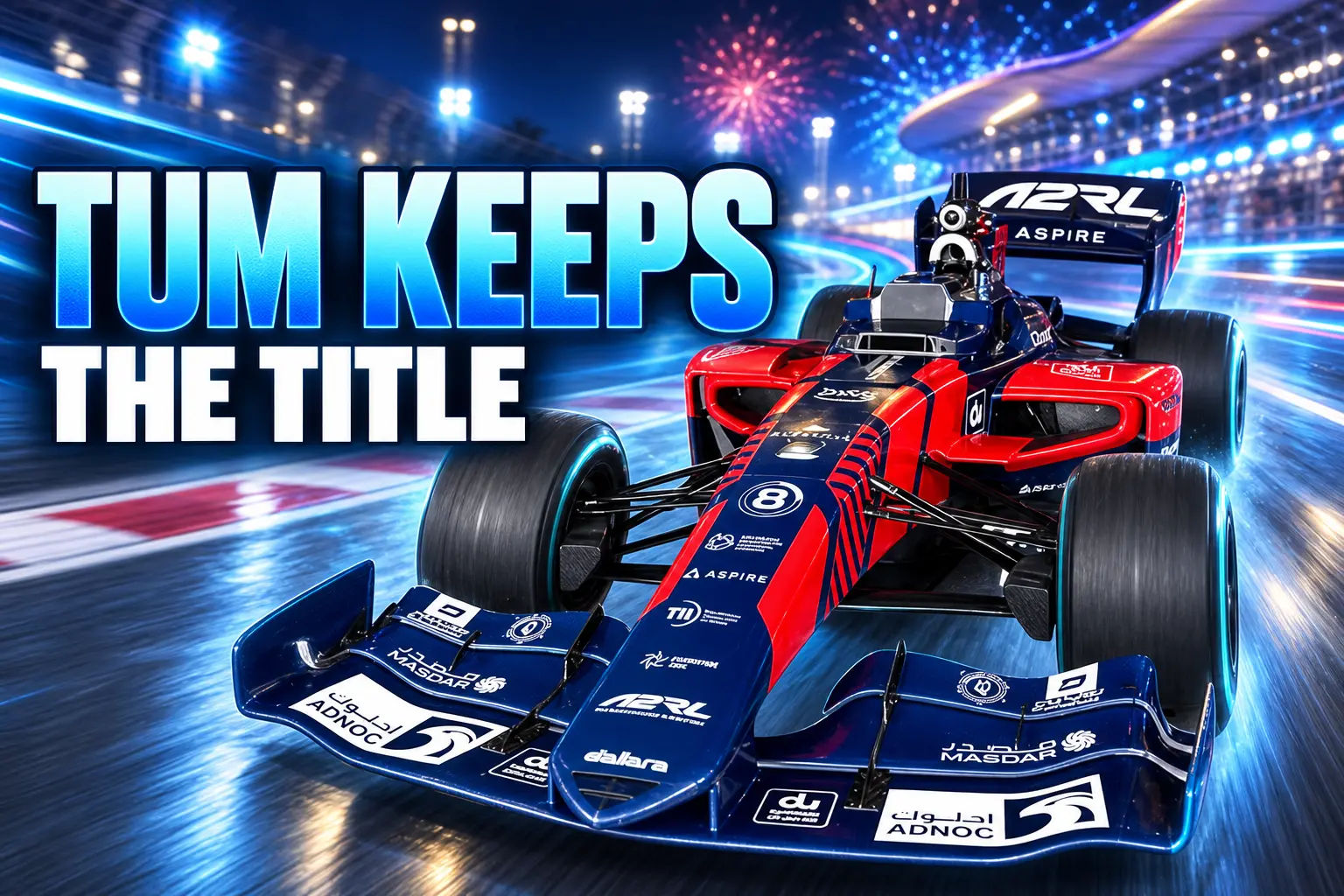
The Podium After a Full-Course Yellow
Four cars still made the flag. TII Racing, the UAE entry running Musa, finished second. PoliMOVE from Italy brought EVA home third. Kinetiz, the Abu Dhabi and Singapore side running Sparkz, was the last classified finisher in fourth. Unimore’s Gianna and Constructor AI did not finish.
GRAND FINAL FINISHING ORDER
| Pos | Team | Car | Result |
|---|---|---|---|
| 1 | TUM (Germany) | HAILEY | Winner |
| 2 | TII Racing (UAE) | Musa | Finished |
| 3 | PoliMOVE (Italy) | EVA | Finished |
| 4 | Kinetiz (UAE and Singapore) | Sparkz | Finished |
| DNF | Unimore (Italy) | Gianna | Collision |
| DNF | Constructor (Germany) | Constructor AI | Collision |
Starting order had been TUM, Unimore, Kinetiz, TII Racing, PoliMOVE, then Constructor. The race shuffled that grid the old way: one overtake at the front, one wreck in traffic, and a champion that never needed to pass again.
His Highness Sheikh Zayed bin Mohamed bin Zayed Al Nahyan, His Highness Sheikh Mohammed bin Sultan bin Khalifa Al Nahyan, and H.E. Faisal Al Bannai honoured the Grand Final winners on the Yas Marina podium. Al Bannai, who set A2RL up through the Advanced Technology Research Council, called the night a public test of systems that will later move through cities, skies, and industry.
Over 8,000 spectators filled the North Grandstand. The Grand Final closed the first Abu Dhabi Autonomous Week, a six-day run that also held the Abu Dhabi Autonomous Summit, the DRIFTx exhibition, and RoboCup Asia-Pacific. More than 140 students from all seven emirates ran a parallel DeepRacer STEM event.
How Close Is AI to Daniil Kvyat?
Before the Grand Final, Daniil Kvyat got ten laps to hunt TUM’s HAILEY. The AI started from a rolling 10-second gap. Kvyat’s best lap was 57.57 seconds. HAILEY’s best was 59.15 seconds. The hole between those two laps was 1.58 seconds, and they crossed the line close together.
THE HUMAN-TO-AI GAP
- Early running: Kvyat said the first A2RL cars were perhaps minutes slower than a human.
- First showcase: That gap was down to 10 seconds a year before this race.
- 15 November 2025: His 57.57-second lap left HAILEY 1.58 seconds behind on best times.
- The catch-up window: ATRC and ASPIRE clock that squeeze at 18 months of racing and testing.
Kvyat had last gone head to head with an A2RL car at a 2024 exhibition in Japan. He said the jump from minutes, to 10 seconds, to fractions of a second was staggering, and that sharing a track with an AI driver still felt unlike anything else. He still won the comparison. The software that can pass TUM at Turn 6 has not yet matched a Formula 1 driver over a single flying lap on the same night.
Stephane Timpano is CEO of ASPIRE, the ATRC unit that runs the league. He said teams had gone from standing still to human-beating laps and complex overtakes in 18 months, by stacking virtual Sim Sprints on top of track tests. The human-beating laps showed up in qualifying. On race night, against Kvyat, HAILEY was still the hunted car.
Unimore’s 58.87-Second Lap Beat a Human Mark
October’s qualifying is where the AI first went past a human reference, and it was not TUM that did it. Pace qualification asked each car to lap Yas Marina’s North Circuit alone. Unimore recorded 59.11 seconds, which broke the one-minute mark and beat the 59.30-second time logged in data gathering with a professional driver.
Multi-car qualification on 20 October then put three cars out together. TUM completed a pass on Unimore and locked pole for 15 November. Unimore still found an autonomous lap record of 58.87 seconds in that traffic and could not get the place back.
Those two Unimore times sit in qualifying, not in the Grand Final result. They are also a different session from Kvyat’s 57.57. The data driver at 59.30 was already slower than Kvyat would be on race night, so the “AI beat a human” claim is true for that benchmark and still false for the F1 comparison that sold the tickets.
Lienkamp’s note on cold tyres fits the same picture. Unimore’s stack was the one that wanted to attack early. TUM’s stack was the one that wanted the fight after the tyres came in. The crash cut that experiment short, which is why the fastest team in the field can still leave Yas Marina as a DNF.
Identical Super Formula Cars, Different Code
Every A2RL car starts as a Dallara Super Formula SF23, rebuilt as the Emirates Autonomous Vehicle. Season 2 ran the EAV-25, a reliability and safety rewrite of the EAV-24. The EAV-25 autonomous racecar upgrades covered steering, GNSS and 5G antennas, electronics, motorsport wiring, batteries, emergency braking, a second inertial unit, the alternator, the gearbox, and a new fuel line.
The engine is a 4 Piston Racing K20C1, a turbocharged 2.0-liter Honda four-cylinder with direct injection. Brakes are Brembo carbon discs fired electro-hydraulically, because there is no driver to press a pedal. Teams do not bring their own chassis. They bring software.
WHAT EACH CAR CARRIES
- Cameras: Seven Sony IMX728 units for 360-degree coverage.
- Radars: Four ZF ProWave units.
- Lidars: Three Seyond Falcon Kinetic FK1 units.
- Brain: A Neousys RGS-8805GC high-level computer.
That sensor farm is why an empty cockpit can attempt an overtake at Turn 6, and why the same stack can still misread a lapped car in mid-corner. Perception, planning, and control are the whole performance gap. The hardware is supposed to be equal.
Season 2 also widened the map. A2RL said elite research teams came from 10 countries, with France and Japan on the grid for the first time beside the USA, Germany, China, Singapore, Italy, and the UAE. Five of those extra programs ran the Silver Race, not the Grand Final. The final still needed six cars that could survive a multi-car gateway, not just a hot lap.
Four Cars Started Season 1. Two Finished.
The irony is older than this crash. A2RL’s first race, on 27 April 2024 at the same circuit, put four driverless cars in a field and got two of them to the flag. TUM won that one too. Constructor finished second. Unimore already had the fastest-lap honour that year and did not finish. PoliMOVE, the other Italian car, went out as well.
FROM FOUR CARS TO IMOLA
- 27 April 2024: TUM’s HAILEY wins the first A2RL race at Yas Marina from a four-car grid; two cars finish.
- October 2025: Unimore logs 59.11 seconds, then 58.87, and beats a 59.30-second human data lap on the North Circuit.
- 15 November 2025: Six cars start a 20-lap Grand Final; Unimore leads and hits Constructor; TUM retains the title; Kvyat beats HAILEY by 1.58 seconds.
- 5 September 2026: A2RL’s first Europe race at Imola runs 12 laps with five cars; Kinetiz wins, and the two Italian cars collide again.
Kvyat’s 10-second showcase gap sits in that first year. So does the league’s habit of losing cars to sudden stops and pack-traffic mistakes. The Season 2 brief was that the field had learned race craft. It had, in the sense that Unimore could plan and land a lead change at 250 km/h. It had not, in the sense that the same team still needed Bertogna to explain a wreck as motorsport.
Imola Repeated the Crash, Not the Champion
On 5 September 2026 the series left Abu Dhabi for Autodromo Enzo e Dino Ferrari at Imola, a 12-lap, five-car race on a tighter track with less runoff. Abu Dhabi’s Autonomous account said the UAE’s Kinetiz won, with Constructor second and PoliMOVE third. A2RL said two-time champion TUM had a technical issue on the formation lap and finished fifth. Unimore was classified fourth.
The official league account posted the other Italian story the morning of 10 September 2026. PoliMOVE and Unimore “came together on track,” and the caption treated the wreck as training data.
What happens after a crash? The learning begins. 🏁
At Imola, Polimove and Unimore came together on track creating real-world data teams can analyse, learn from and use to improve.
Test. Learn. Refine. That’s why we race.#A2RL #AutonomousRacing #Innovation pic.twitter.com/PDxHqU0QEy
— Abu Dhabi Autonomous Racing League (@A2RLeague) September 10, 2026
“What happens after a crash? The learning begins,” the league wrote. That line is honest about the product. The software still throws failures a race engineer would call a stop, a glitch, or a missed lapped car, and the organizers now sell those failures as the point of going racing. The same objection follows the series around: cars still halt for no obvious sporting reason, and a formation-lap fault can wipe a two-year winner before the lights.
ASPIRE had already said Imola was the first step toward an international championship, after more than 5,000 hours of Sim Sprint testing across 11 teams in the prior season. Alessandro Tucci, executive director of ASPIRE’s House of Grand Challenges, called Imola a track that does not allow half-measures. Kinetiz, fourth in Abu Dhabi after the Season 2 yellow, was the car that handled that test. TUM was not.
The 2026 season still ends back at Yas Marina Circuit, on the North layout where Unimore first went past HAILEY and then into Constructor.
Frequently Asked Questions
Who won the A2RL Season 2 Silver Race?
Japan’s TGM Grand Prix won the Silver Race, the time-trial event for the five teams that missed the six-car Grand Final, running the avatar Sakura. Fly Eagle (China and UAE) was second, Code 19 (USA) third, Rapson (Hungary) fourth, and FR4IAV (France) fifth, so the new Japanese and French programs both scored on their first visit even though they never joined the 20-lap final.
What engine and tires does the A2RL car use?
The EAV-25 uses a 4 Piston Racing K20C1 turbo four-cylinder based on Honda’s 2.0-liter K20, a 3MO six-speed gearbox, and Yokohama Advan tires, with Brembo calipers on carbon discs. Teams cannot change that hardware package; the league issues the car so the ranking is supposed to come from code, sensor fusion, and race craft.
How many teams entered A2RL Season 1?
Eight teams entered the inaugural 2024 league and four qualified for the first Yas Marina final, which TUM won from Constructor, Unimore, and PoliMOVE. Season 2 grew that entry list to eleven, with six cars in the Grand Final, which is why the 2025 race could produce a lapped-car collision that the four-car debut never had the density to create.
Who won the A2RL STEM competition in 2025?
UAE University won the University League and SABIS – Ras Al Khaimah won the High Schools title, after more than 140 students from all seven emirates raced 1/18th-scale DeepRacer cars as a junior copy of the main event. Those school results are separate from the $2.25 million Grand Final purse and were handed out on the main podium before the human-versus-AI runs.
Yas Marina gets the 2026 finale on the same North Circuit. The open question is no longer whether six driverless Super Formula cars can start a race. It is whether the next one can end without the leader hitting a lapped car, and whether HAILEY can lap inside 1.58 seconds of a human who still has a steering wheel.

UPI MDR Delay Hands Traders the Calendar After Paytm Falls

Google Messages Builds Nine In-Chat Games After Samsung’s Exit

Anthropic’s $100 Million Academy Trains the Firms That Bill Both Sides

Toyota’s Electric C-HR Leaves the Cheap Twin to Subaru

Markets Bet the Fed Skips October After Hawkish Minutes

The Orchard Bug Forced Zcash to Open an Empty Pool

The $5.99 Game That Won Steam’s 2026 Summer Sale

Don Lee Joins Hemsworth as Extraction 3 Starts Shooting

YouTube Shorts Retires Dislikes and Swaps Likes for Hearts

NEURA Robotics Is Spending Its $1.4B on a Machine Stack
-
 NEWS4 months ago
The Orchard Bug Forced Zcash to Open an Empty Pool
-
 GAMING4 months ago
The $5.99 Game That Won Steam’s 2026 Summer Sale
-
 ENTERTAINMENT6 months ago
Don Lee Joins Hemsworth as Extraction 3 Starts Shooting
-
 NEWS4 months ago
YouTube Shorts Retires Dislikes and Swaps Likes for Hearts
-
 NEWS4 months ago
NEURA Robotics Is Spending Its $1.4B on a Machine Stack
-
 AUTO6 months ago
Kawasaki Bets the New Z1100 Against Its Own Supercharger
-

 BUSINESS5 months ago
Norway’s Export Bank Backs Nscale’s $790 Million Narvik Loan
-
 GAMING4 months ago
Game of Thrones Dragonfire Follows Boston’s Conquest Playbook