
NEWS
Google Health Now Makes Every Fitbit Connection Start Over
Google Health, the former Fitbit app, now requires a Google Account, and third-party apps must re-consent before the Fitbit Web API shuts in September 2026.

Google now requires a Google Account to use the Google Health app, the former Fitbit app, and will shut the Fitbit Web API in September 2026. Taylor Helgren, director of product management, wrote on May 7, 2026, that Google was Fitbit app to become the Google Health app, with the new icon due on May 19. That consumer swap is over. The work that is not over sits with every diet log, clinic study, and Google Fit archive still tied to the old Fitbit login.
Fitbit hardware is still on wrists. The software path those wrists talk to is now a Google-account cloud, and the pipes that third parties used for a decade are being pulled on a calendar Google already published.
The Fitbit App Is Already Google Health
Existing Fitbit users did not download a second store listing. The old app updated in place, kept the history they chose to bring, and opened on four tabs: Today, Fitness, Sleep, and Health. Helgren said dashboards at the top of Today and Health can be customized, and that the app can pull activity, fitness, sleep, vitals, and, in the United States, medical records. It also talks to other apps and devices through Health Connect, Apple Health, and the Google Health APIs, including workouts from Peloton and meals from MyFitnessPal.
Readers who lived through the May 19 Fitbit app cutover already know the icon changed overnight. What followed was slower. Owners still hunt for numbers that used to sit on one home screen, and recent iPhone builds have needed a band reboot before Google Health would sync again. Google’s own support account has also told people they can pair only one Fitbit device or Pixel Watch to an account at a time, so a Charge 6 and a Pixel Watch cannot share a login the way some households expected.
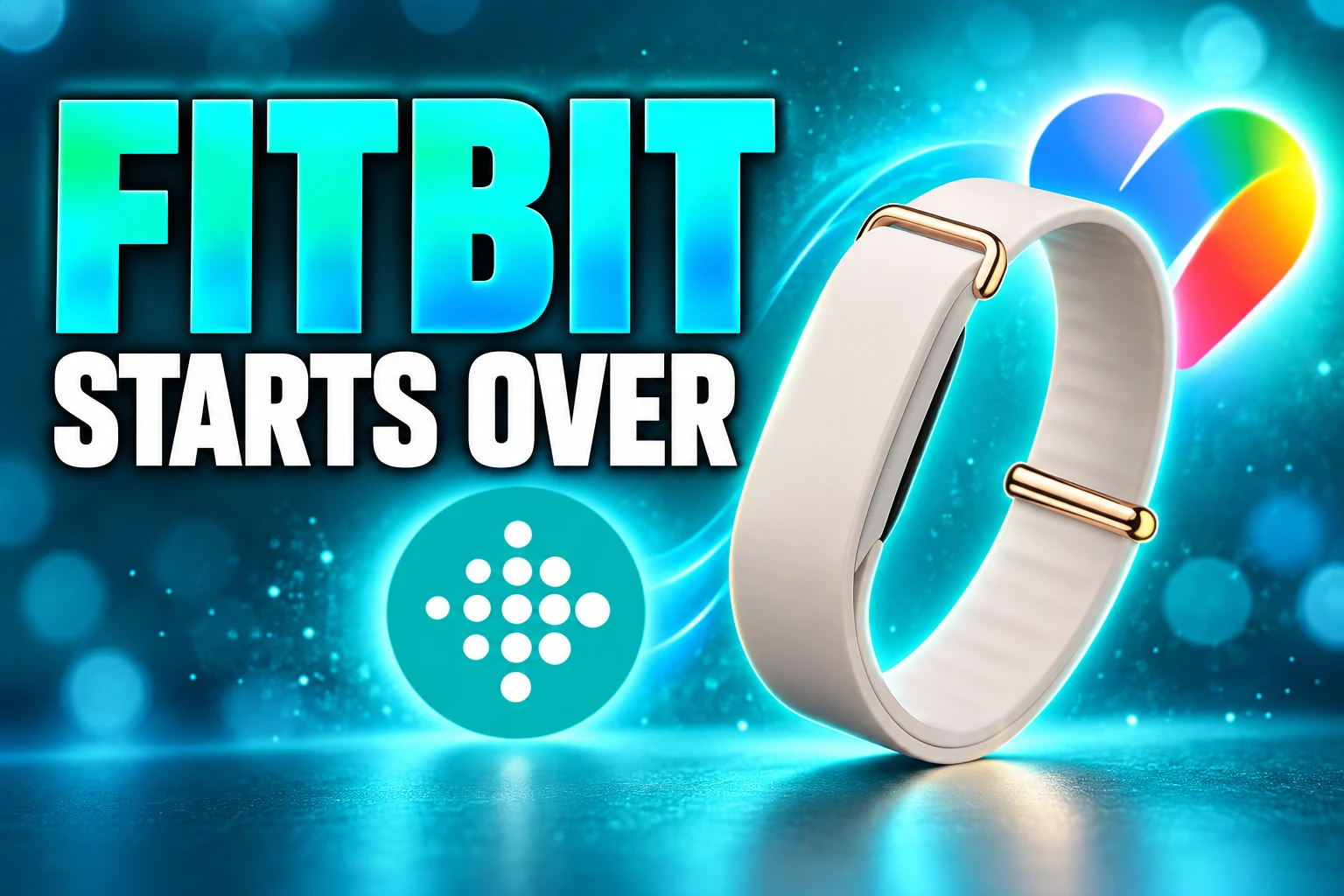
The band Google launched with the app, the screenless Fitbit Air, sells at $99.99 and includes a 3-month trial of Google Health Premium. Core step, heart-rate, and sleep totals still work without that trial. The chat layer does not.
A Google Account Became the Only Login
The Help Center is blunt. After May 19, 2026, you can no longer open Fitbit with a Fitbit account. A Google Account is required to sign up for Google Health and to activate new Fitbit and Pixel devices, and you cannot move your Fitbit account to a Google Account onto a Workspace login. The move keeps the history you choose to bring. It also cannot be undone after the last step.
Family setups split on age. Children under 13, or the local age limit, can move with a parent. Older kids and other adults have to run the same steps themselves. Google still says Fitbit health and wellness data will not feed Google Ads, the promise it made when it closed the Fitbit purchase in January 2021.
THE CUTOVER CALENDAR
- May 7, 2026: Google announces that the Fitbit app will become Google Health and that Google Fit users will be invited to migrate later in the year.
- May 19, 2026: The app updates in place, Fitbit-only logins stop, and a Google Account becomes mandatory for new Fitbit and Pixel devices.
- July 15, 2026: Google begins processing deletions for Fitbit accounts that were never moved, after a window to download or delete data.
- September 2026: The legacy Fitbit Web API is turned down and stops syncing data to or from Fitbit users.
- End of 2026: Google Fit APIs, including the Fit REST API, lose support, with no REST replacement.
The July 15 date sat 57 days after the May 19 cutoff. Google said the deletion job would take time and that some people might still migrate while it ran. It never published a public recovery path for accounts that missed the window.
The Fitbit Web API Goes Dark in September
Consumer Help Center pages talk about icons and tabs. The developer pages name the thing that breaks other people’s products. Google’s Health API site says the legacy Fitbit Web API will be turned down in September 2026 and will no longer sync data to or from Fitbit users. The replacement is the Google Health API, rebuilt on Google Cloud, signed in with Google OAuth 2.0, and limited to Fitbit devices and Pixel watches.
In September 2026, the legacy Fitbit Web API will be turned down and will no longer sync data to or from Fitbit users. All current integrations utilizing the Fitbit Web API and Fitbit Authorization must be fully migrated to the new Google Health API and Google OAuth 2.0 prior to this milestone to ensure uninterrupted data continuity for your users.
Google Health API documentation, Google for Developers
Google says it folded more than 100 legacy endpoints into a smaller set of data-type bundles, with intraday reads and webhooks on a list endpoint. Every Health API scope is Restricted, so a production app has to pass a privacy and security review. Existing Fitbit access and refresh tokens cannot be copied across, which is the line that turns a server upgrade into a product problem.
FITBIT WEB API VERSUS GOOGLE HEALTH API
| Item | Fitbit Web API | Google Health API |
|---|---|---|
| Login | Fitbit authorization | Google OAuth 2.0 |
| Old tokens | Keep working until shutdown | Do not transfer; every user re-consents |
| Endpoints | More than 100 legacy routes | Bundled data types on HTTP/REST |
| Access review | Fitbit developer program | Restricted scopes, privacy review required |
| Devices returned | Fitbit hardware | Fitbit devices and Pixel watches |
| Hard stop | September 2026 | The path after that date |
Philipp Schmid, an engineer at Google DeepMind posting his own views, wrote that an open-source CLI on top of the new API can “pull 40 health metrics from the terminal or pipe them straight into your AI agent.” That is the same pipe vendors are racing to rebuild, and it is also a way for a technical owner to skip the paid Coach.
Diet Apps and Research Studies Must Re-Consent
CareEvolution’s MyDataHelps platform, which pulls wearable data into clinical studies, told project teams the Fitbit API it still uses shuts on September 30, 2026, a working date inside Google’s September window. Because Google Health is a separate provider, every participant has to authorize a new connection. Tokens from the Fitbit era do not count. CareEvolution also warned that units do not always match, with Google Health storing distance in millimeters where Fitbit used kilometers.
Cronometer’s support desk is already fielding Google Health connection errors when the Google login in the food app is not tied to an active Google Health profile. TechDoctor in Japan said it finished moving SelfBase and Health Portal onto the Google Health API so studies would not go dark when the Fitbit Web API dies. The pattern is the same in each case: the wristband never left the user, the cloud account behind it did.
WHO HAS TO ASK AGAIN
- Study platforms: MyDataHelps and similar research tools must collect a new Google Health permission from every Fitbit participant or lose the stream after September 2026.
- Food and workout apps: Cronometer and other logs that spoke Fitbit OAuth have to send each person through Google’s consent screen, then map units and profile links that the old API never asked them to handle.
- Clinic software: Teams that passed Google’s Restricted-scope review, as TechDoctor says it did, still need each patient or subject to tap allow again because old Fitbit grants do not carry over.
- Anyone on a leftover 4.x Fitbit build: Sideloaded old apps kept working only until Google ended support for versions older than 5.0 on July 15, 2026, and the servers those builds called are the same ones going away.
Google’s own migration guide tells developers not to spring the new consent screen mid-workout, to warn for several weeks, and to show a recovery banner after the cutoff if a user never tapped through. Re-consent is never 100 percent. The missing slice is the quiet loss: a study arm that stops updating, a food log that freezes, a patient whose band still blinks and whose chart does not.
What Happens to Years of Google Fit Data?
Google Health grew out of Fitbit, not Google Fit. The older Fit app, launched in 2014, is still a separate product with a separate clock. Helgren wrote that Google would invite Fit users to move their data into Google Health later in 2026. As of late August, that invitation still had no public date, no Help Center tool, and no list of which record types survive the copy.
Developers are on a firmer timeline and a worse map. Android’s Fit FAQ says Google will support the Google Fit APIs until the end of 2026, and that new sign-ups have been closed since May 1, 2024. After that window, Fit APIs stop. The FAQ is explicit about the cloud REST flavor: there is no alternative to the Fit REST API. Android apps are pointed at Health Connect, which keeps data on the device, or at the Google Health API, which stores it on the Google Account instead.
Nest Hub sleep sensing, which has lived in Google Fit since the second-generation display launched, is being retargeted at Google Health in Home app strings. That is a small example of the same merge. People who only ever opened Fit still do not have the consumer copy job Google described in May.
Gemini Coaching Comes With a $99.99 Yearly Bill
The Google Health Coach, built with Gemini, is the layer Google put on every tab. On Today it writes timely notes. Fitness holds a weekly plan that can take natural-language workout requests. Sleep tracks weekly consistency. Health can summarize connected medical records. Google said nearly 500,000 people had tested the Coach since October 2025 and that it had taken in over a million points of feedback before the May ship.
Rishi Chandra, Google’s vice president for health and home, said the investment of the last few years was “literally designed for this one moment.” The moment is metered. Google Health Premium is $9.99 a month or $99.99 a year, and it is bundled into Google AI Pro at $19.99 a month and into Ultra. The Fitbit Air’s 3-month trial is how most new buyers meet the chatbot. Without Premium, the band still counts steps, heart rate, and sleep length. Weekly plans, the workout library, meal photos, and the Coach’s record summaries sit behind the paywall.
WHAT PREMIUM GATES
- The Coach: Gemini notes on Today, a weekly fitness plan, sleep-consistency coaching, and spoken or typed logging, including a photo of a meal or a gym whiteboard.
- Record summaries: If you connect U.S. medical records, the Coach can read them only with Premium and a separate records consent.
- The trial: New Fitbit Air buyers get 3 months, then the $9.99 monthly or $99.99 yearly bill unless they already pay for AI Pro or Ultra.
Reviewers who liked the Air often split on the chat. Some called it the easiest way to build a week of workouts. Others found it long-winded, shallow, and hard to mute, with early sessions mixing up basic product facts. Google’s privacy FAQ says conversations inside the Health app are not used to train the underlying generative models unless you opt into a separate research deal, and that human reviewers see a thread only when you send feedback.
Uploaded Records Leave Federal HIPAA Cover
U.S. users can search a clinic, connect a patient portal, or upload files, then see labs, vitals, and medications next to band data. Helgren said those records stay in the app and that you control how they are used, shared, or deleted. The privacy FAQ adds the legal catch. For users in the United States, when you ask a provider to send records to Google Health, or when you upload them yourself, they are no longer under the federal Health Information Portability and Accountability Act (HIPAA).
If you have Premium, those same records can feed the Coach once you grant that extra consent. If you donate data for research, Google says the files may be used for health and wellness research, including training AI models. Optional features such as cycle tracking, irregular-rhythm alerts, ECG, and records can be switched off, and Google says you can download or delete the store. The company still repeats the ads silo for Fitbit wellness data. Clinic files you choose to drop into the same account are a different pile, sitting under Google’s privacy policy rather than a hospital’s HIPAA notice.
This is the second time Google has sold a personal health record under this name. The first Google Health opened to the public on May 20, 2008, and was a place to keep medical files online. Aaron Brown, then senior product manager, said on June 24, 2011, that it was “not having the broad impact we had hoped it would.” The service closed on January 1, 2012. The 2026 version does not ask healthy people to type their charts by hand. It inherits Fitbit’s already-paired devices, then invites the clinic file to sit beside the step count, under a Google login the band now requires.
Google still has not published a date for the Google Fit consumer copy it promised for later this year. The Fitbit Web API does not wait.
Disclaimer: This article is news reporting and analysis of Google’s health and fitness products, and it is for information only. It is not medical advice, not a diagnosis, and not a recommendation to connect, upload, or donate health records, nor is it investment or subscription advice about Google Health Premium, Google AI Pro, or any wearable. Speak with a licensed physician or other qualified clinician before acting on coaching prompts, lab summaries, or cycle and heart-rate alerts, and speak with a qualified privacy or legal professional before moving clinical records out of a provider portal. Prices, app versions, API shutdown windows, and account-migration rules reflect the company pages and product listings cited here and can change.

UPI MDR Delay Hands Traders the Calendar After Paytm Falls

Google Messages Builds Nine In-Chat Games After Samsung’s Exit

Anthropic’s $100 Million Academy Trains the Firms That Bill Both Sides

Toyota’s Electric C-HR Leaves the Cheap Twin to Subaru

Markets Bet the Fed Skips October After Hawkish Minutes

The Orchard Bug Forced Zcash to Open an Empty Pool

The $5.99 Game That Won Steam’s 2026 Summer Sale

Don Lee Joins Hemsworth as Extraction 3 Starts Shooting

YouTube Shorts Retires Dislikes and Swaps Likes for Hearts

NEURA Robotics Is Spending Its $1.4B on a Machine Stack
-
 NEWS4 months ago
The Orchard Bug Forced Zcash to Open an Empty Pool
-
 GAMING4 months ago
The $5.99 Game That Won Steam’s 2026 Summer Sale
-
 ENTERTAINMENT6 months ago
Don Lee Joins Hemsworth as Extraction 3 Starts Shooting
-
 NEWS4 months ago
YouTube Shorts Retires Dislikes and Swaps Likes for Hearts
-
 NEWS4 months ago
NEURA Robotics Is Spending Its $1.4B on a Machine Stack
-

 AUTO6 months ago
Kawasaki Bets the New Z1100 Against Its Own Supercharger
-

 BUSINESS5 months ago
Norway’s Export Bank Backs Nscale’s $790 Million Narvik Loan
-

 GAMING4 months ago
Game of Thrones Dragonfire Follows Boston’s Conquest Playbook