
NEWS
Google and SpaceX Eye Space Data Centers to Power AI Boom

The race to power artificial intelligence is leaving Earth. Google and SpaceX are now in serious talks to launch AI data centers into orbit, a plan that could rewrite where the internet actually lives. With electricity bills exploding and neighborhoods fighting new server farms, the two giants believe sunlight in space might solve a crisis brewing on the ground.
Why Big Tech Is Suddenly Looking Up
The numbers behind this push are staggering. The International Energy Agency projects data center electricity consumption will push past 1,000 terawatt-hours by the end of 2026. AI models keep getting bigger. The power grid is not.
The talks arrive at a moment when hyperscalers are scrambling for electricity, land, cooling capacity, and GPU supply. AI training clusters now consume energy at levels once associated with industrial facilities and small cities. Across the U.S. and Europe, new data-center projects are facing resistance tied to power consumption, water usage, zoning disputes, and environmental concerns.
Space, supporters argue, sidesteps all of that. In space, satellites can collect sunlight more consistently than solar panels on Earth. There are no clouds, no nighttime in the same way and no local fights over using thousands of acres of land for power infrastructure.
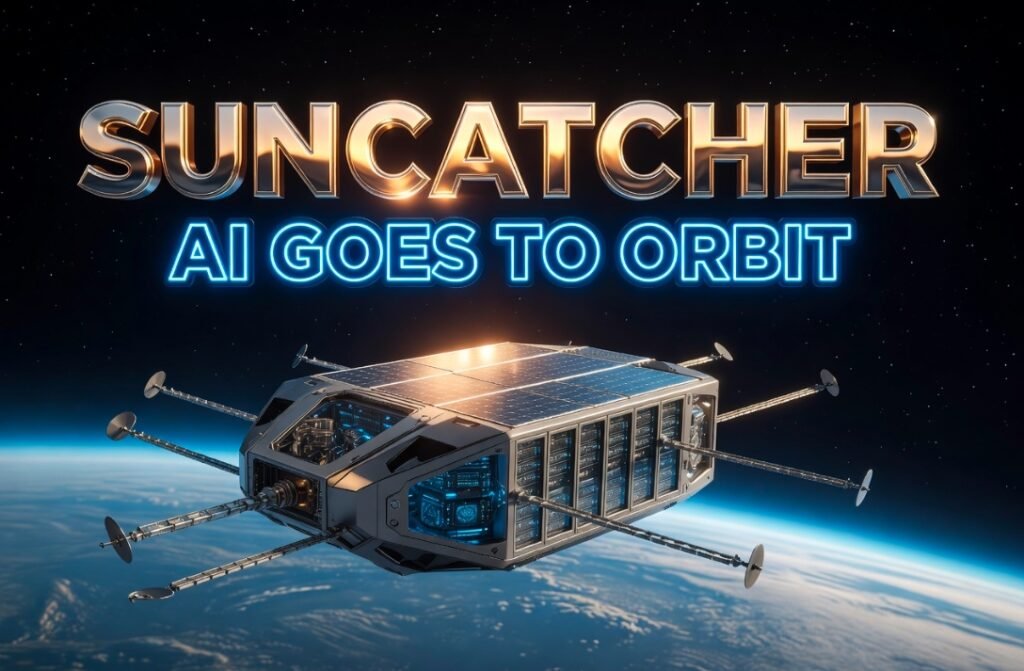
google spacex orbital ai data center satellite project suncatcher
Inside Google’s Project Suncatcher Plan
Google is not just talking about the idea. It is actively building toward it. The project would place Google’s Tensor Processing Units, or TPUs, on solar-powered satellites linked by optical communications, creating what the company describes as a path toward machine-learning compute in space.
The cloud and search giant ultimately aims to launch some 81 satellites spanning a 1km radius to create an in-orbit compute cluster, which will have Google’s customer Tensor Processing Units on board. Planet Labs is the satellite manufacturer for the effort.
The launch timeline is tight. Last year, the search giant announced Project Suncatcher, a moonshot initiative aimed at launching prototype satellites by 2027. The company is working with Planet Labs to build those satellites.
Google has also done the homework on whether its chips can survive up there. Google’s own Trillium TPUs, the chips that power its AI workloads, have already passed radiation testing in a particle accelerator simulating low-Earth orbit conditions. Cooling via radiators is viable. Inter-satellite data links at 10 Tbps are achievable with off-the-shelf technology.
SpaceX, the IPO, and a $1.75 Trillion Bet
For Elon Musk, the timing is everything. The potential deal comes as SpaceX gears up for its $1.75 trillion IPO later this year, selling investors on the idea that data centers in space will be the cheapest place to put AI compute within the next few years.
SpaceX has been laying the groundwork for months. In a filing submitted to the Federal Communications Commission on January 30, 2026, SpaceX requested authority to launch and operate a proposed constellation of up to one million satellites in low Earth orbit, which the company formally designated as the SpaceX Orbital Data Center System. The FCC’s Space Bureau accepted the filing for public comment on February 4, 2026.
Then came the megadeal. SpaceX and xAI, Elon Musk’s artificial intelligence company, completed an all-stock merger transaction on February 2, 2026. Bloomberg, which was first to report the completed deal, confirmed a combined entity valuation of $1.25 trillion at the time of the transaction.
Google’s existing footprint inside SpaceX adds fuel to the partnership talk.
- Google invested $900 million in SpaceX in 2015, according to regulatory filings.
- Google’s parent company, Alphabet, currently owns 6.1 percent of SpaceX. Moreover, the partnership is cemented at the leadership level, with Google executive Don Harrison serving on the SpaceX board.
- SpaceX signed a deal with Anthropic, where the AI firm will use all of the computing capacity at SpaceX’s Colossus 1 data center. That amounts to more than 300 megawatts of new AI compute via more than 220,000 Nvidia GPUs.
The Brutal Math Standing in the Way
This is where the dream meets reality. The cost gap right now is huge.
| Cost Benchmark | Current Figure |
|---|---|
| SpaceX standard rideshare rate | $7,000 per kg |
| Theoretical SpaceX internal launch cost | About $2,700 per kg |
| Google’s break-even target for orbital AI | $200 per kg |
| Expected year break-even is reached | Mid-2030s |
SpaceX’s February 2026 price table lists $7,000 per kg as a standard rideshare price. The math for Google’s Project Suncatcher says that the financial equilibrium for space data centers sits at around the $200 per kg mark, not even in the same galaxy as current figures.
Google’s internal models put the break-even point at $200 per kilogram, a figure that only becomes realistic if SpaceX’s Starship rocket flies around 180 times a year and drives prices down roughly 90% from today’s rates. Google’s own projection puts that target at 2035. Until then, orbital data centers are roughly three times more expensive than their terrestrial equivalents.
Even SpaceX itself is hedging in writing. SpaceX told prospective investors in its confidential S-1 pre-IPO filing that its plans for orbital AI data centers “involve significant technical complexity and unproven technologies, and may not achieve commercial viability.” The company warned that any future space-based compute infrastructure will operate “in the harsh and unpredictable environment of space, exposing them to a wide and unique range of space-related risks that could cause them to malfunction or fail.”
And then there is the hardware problem. GPUs depreciate as new architectures emerge every two to three years. On Earth, racks are swapped continuously. In orbit, every hardware replacement requires a launch, docking, or robotic servicing mission.
A Crowded Race Above Our Heads
Google and SpaceX are far from alone. Jeff Bezos, Amazon’s founder and the owner of Blue Origin, said in late 2025 that there will be gigawatt data centers in space in more than 10 years, while former Google CEO Eric Schmidt this year said that he acquired rocket company Relativity Space to put data centers in orbit.
One startup has already moved past the talking stage. Starcloud, formerly Lumen Orbit, launched the first high-powered GPU into orbit in November 2025, an Nvidia H100 that represented 100 times more compute than had ever operated in space. In December, Starcloud became the first company to run a large language model, Google’s Gemma, and the first to perform in-orbit LLM training. By March 2026 it had raised $170 million at a $1.1 billion valuation, the fastest unicorn in Y Combinator’s history.
“A launch deal would put the two companies in partnership as they gear up to compete on orbital data centers, an unproven technology that SpaceX Chief Executive Elon Musk has said is the next frontier for his rocket company.” reported the Wall Street Journal.
Critics still see plenty of warning signs. Some warn they could even cause an environmental catastrophe, with aging and failing hardware doomed to burn up in the Earth’s atmosphere while releasing copious amounts of ozone-depleting chemicals.
Whether you cheer it or fear it, the conversation has clearly shifted. What sounded like science fiction in 2024 is sitting inside boardrooms and SEC filings in 2026. The next two years will tell us if the cloud truly belongs in the sky, or if gravity, both literal and financial, drags this dream back to Earth. Tell us in the comments what you think. Should AI live above our heads, or stay grounded? Share your take and join the conversation using #ProjectSuncatcher on X.


Galaxy Ring’s FDA Sleep Apnea Clearance Faces a Familiar Wait

kausable’s €12 Million Seed Joins a Quiet Bet Against AI Scaling

Bitcoin ETFs Shed $225 Million as Treasury’s Biggest Buyers Retreat

telli Raises $15 Million Seed to Rival Billion-Dollar AI Giants

PageMind Raises €1.2 Million to Crack AI Shopping Search

Hackers Hijack Robinhood CEO’s X to Push Fake Memecoin

Apple’s Trade Secrets Suit Against OpenAI Is Europe’s Problem Too

Adobe’s Patch Leaves WhatsApp’s Own Security Gap Untouched

Reddit and Publishers Weigh Blocking Google Over AI Traffic Losses

CuspAI’s $2.6 Billion Bet Echoes AI Drug Discovery’s Playbook

CLARITY Act Final Text Expected This Weekend as 60-Vote Hurdle Looms

Fed Minutes Cite AI Demand as Inflation Risk, Put a 2026 Hike Back on the Map

Kalshi Loses Major NY Prediction Markets Ruling to Judge Torres

Marker AI Writing Startup Lands $13M Seed Led by Index Ventures

Dota 2 Esports World Cup 2026: Spirit Defends $2M Title In Paris

Meta’s Muse Spark 1.1 Beats Rivals on Price, Trails on Coding

CS2 Premier Season 5 Lands With Cache and a C4 Damage Rework

Trump Calls Iran ‘Islamic Republic of Japan’ as Ceasefire Ends

ARC Intelligence Closes €4M Seed Round in Roughly a Week

Finto Picks Munich Over Silicon Valley After YC, Raises $3.4M
-
 FINANCE2 months ago
Zcash Patched a Double-Spend Bug as ZEC Climbed 5%
-
 ENTERTAINMENT2 months ago
Steam Summer Sale 2026 Locks In June 25 to July 9 Dates
-
 NEWS2 months ago
Meta Adds AI Replies to Threads, But Users Can’t Block It
-
 FINANCE3 weeks ago
CLARITY Act Final Text Expected This Weekend as 60-Vote Hurdle Looms
-
 ENTERTAINMENT2 months ago
‘Widow’s Bay’ Review: Apple TV’s Sleeper Horror-Comedy Earns Its Fog
-
 NEWS7 months ago
FolderFresh Review: This Free Tool Automates Windows File Organizing
-
 NEWS4 months ago
U.S. Navy Deploys Solar-Powered Lightfish Drone to Patrol Oceans
-
 FINANCE2 weeks ago
Fed Minutes Cite AI Demand as Inflation Risk, Put a 2026 Hike Back on the Map