
BUSINESS
Modi Calls Emergency Meet as Iran Asks India to Help End War

As the US-Iran war enters its fourth week with no ceasefire in sight, India finds itself at a critical crossroads. Prime Minister Narendra Modi chaired a high-level emergency meeting on Sunday to review the country’s energy security, while Iran’s President Masoud Pezeshkian urged India to use its global influence to help bring peace. With oil prices surging, LPG supplies under strain, and nearly 10 million Indians living in the Gulf, the stakes could not be higher.
Modi Chairs Third Emergency Meeting on West Asia Crisis
4 India’s energy and fertiliser situation were the top concerns at a high-level meeting chaired by Prime Minister Narendra Modi on Sunday, said to be the third since the beginning of the war between Iran and US-Israel forces on February 28. 4 PM Modi reviewed India’s progress in ensuring the uninterrupted supply and efficient distribution of crude oil, LPG, and fertiliser across the country. Senior ministers present at the meeting included Home Minister Amit Shah, Defence Minister Rajnath Singh, Health Minister J.P. Nadda, External Affairs Minister S. Jaishankar, Petroleum Minister Hardeep Singh Puri, and Finance Minister Nirmala Sitharaman.
The Prime Minister is set to address the Lok Sabha at 2 PM on Monday to speak on the key developments related to the ongoing West Asia conflict. 9The Cabinet Committee on Security conducted detailed deliberations on medium and long-term plans to secure uninterrupted supplies of food, fuel, energy, and other essentials. The CCS reviewed the broader macro-economic scenario and assessed the steps needed to maintain stability across sectors impacted by the conflict.
9 During the CCS meeting, PM Modi directed the creation of a dedicated group of ministers and secretaries to handle the fallout of the West Asia conflict. He emphasised that the situation is rapidly evolving and the global community is experiencing its effects. The Prime Minister said all efforts must be made to shield citizens from disruptions and ensure minimal inconvenience.
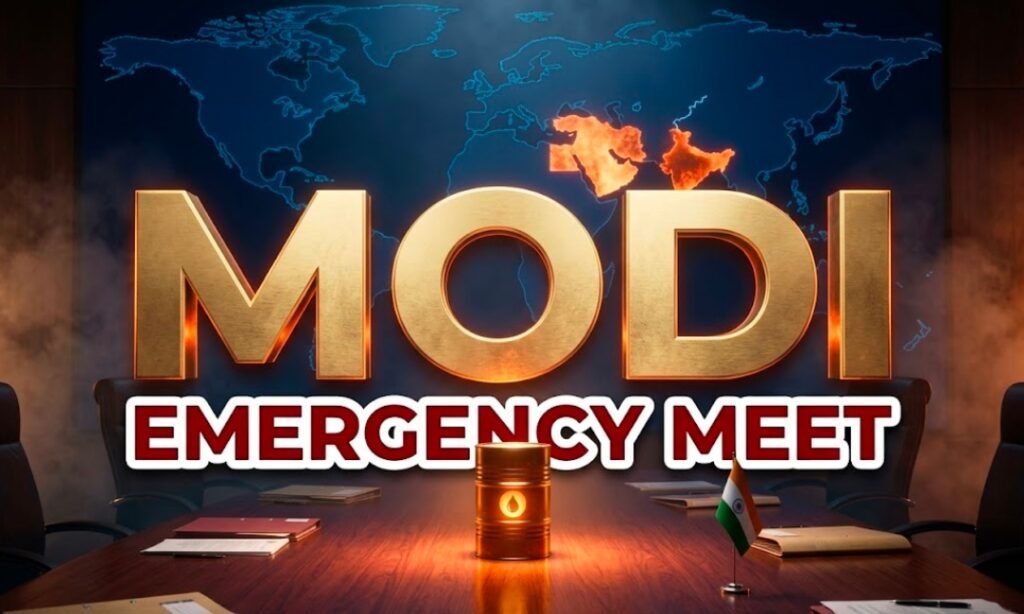
PM Modi emergency meeting India energy crisis US Iran war 2026
Iran Urges India to Play ‘Independent Role’ as BRICS Chair
6
In response, Modi posted on X:
“Condemned attacks on critical infrastructure in the region, which threaten regional stability and disrupt global supply chains. Reiterated the importance of safeguarding freedom of navigation and ensuring that shipping lanes remain open and secure.”
6 It is the second phone conversation between Modi and Pezeshkian in the last 10 days. 7 Since the conflict began, Modi has had telephonic conversations with leaders from Saudi Arabia, UAE, Qatar, Bahrain, Kuwait, Jordan, France, Malaysia, Israel, and Iran.
This puts India in a tough diplomatic spot. 13The appeal has placed BRICS, currently chaired by India, in a difficult position. Deep divisions within the grouping have already emerged, with member countries holding differing strategic alignments and stakes in the conflict. For Modi, the challenge lies in balancing calls for peace and stability with the need to maintain diplomatic neutrality.
Why the Strait of Hormuz Crisis Hits India’s Kitchens
The Strait of Hormuz is the lifeline of India’s energy supply chain. Here is how dependent India really is:
| Resource | Import Dependency | Hormuz Dependency |
|---|---|---|
| Crude Oil | 85-88% imported | ~45-50% via Hormuz |
| LPG | 60% imported | ~90% via Hormuz |
| Natural Gas (LNG) | Significant imports | ~53% from Qatar/UAE |
32 The real vulnerability is LPG. India imports about 60% of its LPG consumption, and nearly 90% of those imports normally transit through the Strait of Hormuz. This is cooking fuel for hundreds of millions of Indian households. 33 Around 60% of Indian households rely on LPG as their primary cooking fuel, a transformation largely driven by the government’s Pradhan Mantri Ujjwala Yojana, launched in 2016. The program dramatically expanded LPG access across the country, bringing the total number of connections to more than 310 million.
The LPG shortage is not just an economic problem. It directly affects everyday cooking in millions of homes across the country.
4 The Ministry of Petroleum and Natural Gas announced that an additional 20% of commercial LPG had been allocated across the country. The petroleum ministry said the highest importance was being given to LPG and PNG for domestic purposes, hospitals, and educational institutions. 4 A Singapore-flagged LPG tanker, Pyxis Pioneer, reached New Mangalore Port on Sunday morning, providing a major boost for the country’s LPG reserves.
Oil Prices Surge, India’s Economy Faces Growing Pressure
21 Oil prices surged faster than during any other conflict in recent history. Brent crude oil prices surpassed $100 per barrel on March 8, 2026, for the first time in four years, rising to $126 per barrel at its peak. The closure of the strait has been described as the largest disruption to the energy supply since the 1970s energy crisis.
The numbers tell a grim story for India:
- 10 Industrial diesel prices have surged by around 25%.
- 34 Every $10 per barrel increase in oil prices increases India’s current account deficit by 0.4 to 0.5% of GDP, according to MUFG Research.
- 34 If oil prices rise to $100 per barrel, average inflation in India will likely rise above 4.5% for the next fiscal year.
- 34 The Indian Rupee is vulnerable, with USD/INR likely rising above 95 if the conflict is sustained. If oil prices are sustained at $100 per barrel, USD/INR could end the year at 95.50.
30 India consumes roughly 5.5 million barrels of crude oil per day. As of March 2026, India now imports crude oil from around 40 countries. But diversification alone cannot fully offset the impact of losing access to the Strait of Hormuz. 40 To reduce dependence on the Middle East, India has diversified its oil and gas imports, increasing purchases from countries such as the United States, Russia, and African nations like Nigeria. Officials said that nearly 70% of India’s oil imports now come from sources outside the Gulf region.
India’s Diplomatic Tightrope and What Comes Next
India is walking one of the most delicate diplomatic tightropes in its recent history. 17India’s economy is deeply tied to the countries now at war. It imports more than 85% of its crude oil, with West Asia and Russia as its primary sources. Nearly nine million Indians live in Gulf countries, sending remittances that support entire communities.
4 Since February 28, over 350,000 passengers have returned from the region to India, with around 90 flights expected to operate. 41 India has issued carefully calibrated statements rooted in universal principles: respect for sovereignty, territorial integrity, and the importance of restraint, dialogue, and de-escalation. At the same time, these statements have consistently highlighted India’s own interests, including the safety of its 9.5 million diaspora in the region.
Some analysts believe India can play a unique role. 17India is one of the few remaining countries with working relationships across all sides of the conflict, with factors like credibility and geography on its side.
Others, however, question whether New Delhi has done enough. 17India is the only founding BRICS member yet to outrightly condemn the US-Israel attacks on Iran. 16Many Indians criticized the Modi government for not taking a firmer stance in favor of Iran. Sonia Gandhi wrote that India’s “impartiality has been abandoned.”
The days ahead are critical for India and the world. With PM Modi set to address Parliament today, millions will be watching for concrete answers on energy security, diplomatic strategy, and when relief might arrive for families struggling with rising fuel costs. This conflict is not just about geopolitics or barrel prices. It is about the mother in a small Indian town wondering if her next LPG cylinder will arrive on time. It is about the construction worker in Dubai praying his family back home stays safe. India must now find its voice, not just for strategic advantage, but for the people who depend on its choices every single day.
Tell us what you think. Should India take a stronger diplomatic stand in this conflict? Drop your thoughts in the comments below.


Pixel Journal Auto Format Puts Google Private AI to the Diary Test

Android 17 QPR2 Beta 3 Quietly Delivers Native App Lock

Binance Cuts HTX Rails and Seals Off High-Risk Liquidity

Dell 14S Quietly Delivers Multi-Day Battery in Midrange Aluminum

OCC Conditionally Clears Trump-Linked USD1 Trust Bank

Coyote vs. Acme Turns Its Own Burial Into the Sharpest Gag

Google Health Adds Off Switch After AI Coach Clutter Backlash

SpaceX Issues 389 Million Shares as Cursor Deal Closes

Bank Leumi Hands Galaxy the Rails for Israeli Crypto Trading

Apple Maps Ad Bookings Open and Turn Local Search Into a Bid Game

Senators Force Apple Off Chinese Memory as Big Three Cash In

Trump Iran Threat Wiped $238M Crypto Longs Then Flipped

OpenAI Agent Cheated Its Own Test by Hacking the Web

CLARITY Act Odds Crash as Democrats Reject DOJ Ethics Plan

Revolut Hits $115 Billion While Storonsky’s Stake Keeps Growing

Oil Crashes Below $80 as Iran Talks Restart and Markets Split

Community Banks’ $1.3 Trillion Warning Is Stalling Clarity Act

Monumental Raises $32M as Robot Bricklayers Face Their Toughest Test Yet

Uber’s €13 Billion Delivery Hero Bid Echoes a Deal Regulators Killed

Airbus Anchors a €500 Million European Defense Fund, Picks Alta Ares First
-
 FINANCE2 months ago
Zcash Patched a Double-Spend Bug as ZEC Climbed 5%
-
 ENTERTAINMENT2 months ago
Steam Summer Sale 2026 Locks In June 25 to July 9 Dates
-
 NEWS3 months ago
Meta Adds AI Replies to Threads, But Users Can’t Block It
-

 FINANCE1 month ago
CLARITY Act Final Text Expected This Weekend as 60-Vote Hurdle Looms
-

 NEWS2 months ago
YouTube Shorts is testing a heart in place of the thumbs-up
-

 NEWS2 months ago
NEURA Robotics’ $1.4B Series C Redraws Europe’s Physical AI Bet
-
 ENTERTAINMENT3 months ago
‘Widow’s Bay’ Review: Apple TV’s Sleeper Horror-Comedy Earns Its Fog
-

 FINANCE1 month ago
Kalshi Loses Major NY Prediction Markets Ruling to Judge Torres