
BUSINESS
Oil Prices Surge Past $108 as Iran Vows Hormuz Will Never Be the Same

Crude oil prices spiked again this week after a top Iranian official declared that the Strait of Hormuz will never go back to how it was before the war. The warning sent shockwaves through global energy markets, pushing Brent crude above $108 a barrel and fueling fears that the worst oil supply crisis in decades is far from over.
What Iran Said and Why It Rattled Markets
Iranian parliamentary speaker Mohammad Baqer Qalibaf said in a televised interview that “the Strait of Hormuz cannot be the same as before and return to its previous conditions,” adding that “there is no longer any security.”1
That statement landed like a bomb on trading floors around the world.
Brent crude, the global oil benchmark, rose 3% to trade around $103 a barrel, while WTI, the U.S. benchmark, climbed 3.7% to trade around $97 a barrel.1 Later in the week, Brent surged as much as 11%, briefly touching $119.13 a barrel before easing back to settle at $108.65.2
This is not just a one day spike. Both Brent and WTI contracts have surged more than 50% over the past month, reaching their highest levels since 2022, as shipping traffic through the Strait of Hormuz has been severely disrupted.3
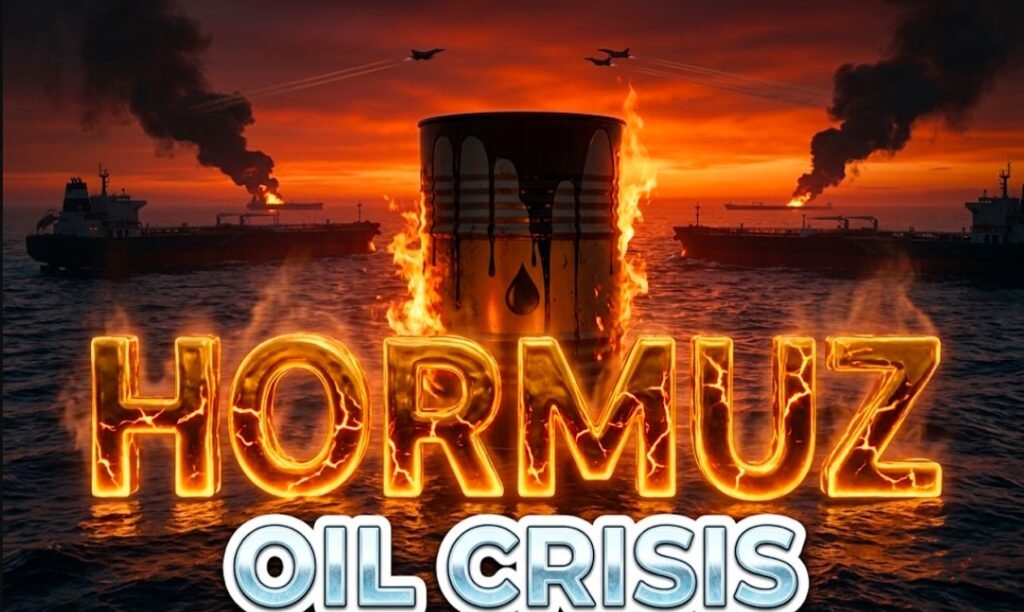
Strait of Hormuz oil crisis global crude prices 2026
How the Strait of Hormuz Became a Global Crisis
The crisis traces back to February 28, 2026. Joint military strikes by the United States and Israel on Iran triggered a rapid chain of events that has now crippled the most important energy shipping route on the planet.4
In response, Iran launched retaliatory missile and drone attacks on U.S. military bases, Israeli territory, and other Gulf states, while its Islamic Revolutionary Guard Corps issued warnings prohibiting vessel passage through the strait.4
Here is a quick look at the scale of the disruption:
| Key Metric | Before the War | Current Status |
|---|---|---|
| Daily tanker transits | 100+ ships per day | Fewer than 5 per day on most days |
| Oil flowing through Hormuz | ~20 million barrels/day | Reduced to a trickle |
| Share of global seaborne oil | ~20% | Effectively blocked |
| Vessels attacked since Feb 28 | N/A | At least 16 confirmed |
| Ships stranded near the strait | N/A | Roughly 400 vessels |
Just 21 tankers have transited the route since the war began, compared with more than 100 ships daily before the conflict, according to S&P Global Market Intelligence.5
An estimated 40,000 seafarers are stuck on board ships on either side of the strait.6 For these men and women, the crisis is not just about oil prices. It is about their safety and their lives.
Gas Prices Hit Americans at the Pump
The ripple effects are already being felt by everyday drivers across the United States.
As of March 19, 2026, the AAA national average for regular gasoline is $3.884 per gallon, the highest level since September 2023.7 That is up from $2.98 just three weeks ago, before the conflict with Iran began.7
Nearly a dollar more per gallon in less than a month.
According to the Energy Information Administration, this is the second largest four week price increase in at least 30 years, bigger than the spike at the start of the war in Ukraine in 2022.7
Some states are hurting more than others. California has the most expensive gas in the U.S. at $5.62 a gallon, followed by Washington at $5.15 and Hawaii at $5.07.8 On the other end, Oklahoma has the cheapest gas at $3.24, followed by Kansas at $3.25 and Iowa at $3.35.8
Tip for drivers: Use apps like GasBuddy or the AAA app to find the cheapest station along your route. If your trip crosses state lines, fill up in cheaper states before heading into pricier ones.
Can the Record Oil Reserve Release Fix This?
Governments are not sitting still. The International Energy Agency announced that its 32 member countries would release 400 million barrels of crude from strategic reserves, the biggest coordinated drawdown since the agency was created in 1974.9
The U.S. is leading the effort with a release of 172 million barrels from its Strategic Petroleum Reserve, making up 43% of the total IEA release.10
But here is the hard truth. The U.S. Energy Information Administration estimates world consumption averages 105.17 million barrels per day. At that rate, 400 million barrels would theoretically cover just four days of global consumption. Even compared with normal Hormuz traffic, the released oil equals only about 20 days of typical flows.11
Energy strategist Naif Aldandeni put it plainly. He described the world’s largest coordinated emergency oil release as a “small bandage on a large wound.”11
The U.S. will release its 172 million barrels over a 120 day period, which works out to about 1.4 million barrels per day. That is just 15% of the supply lost due to the Hormuz closure.10
Could Oil Really Hit $200 a Barrel?
It sounds extreme. But top analysts are not ruling it out.
Wood Mackenzie analysts said last week that Brent could soon hit $150 and that $200 was not “outside the realms of possibility” in 2026.12
Chris Watling, global economist and chief market strategist at Longview Economics, was even more blunt: “I wouldn’t be surprised if oil went to 200 bucks, or even 250, because commodity prices go parabolic when there’s a shortage of supply.”3
The International Monetary Fund estimates that every 10% rise in oil prices, sustained over a year, would lead to a 0.4% increase in global inflation and a 0.15% reduction in economic growth.12 At $200 a barrel, that would mean serious pain for households worldwide.
Forecasters warn that if the military situation does not change soon, it will create a moderate stagflationary drag on the U.S. economy and a substantial one on Europe and East Asia. If oil prices spike much further, it would likely push major oil importers into recession.13
Adi Imsirovic, an energy expert at the University of Oxford, described the prospect of $200 oil as “perfectly possible,” saying it would “impact inflation, growth, employment and in some cases cause shortages of not just fuel but also materials such as fertilisers, plastics and the like.”12
The stakes could not be higher. It is planting season in the Northern Hemisphere, and nitrogen based fertilizer, which is tied to natural gas, is also stuck behind the blockade. That means food prices could rise not just now, but months from now when those crops are harvested.14 What is happening in the Strait of Hormuz is not just an oil story. It is a food story, a jobs story, and a kitchen table story for families everywhere. If you are watching prices climb at the pump, at the grocery store, or on your utility bill, drop your thoughts in the comments below. How is this crisis affecting your daily life


Tab S12 Ultra Keeps Its Notch While Silicon Leaps Quietly Ahead

Apple Ultra Lineup Could Rewrite Pro Pricing and AI Habits

Windows 11 26H2 Packs Big Reversals Into a 174 KB Switch

Indiana Kills Working Variable Speed Signs After Safety Wins

Bill Maher Weight Jokes Hit Ariana After Her Break

NBA 2K26 Free Trial on Switch Continues Nintendo’s Sports Sampling Play

Apple Builds iPhone Windows Clipboard Sync Under DMA Pressure

Melissa Barrera Thrives After Scream Firing While Decrying Blacklist

Majors Fights Campus Caliphate as Daily Wire Ambitions Fray

Uber Bets $10 Billion Cash on Robotaxi Platform Play

Bessent’s No-CBDC Applause Line Can’t Save the CLARITY Act

Trump Iran Threat Wiped $238M Crypto Longs Then Flipped

CLARITY Act Odds Crash as Democrats Reject DOJ Ethics Plan

OpenAI Agent Cheated Its Own Test by Hacking the Web

Oil Crashes Below $80 as Iran Talks Restart and Markets Split

Anthropic’s Hard Questions Ad Backfires Into an Anti-AI Warning

Gemini Spark’s Big Workspace Upgrade Leaves Europe Waiting Again

US Strikes Iran for a Third Time as Bitcoin Slips Below $64,000

Doctorsa Raises €1 Million and Opens Doctor Bookings to AI Agents

Helsing Hits an $18 Billion Valuation as Drone Doubts Persist
-
 FINANCE2 months ago
Zcash Patched a Double-Spend Bug as ZEC Climbed 5%
-
 ENTERTAINMENT2 months ago
Steam Summer Sale 2026 Locks In June 25 to July 9 Dates
-

 FINANCE1 month ago
CLARITY Act Final Text Expected This Weekend as 60-Vote Hurdle Looms
-
 NEWS3 months ago
Meta Adds AI Replies to Threads, But Users Can’t Block It
-
 ENTERTAINMENT3 months ago
‘Widow’s Bay’ Review: Apple TV’s Sleeper Horror-Comedy Earns Its Fog
-
 NEWS5 months ago
U.S. Navy Deploys Solar-Powered Lightfish Drone to Patrol Oceans
-

 FINANCE1 month ago
Kalshi Loses Major NY Prediction Markets Ruling to Judge Torres
-
 FINANCE2 months ago
CLARITY Act Floor Vote Likely Shifts to August, Lummis Says