
ENTERTAINMENT
Starfleet Academy Slides Off Paramount+ Then Loses Season 3
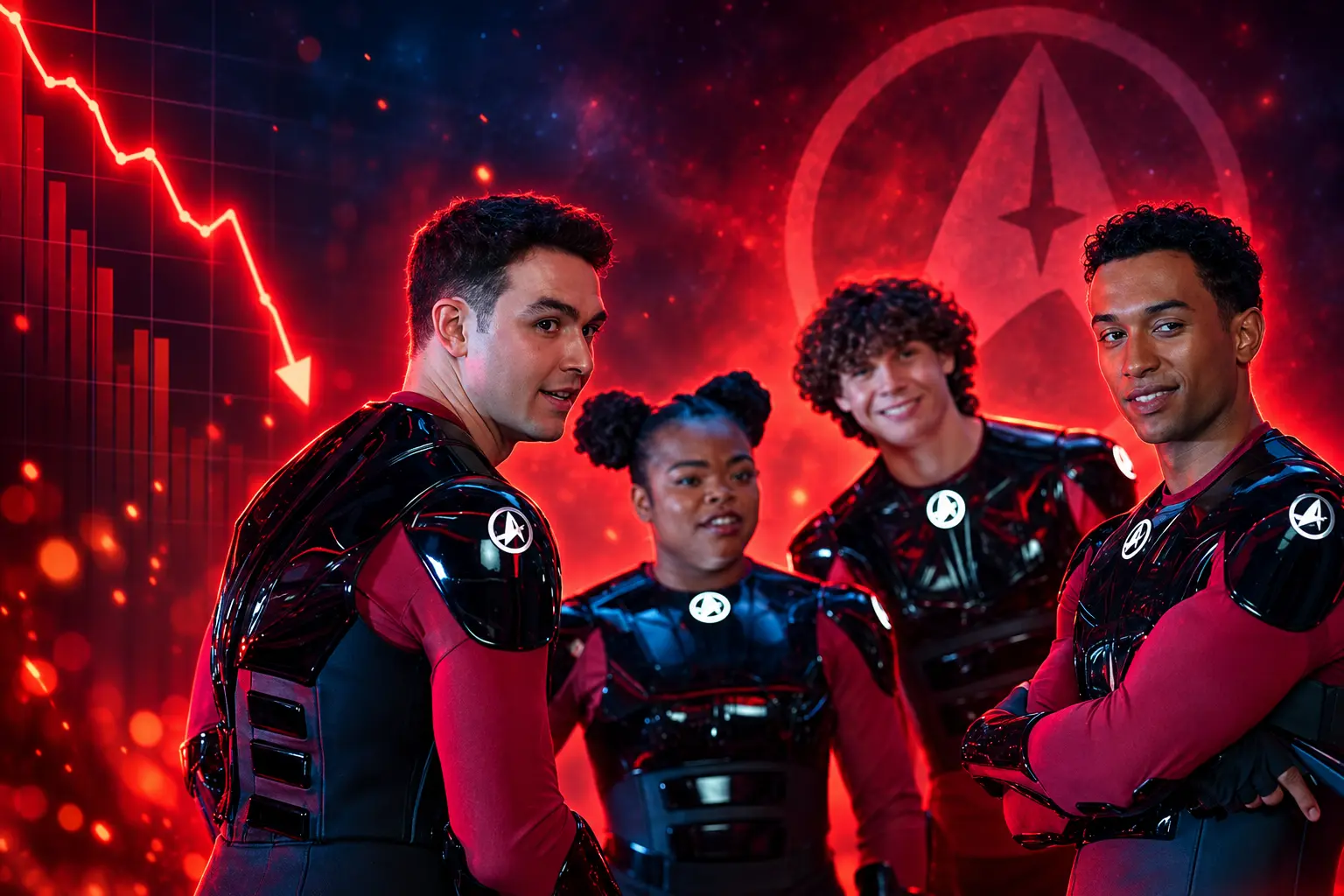
Starfleet Academy fell off Paramount+’s U.S. top 10 after episode 3. Paramount then ended the show with a filmed second season after a Nielsen miss.

Three days after its third episode, Star Trek: Starfleet Academy dropped out of Paramount+’s U.S. top 10. SpongeBob SquarePants was still sitting at No. 10, and Everybody Loves Raymond held No. 8.
The January slide looked like a weekly wobble for a new show. On March 23, Paramount ended the series with a second season that had already wrapped, after the first season never ranked on Nielsen’s Top 10 streaming chart.
It Slid off a Chart Still Holding SpongeBob
The series had a two-episode premiere on January 15, then Episode 3, “Vitus Reflux,” on January 22. Three days later it was gone from the U.S. ranking, and the titles that stayed were not new sci-fi hours fighting for the same night.
On debut the show had placed third on that same Paramount+ list, behind Taylor Sheridan’s Landman and South Park. The drop after Episode 3 was the first time a flagship Trek launch looked smaller than the service’s comfort catalog.
THE PARAMOUNT+ U.S. TOP 10 AFTER EPISODE 3
| Rank | Series |
|---|---|
| 1 | Landman |
| 2 | UFC |
| 3 | South Park |
| 4 | Tulsa King |
| 5 | NCIS |
| 6 | Handsome Devil: The Charming Killer |
| 7 | Mayor of Kingstown |
| 8 | Everybody Loves Raymond |
| 9 | Criminal Minds |
| 10 | SpongeBob SquarePants |
Starfleet Academy is not on that list. A weekly 32nd-century cadet drama was being measured against live fights, Sheridan neo-Westerns, and sitcoms that have been in living rooms for decades, which is a lousy neighborhood in which to look expendable.
Critics did not see the same show the user score described. By January 26, Rotten Tomatoes showed an 88% critics rating against a 43% audience score, the critic-audience split at premiere that review-bombing claims attached themselves to within days. Samantha Coley gave it 9/10 and called it “the best example of what Star Trek can and should be doing in this modern era, effortlessly inclusive, compelling, and innovative.” Metacritic later posted a generally favorable Metascore of 67.
2.1 Million Viewers Were Never the Number Paramount Wanted
The in-app chart is a mood board. The first hard headcount came from Ted Linhart, a television analyst using Luminate data, who logged 2.1 million viewers for the first eight days of the first two episodes.
That figure sat 60% above the opening pace of Strange New Worlds season 3 and Picard season 3, and still well behind Landman, 1923, Tulsa King, and Mayor of Kingstown. Linhart also had Starfleet Academy ahead of NCIS: Tony & Ziva and Criminal Minds: Evolution, two other franchise extensions on the same service.
“Academy is off to a decent start compared to other recent live-action Star Trek seasons,” Linhart said. “It has neither stumbled out of the gate nor shown the ability to bring in audiences outside the current Par+ Trek fan base at launch. It is also much smaller than Taylor Sheridan programs as are all the other Trek shows.”
That last clause is the one Paramount’s new owners already knew how to read. Sheridan’s shows were the streamer’s actual prime-time. Trek was the brand on the logo.
Nielsen’s Top 10 Became the Cancellation Test
Across its 10-episode first season, Starfleet Academy did not appear on Nielsen’s Top 10 streaming viewership charts. A Paramount source put the creative praise and the business math in one sentence: “While we loved the creative and performances, it’s not a secret that the series did not chart on Nielsen’s top 10.”
Other recent live-action Star Trek series on the service had cleared that bar. This one did not, in premiere week or in any week that followed, which is the fact CBS Studios and Paramount+ were willing to hang a cancellation on.
The in-app story was messier. The show popped back onto domestic Paramount+ charts after Episode 4, and FlixPatrol later had it high on Amazon Channels in the United States, the United Kingdom, and Germany, plus several European Paramount+ top tens into March. None of that moved Nielsen, and Nielsen is the chart you can wave at a board.
The louder argument on X never really left January. One camp treated the Nielsen blank as proof the show was The Acolyte in a combadge. The other treated any audience-score collapse as a raid. Paramount did not have to pick a side. It had a missing Top 10 line.
Why the Early Renewal Trapped the Studio
Paramount+ ordered the series in March 2023 and picked up season 2 in October 2024, months before a frame had aired. That early vote of confidence is what later made the cancellation look both slow and sudden: the studio had already paid to finish a second year it no longer wanted to extend.
THE ROAD FROM PICKUP TO THE AXE
- March 2023: Paramount+ orders Starfleet Academy, with Alex Kurtzman and Noga Landau as showrunners and Gaia Violo as creator.
- October 2024: Season 2 is renewed before season 1 airs.
- January 15, 2026: Episodes 1 and 2 debut. The show opens at No. 3 on Paramount+ in the U.S.
- January 22, 2026: Episode 3 premieres. Within three days the series is off the U.S. top 10.
- February 24, 2026: Season 2 wraps in Toronto while season 1 is still airing.
- March 12, 2026: Season 1 ends with “Rubincon.”
- March 22, 2026: Producers hold a Zoom with the cast.
- March 23, 2026: Paramount says season 2 will be the last, 11 days after the finale.
CBS Studios and Paramount+ called the work ambitious and said they were grateful to Kurtzman, Landau, Violo, and the crew. They also said they looked forward to sharing “the upcoming second and final season.” Kurtzman and Landau, writing to their company, put the same news in plainer words: “We are in post-production now on what will be the second and final season. We’re so proud of what we’ve accomplished together on this show, and the world will get to see the work of these extraordinary artists when season two airs. We will finish strong.”
Kurtzman has steered Trek television since Discovery launched in 2017. His overall deal with CBS Studios through Secret Hideout runs through the end of 2026, and the two sides have been in talks on what, if anything, comes next.
The Doctor Says You Could Not Find It
Robert Picardo, who plays the Doctor, has spent the months since March arguing that a Nielsen miss is not the whole file. At SpaceCon he said the show was conceived under the prior CBS Paramount regime, and that once new owners took over there were no ads. Friends with Paramount+ accounts told him they could not locate the series. “After the premiere episode, it kind of dropped off the menu,” he said. “Usually, if people have a history on Paramount+ of watching Star Trek, you would pitch them the new Star Trek show, but that didn’t happen on mine.”
Let’s face it: when someone that high up in the administration and also Elon Musk piled on the same day, do I think it’s a coincidence that the new owners of Paramount cancelled our show the first moment they could have? We did not get a fair shake. We were killed in the cradle.
Robert Picardo, actor, to The Guardian
Picardo is describing a political pile-on as the climate in which a youth-skewing Trek show got measured. Paramount’s on-the-record math remains the Nielsen blank. Those two stories do not cancel each other. They also do not need to agree.
WHAT WE KNOW
- The Nielsen line: Season 1 never ranked on the Top 10 streaming viewership charts, and a Paramount source cited that miss when the series was ended.
- The film in the can: Season 2’s 10 episodes had wrapped by February 24, so the studio is airing a final year it already paid to shoot.
- The January chart: The U.S. Paramount+ top 10 dropped the show three days after Episode 3, with SpongeBob still at No. 10.
WHAT IS UNCONFIRMED
- The home-screen claim: Picardo says the title vanished from Paramount+ menus after night one; the company has not answered that in public.
- The politics: Musk and White House aides attacked the show in January, but Paramount has not said those posts entered the cancellation file.
- The season 2 date: A 2027 premiere is expected, and no day has been set.
Cost still sits under every version. A cadet show with Holly Hunter as chancellor Nahla Ake, Paul Giamatti in heavy makeup as Nus Braka, and a Toronto soundstage full of new aliens was never going to be cheap, and it never became Landman. The people who wanted it dead on night one and the people who wanted a four-year run are still having the same fight. The studio used the chart that advertisers understand.
A Four-Year College Story Stops at Sophomore Year
Kurtzman and Landau built Starfleet Academy as a four-year college story, one class moving from first-year nerves to graduation. Ending on season 2 leaves Sandro Rosta’s Caleb Mir and the rest of the class in sophomore year, short of the commission the premise promised.
They did not hedge the ending they shot. In late February, with season 2 wrapped and season 1 still on the air, Landau told an interviewer they had not written a series finale. After the season 1 closer, she was blunter: “I would say it is a cliffhanger. It is a cliffhanger at the end of season 2.” She said they followed the story they had, “and I hope we get to keep making many more seasons of Starfleet Academy, because we have a lot more story to tell.”
They will not. Karim Diané, who plays Klingon cadet Jay-Den Kraag, said the sentence out loud on Instagram: “Season 2 will be our last season,” adding that it was “really hard for me to say.” By April the Toronto sets were being pulled apart for a studio auction, which is how a production tells you there will be no extra coda like the one Discovery got.
WHAT SEASON 2 STILL HAS TO AIR
- Ten filmed hours: A full second season is in post-production, the same episode count as season 1.
- A planned cliffhanger: Landau confirmed the last hour does not land as a series finale.
- A half-finished college arc: The cadets stop in year two of a four-year design, with no extra shoot announced to graduate them.
- A 2027 window: Paramount has pointed to next year and has not named a night.
The first season at least closed its own file. “Rubincon” put the cadets and instructors on a mission to save the Federation and made Holly Hunter’s Ake face a trial of her own mistakes. That is a complete TV year. It is also a strange object to follow with ten more hours that the people who made them already described as unfinished.
The Same Title Later Sold on Apple TV
Season 1 went on sale as a digital purchase on June 15, which is how a canceled streaming original tries to find people who never opened Paramount+. On September 2, FlixPatrol ranked Starfleet Academy No. 14 among TV shows in the Apple TV Store, a paid chart for a series the home service had already sentenced.
That bump does not revive season 3. It does make the January panic look smaller than the press around a SpongeBob comparison. A Trek title that could not hold a U.S. in-app top 10 against Everybody Loves Raymond still had buyers once it left the walled garden, which is an awkward exhibit for a studio that said the audience was not there.
The 10-episode first season on Paramount+ remains up, and season 2 is still listed as coming. Strange New Worlds has later seasons in the queue, including a fifth and final year already shot. Beyond that, no new Star Trek series has been announced as being in production, the first empty stretch since Discovery went to camera in 2017.
Frequently Asked Questions
Where Can You Buy Starfleet Academy Without Paramount+?
Season 1 went on sale June 15, 2026, on Amazon, Apple TV, Google Play, and Fandango at Home, with no subscription required. Paramount Home Entertainment bundled more than an hour of extras that never ran on the streamer, including deleted scenes, a featurette, and a gag reel.
What Is Starfleet Academy’s Metacritic Breakdown?
The 67 Metascore rests on 26 critic reviews: 17 positive, 9 mixed, and 0 negative. That split is why the show could be called generally favorable in aggregate while still reading, to a lot of paying viewers, like a fight.
Where Was Starfleet Academy Filmed?
Both seasons shot at Pinewood Toronto Studios in Canada. Season 1 filmed from August 2024 to February 2025, and season 2 followed from August 2025 to February 2026, which is why the cancellation landed on a production that had already gone home.
Who Created Starfleet Academy?
Gaia Violo created the series. Kurtzman and Landau ran the writers’ room, CBS Studios produced it with Secret Hideout and Roddenberry Entertainment, and Jeff Russo scored it. The first episode, “Kids These Days,” runs 1 hour 15 minutes and was written by Violo and directed by Kurtzman.
Alex Kurtzman’s overall deal with CBS Studios runs through the end of 2026, and no new Star Trek series has been announced to replace this one. Season 2 is still due in 2027, with a cliffhanger the showrunners already refused to sand down.

UPI MDR Delay Hands Traders the Calendar After Paytm Falls

Google Messages Builds Nine In-Chat Games After Samsung’s Exit

Anthropic’s $100 Million Academy Trains the Firms That Bill Both Sides

Toyota’s Electric C-HR Leaves the Cheap Twin to Subaru

Markets Bet the Fed Skips October After Hawkish Minutes

The Orchard Bug Forced Zcash to Open an Empty Pool

The $5.99 Game That Won Steam’s 2026 Summer Sale

Don Lee Joins Hemsworth as Extraction 3 Starts Shooting

Atlantic City Turned WWE’s Return Into a Civic Night

YouTube Shorts Retires Dislikes and Swaps Likes for Hearts
-
 NEWS5 months ago
The Orchard Bug Forced Zcash to Open an Empty Pool
-
 GAMING5 months ago
The $5.99 Game That Won Steam’s 2026 Summer Sale
-
 ENTERTAINMENT7 months ago
Don Lee Joins Hemsworth as Extraction 3 Starts Shooting
-
 NEWS5 months ago
Atlantic City Turned WWE’s Return Into a Civic Night
-
 NEWS5 months ago
YouTube Shorts Retires Dislikes and Swaps Likes for Hearts
-
 NEWS5 months ago
NEURA Robotics Is Spending Its $1.4B on a Machine Stack
-

 BUSINESS6 months ago
Norway’s Export Bank Backs Nscale’s $790 Million Narvik Loan
-
 GAMING5 months ago
Game of Thrones Dragonfire Follows Boston’s Conquest Playbook