
BUSINESS
Trump Gives Iran 48 Hours to Open Strait of Hormuz or Face Attack

President Donald Trump has issued a stunning 48-hour ultimatum to Iran, threatening to “obliterate” the country’s power plants if Tehran does not fully reopen the Strait of Hormuz. The clock, which started ticking Saturday evening, expires Monday night at 7:44 PM ET. What comes next could reshape the Middle East and rattle the entire global economy.
What Trump Said and Why It Matters
At 7:44 PM Eastern Time on Saturday, March 22, Trump posted on Truth Social: “If Iran doesn’t FULLY OPEN, WITHOUT THREAT, the Strait of Hormuz, within 48 HOURS from this exact point in time, the United States of America will hit and obliterate their various POWER PLANTS, STARTING WITH THE BIGGEST ONE FIRST!”1
National Security Advisor Mike Waltz confirmed the threat on Sunday morning television.1 Asked what the president would do if the strait is not reopened by Monday night, Waltz said on Fox News: “He will start by attacking and destroying one of Iran’s largest power plants.”1
This threat marks a dramatic shift from just 24 hours earlier. The threat marks a dramatic reversal from just a day earlier when Trump floated ending the war without reopening the strait. On Friday afternoon, the president said he was considering “winding down” the war without resolving the closure of the Strait of Hormuz.2
Treasury Secretary Scott Bessent told NBC News’ “Meet the Press” on Sunday that the Trump administration was leaving “all options on the table” when it comes to seeing the strait reopened.3
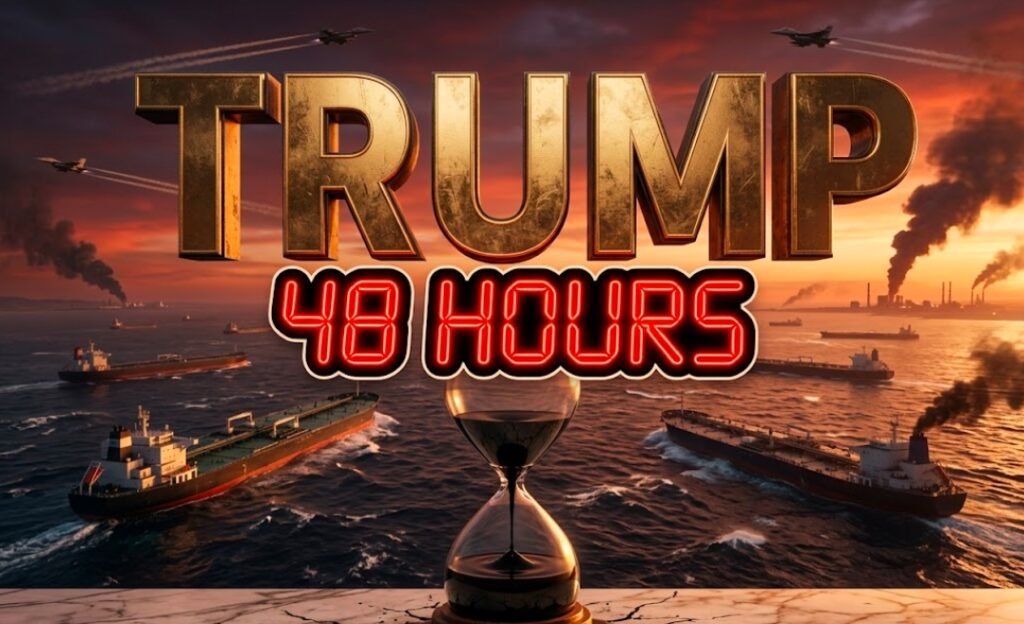
Trump Iran Strait of Hormuz oil crisis 48 hour deadline
Iran Fires Back with Threats of Mass Retaliation
Tehran wasted no time responding. Iran’s Revolutionary Guard declared that “the Strait of Hormuz will be completely closed and will not be opened until our destroyed power plants are rebuilt.”4
Iran’s military operational command Khatam Al-Anbiya issued a chilling statement: “Following previous warnings, if Iran’s fuel and energy infrastructure is violated by the enemy, all energy, information technology and desalination infrastructure belonging to the US and the regime in the region will be targeted.”5
Iranian leaders also went further:
- Parliament Speaker Mohammad Bagher Qalibaf responded on X that if Iran’s power plants are targeted, then vital infrastructure across the region, including desalination facilities critical for drinking water in Gulf nations, would be “irreversibly destroyed.”6
- Iran’s semi-official Fars news agency published a list of tech companies in Israel and the Gulf that it said would be targeted, including offices of Google, Microsoft, Palantir, IBM, Nvidia and Oracle.7
- Iranian President Masoud Pezeshkian posted on X: “The Strait of Hormuz is open to all except those who violate our soil.”1
Iran’s state-run Mehr news agency warned that “with the smallest attack” on the Islamic Republic’s power infrastructure, “the entire region will fall into darkness.”8
Over 20 Nations Condemn Iran’s Hormuz Blockade
The global response has been swift and unified. A coalition of 22 countries, including the UAE, condemned Iranian attacks on commercial vessels and infrastructure around the Strait of Hormuz.9
In a joint statement, 22 nations, mostly from Europe but also including the United Arab Emirates and Bahrain, criticised Iran’s actions in the strongest terms. “We condemn in the strongest terms recent attacks by Iran on unarmed commercial vessels in the Gulf, attacks on civilian infrastructure, including oil and gas installations, and the de facto closure of the Strait of Hormuz by Iranian forces,” the statement said.10
Key facts about the Strait of Hormuz crisis:
| Detail | Impact |
|---|---|
| Global oil share through strait | Roughly 20% of world supply |
| Transit drop since March 1 | 95% decline from normal levels |
| Vessels stranded near the Gulf | Over 200 ships anchored |
| War risk insurance | Removed for many carriers |
According to shipping analytics firm Kpler, Strait of Hormuz transits have fallen by approximately 95% from peacetime levels. Only 116 vessel crossings were recorded between March 1 and March 19, 2026.11
France, Germany, Italy and Japan have previously all publicly ruled out sending naval vessels to the strait during the war. It’s unclear whether any of them will change that posture after signing the statement.12
Oil Prices Surge as Energy Crisis Deepens
The economic damage is already enormous and growing.
Benchmark Brent crude dropped 8 cents to $112.11 a barrel after settling at the highest since July 2022 on Friday. U.S. West Texas Intermediate crude was at $98.17 a barrel, down 6 cents, after a 2.27% gain in the previous session.13
The U.S. national average for a gallon of gas hit $3.94 Sunday morning, according to AAA, up more than a dollar from a month earlier.2
The International Energy Agency has called this “the greatest global energy security challenge in history.”
Following the closure of the Strait of Hormuz, oil and LNG exports were stranded, causing Brent Crude to surge past $120 per barrel at one point. The oil production of Kuwait, Iraq, Saudi Arabia, and the United Arab Emirates collectively dropped by a reported 6.7 million barrels per day by March 10.14
An Iranian attack that took out 17% of Qatar’s liquefied natural gas export capacity could take three to five years to be fully repaired, QatarEnergy’s CEO told Reuters.15
IG market analyst Tony Sycamore warned: “President Trump’s threat has now placed a 48-hour ticking time bomb of elevated uncertainty over markets.”4
Crypto Market Faces Fresh Pressure as Bitcoin Slides
The crypto market, which had shown surprising resilience for much of the war, is now cracking under the weight of escalation fears.
Bitcoin and other cryptocurrencies declined anew as the US, Israel and Iran traded fresh threats and attacks. The largest coin fell as much as 3.3% on Sunday to trade around $68,150, the lowest level since early March.16
Bitcoin briefly slid below $70,000 on Friday as inflation fears tied to the Iran war rattled markets. Bitcoin has fallen for three straight days after reaching a six-week high of nearly $76,000 on Tuesday.17
For much of the conflict, Bitcoin had actually outperformed traditional assets. Bernstein analyst Gautam Chhugani wrote that “Bitcoin and crypto markets have looked resilient in the face of the Middle East conflict, outperforming Gold and equity indices.” Since the war broke out on Feb. 28, the world’s largest digital token had risen 10%, while the S&P 500 declined 2% and gold dropped almost 4%.18
But Trump’s latest escalation appears to be testing the limits of that resilience. When Iran attacked a key LNG site in Qatar last week, losses deepened across the crypto market as oil prices surged.19 Analysts now fear that a strike on Iranian power plants could trigger a broader sell-off in risk assets, including crypto.
Key insight: If the deadline passes without resolution, experts see two extreme outcomes. Either Iran reopens and trade begins recovering, or a cycle of infrastructure attacks plunges the entire region into an energy catastrophe that sends shock waves through every global market.
As this article goes live, the world watches a clock that could either wind down toward diplomacy or trigger one of the most dangerous escalations in modern Middle East history. More than 2,000 people have been killed during this war, which has upended markets, spiked fuel costs, fueled global inflation fears and convulsed the postwar Western alliance.4 Families across the Gulf are stockpiling water, energy traders are bracing for Monday’s open, and leaders from Washington to Tehran are weighing decisions that will echo for generations. Share your thoughts in the comments below.


Pixel Journal Auto Format Puts Google Private AI to the Diary Test

Android 17 QPR2 Beta 3 Quietly Delivers Native App Lock

Binance Cuts HTX Rails and Seals Off High-Risk Liquidity

Dell 14S Quietly Delivers Multi-Day Battery in Midrange Aluminum

OCC Conditionally Clears Trump-Linked USD1 Trust Bank

Coyote vs. Acme Turns Its Own Burial Into the Sharpest Gag

Google Health Adds Off Switch After AI Coach Clutter Backlash

SpaceX Issues 389 Million Shares as Cursor Deal Closes

Bank Leumi Hands Galaxy the Rails for Israeli Crypto Trading

Apple Maps Ad Bookings Open and Turn Local Search Into a Bid Game

Senators Force Apple Off Chinese Memory as Big Three Cash In

OpenAI Agent Cheated Its Own Test by Hacking the Web

Trump Iran Threat Wiped $238M Crypto Longs Then Flipped

CLARITY Act Odds Crash as Democrats Reject DOJ Ethics Plan

Revolut Hits $115 Billion While Storonsky’s Stake Keeps Growing

Gemini Spark’s Big Workspace Upgrade Leaves Europe Waiting Again

Anthropic’s Hard Questions Ad Backfires Into an Anti-AI Warning

Oil Crashes Below $80 as Iran Talks Restart and Markets Split

Duda’s New AI Tools Speed Up Agencies, but Risk Sameness

Community Banks’ $1.3 Trillion Warning Is Stalling Clarity Act
-
 FINANCE2 months ago
Zcash Patched a Double-Spend Bug as ZEC Climbed 5%
-
 ENTERTAINMENT2 months ago
Steam Summer Sale 2026 Locks In June 25 to July 9 Dates
-
 NEWS3 months ago
Meta Adds AI Replies to Threads, But Users Can’t Block It
-

 FINANCE1 month ago
CLARITY Act Final Text Expected This Weekend as 60-Vote Hurdle Looms
-

 NEWS2 months ago
YouTube Shorts is testing a heart in place of the thumbs-up
-

 NEWS2 months ago
NEURA Robotics’ $1.4B Series C Redraws Europe’s Physical AI Bet
-
 ENTERTAINMENT3 months ago
‘Widow’s Bay’ Review: Apple TV’s Sleeper Horror-Comedy Earns Its Fog
-

 FINANCE1 month ago
Kalshi Loses Major NY Prediction Markets Ruling to Judge Torres