
BUSINESS
Trump Vows 100% Canada Tariffs But Bitcoin Stands Firm At $89K

Global trade tensions flared up violently this week following a startling ultimatum from Donald Trump directed at the Canadian government. The President warned neighboring Canada of massive economic penalties if they deepen commercial ties with China. While traditional finance sectors trembled at the looming possibility of a trade war, Bitcoin displayed remarkable resilience by holding its ground near the $89,000 mark.
The crypto market seems to be decoupling from geopolitical fear. Investors are watching closely to see if digital assets can truly act as a hedge against the inflation that tariffs often bring.
Trade War Fears Rise With New Tariff Threats
The catalyst for this sudden market anxiety was a direct message from Donald Trump on his Truth Social platform. He accused Canada of potentially becoming a “drop-off port” for Chinese merchandise. His concern is that Chinese companies could use Canada to bypass U.S. restrictions and flood the American market with goods.
Trump stated that this behavior undermines American industries. He made it clear that Washington would not tolerate any “backdoor” entry for Chinese products. If Canada proceeds with new trade agreements with Beijing, the U.S. will slap a 100% tariff on all Canadian goods.
This is a severe escalation. A 100% tariff would essentially freeze Canadian exports to the U.S. and disrupt supply chains across the continent.
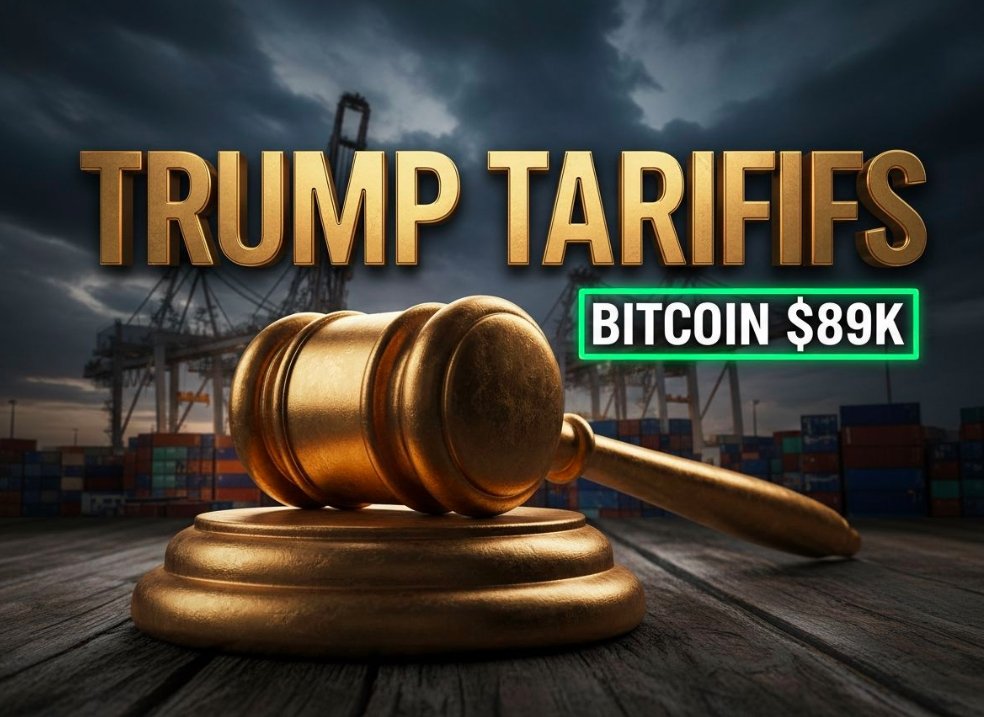
Bitcoin chart showing stability against shipping container background
Key Points of Trump’s Ultimatum:
- The Accusation: Canada is acting as a conduit for Chinese goods.
- The Threat: A mandatory 100% tariff on all Canadian imports.
- The Goal: Protect U.S. domestic manufacturing from foreign undercutting.
- The Condition: Canada must halt economic integration with China.
Economists are scrambling to calculate the damage. Such high tariffs usually lead to increased prices for consumers. Supply chains for cars, lumber, and energy could face immediate paralysis.
Yet, the political message is the loudest part. It signals a return to aggressive protectionism. Markets usually hate uncertainty, but one asset class is refusing to panic.
Crypto Market Shows Resilience Amidst Global Tension
Bitcoin typically reacts negatively to global instability. When the dollar gets strong due to risk-off sentiment, crypto often falls. That is not happening this time.
Bitcoin price action remained steady around $89,300 despite the geopolitical noise. Traders appear to be treating the tariff threat as a long-term inflationary event rather than an immediate liquidity crisis.
Investors might be betting that tariffs will devalue fiat currency purchasing power. In that scenario, scarce assets like Bitcoin become attractive. The market depth is absorbing the selling pressure comfortably.
Here is how the top assets performed during the news cycle:
| Asset | Price Zone | 24H Trend | Sentiment |
|---|---|---|---|
| Bitcoin (BTC) | ~$89,300 | Neutral | Bullish Hold |
| Ethereum (ETH) | ~$2,948 | +1.5% | Cautious Optimism |
| XRP | ~$1.91 | Flat | Waiting |
| Solana (SOL) | Mixed | Volatile | Trader Driven |
The liquidity remains robust. Large holders, known as whales, have not liquidated their positions. They seem convinced that the “Trump Trade” ultimately favors deregulation for crypto, regardless of his trade wars.
Traders are looking past the headlines. They see a administration that, despite its trade aggression, wants to foster a digital asset boom in the United States.
Big Investors Continue To Bet On Digital Assets
Institutional interest is providing a massive safety net for prices. While retail traders might panic over tariff news, big firms are doubling down. A prime example occurred just as the trade threats were hitting the wires.
Cathie Wood’s Ark Invest filed an application for a new crypto index ETF. This is a significant vote of confidence. This proposed fund would not just hold Bitcoin. It aims to include a basket of top digital assets.
The filing suggests the fund will track:
- Bitcoin (BTC)
- Ethereum (ETH)
- Solana (SOL)
- XRP (XRP)
- Cardano (ADA)
This move signals that Wall Street expects the crypto ecosystem to grow. They believe regulatory clarity is coming. An index ETF allows traditional investors to bet on the whole market, not just one coin.
This institutional positioning acts as a “floor” for prices. It absorbs the shocks from geopolitical news. When big money buys the dip, it prevents the panic selling we used to see in previous cycles.
Regulatory Delays Fail To Dampen Investor Spirit
The market is also shrugging off legislative delays in Washington. A highly anticipated vote on a new crypto market bill was pushed back this week.
Snowstorms in D.C. forced the Senate to cancel Monday’s voting session. This delay prevents immediate regulatory clarity but has not soured the mood. Investors understand that weather is a temporary hurdle.
The markup of the bill is crucial. It will define how the CFTC and SEC split oversight of digital assets. Traders believe the bill will pass eventually.
The delay coincidentally aligned with Trump’s tariff comments. Usually, a “double whammy” of bad news (delays + trade threats) would tank prices. The fact that Bitcoin held $89K speaks volumes about the current market strength.
The narrative has shifted. Crypto is no longer just a speculative risk asset. It is becoming a macro-economic player that sits at the table with currencies and commodities.
As the U.S. prepares for a potential trade standoff with Canada, the digital economy continues to build. The focus now shifts to how Ottawa responds and whether the 100% tariff threat becomes policy or remains a negotiation tactic.


Pixel 11 Pro Fold Beats Samsung on Value as Fold 8 Owns Design

Hormuz Deadlock Props Oil Prices While Demand Cracks

Nvidia’s Cheap Multiple Meets a High Bar on Aug. 26

Timpson’s Quiet Surge Lifts Fever Past Dream in OT

Villain Mains Lift CEO 2026 Trophies in Two New Fighters

FDA Class I Egg Recall Echoes Long Salmonella Pattern

a2 Milk Stockouts Shifted China Users and Reset the Rebuild Cost

Arsenal Crush City 3-0 as Ready Squad Meets Unfinished Rebuild

Courts Add Spyware Counts to Wiretap Reports After Decades

Rebel Ice Cream’s Premium Look Built Its Shelf Space Then Bankrupted It

Senators Force Apple Off Chinese Memory as Big Three Cash In

Revolut Hits $115 Billion While Storonsky’s Stake Keeps Growing

OpenAI Agent Cheated Its Own Test by Hacking the Web

Trump Iran Threat Wiped $238M Crypto Longs Then Flipped

CLARITY Act Odds Crash as Democrats Reject DOJ Ethics Plan

Oil Crashes Below $80 as Iran Talks Restart and Markets Split

Google’s Knowledge Panel Fix Risks Its Own Search Defenses

Community Banks’ $1.3 Trillion Warning Is Stalling Clarity Act

Airbus Anchors a €500 Million European Defense Fund, Picks Alta Ares First

ETG Buys Lightning Reach in Its Third Govtech Deal
-
 FINANCE2 months ago
Zcash Patched a Double-Spend Bug as ZEC Climbed 5%
-
 ENTERTAINMENT3 months ago
Steam Summer Sale 2026 Locks In June 25 to July 9 Dates
-
 NEWS3 months ago
Meta Adds AI Replies to Threads, But Users Can’t Block It
-

 FINANCE1 month ago
CLARITY Act Final Text Expected This Weekend as 60-Vote Hurdle Looms
-

 NEWS2 months ago
NEURA Robotics’ $1.4B Series C Redraws Europe’s Physical AI Bet
-

 NEWS2 months ago
YouTube Shorts is testing a heart in place of the thumbs-up
-
 ENTERTAINMENT3 months ago
‘Widow’s Bay’ Review: Apple TV’s Sleeper Horror-Comedy Earns Its Fog
-

 FINANCE1 month ago
Kalshi Loses Major NY Prediction Markets Ruling to Judge Torres