
BUSINESS
Wall Street Swings Wild as Cisco Jumps, Inflation Soars

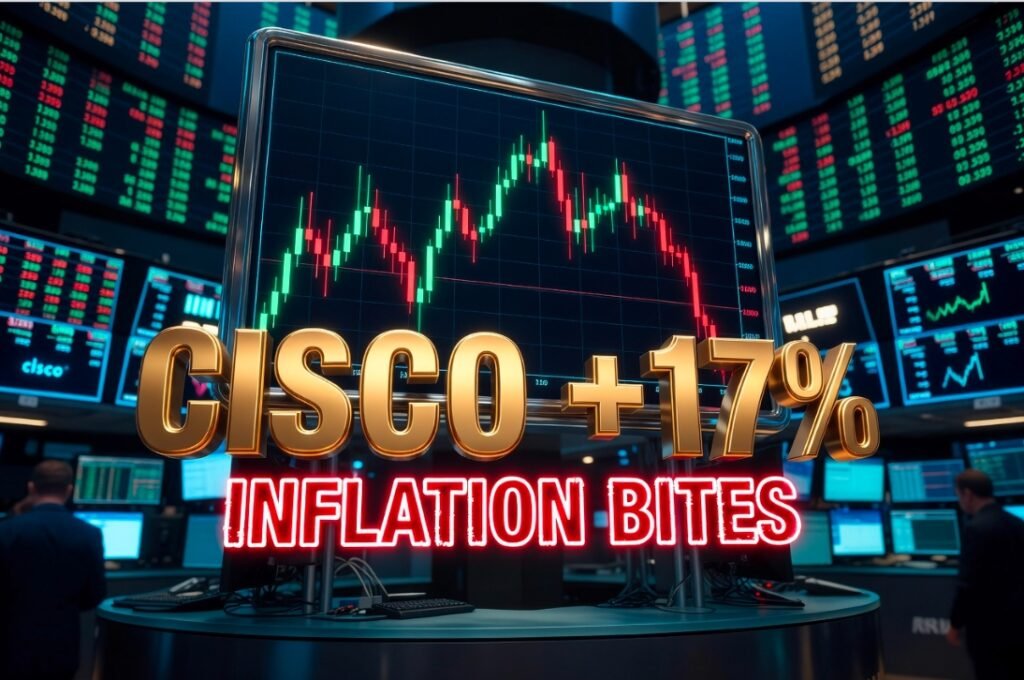
Wall Street opened Thursday with some of the sharpest single-stock swings of the year. Cisco is surging nearly 17% on a blockbuster earnings report packed with AI orders. Doximity just cratered 18%. And back-to-back inflation shocks this week have pushed Treasury yields to their highest point of 2026. This is not an ordinary morning on the Street.
The Stocks Posting the Biggest Moves Today
Cisco Systems is the name everyone is talking about.
The networking giant reported Q3 fiscal 2026 revenue of $15.84 billion, topping Wall Street’s $15.56 billion forecast, with adjusted earnings per share of $1.06 against an expected $1.04. But the real bombshell was the AI order book. Cisco said it has already received $5.3 billion in artificial intelligence infrastructure and hyperscaler orders this fiscal year alone. It raised its full-year AI order target to $9 billion, doubling down from a prior estimate of $5 billion.
The stock surged as much as 19% in after-hours trade before Thursday’s open. If the gains hold through the session, it would mark Cisco’s strongest single-day rally since 2002.
Meanwhile, Doximity had the opposite experience. The healthcare tech firm dropped 18% after issuing revenue guidance that fell well short of expectations. That sharp divide between Cisco and Doximity tells you exactly what the market wants right now: beat and raise, or get crushed.
Here is a full breakdown of the session’s biggest movers:
| Stock | Move | Catalyst |
|---|---|---|
| Cisco (CSCO) | +17% to +19% | Q3 AI earnings beat, orders raised to $9B |
| Monday.com | +26% | Revenue up 24% YoY to $351.3M on AI platform launch |
| Nextpower | +14% | Raised full-year revenue guidance to $3.8B–$4.1B |
| Moderna | +9% | Early-stage hantavirus vaccine development |
| Lumentum | +5% | Added to Nasdaq 100 index, replacing CoStar on May 18 |
| Doximity | -18% | Missed earnings, weak full-year revenue guidance |
| Karman | -11% | Adjusted EPS of $0.11 missed $0.12 estimate |
| Birkenstock | -5.5% | Missed both earnings and revenue estimates |
| Alibaba (BABA) | -4% | Core profitability collapsed 84% year-over-year |
Wall Street early trading sharp stock market swings 2026
Inflation Data Is Shaking the Trading Floor
The market’s mood this week has been shaped heavily by two alarming inflation prints that arrived back to back.
Tuesday’s Consumer Price Index showed annual inflation accelerating to 3.8% in April, above expectations of 3.7% and the highest reading since May 2023. That alone rattled rate cut hopes. Then Wednesday dropped another bomb.
The April Producer Price Index came in at 1.4% month-over-month, more than triple the 0.4% consensus estimate. Year-over-year, PPI surged 6.0%, the largest jump in over three years. Core PPI, which strips out food and energy, also spiked 1% against an expected 0.3%.
The 10-year Treasury yield climbed to 4.48% after the data dropped, touching its highest level of the year. Rising yields hammered rate-sensitive sectors. The S&P 500 Utilities index fell more than 1% Wednesday alone, and is now down nearly 5% in May.
“The hot PPI data is sending yields sharply higher. The headline number was bad, but stripping out energy costs still shows that there’s inflation in the pipeline.” — Cooper Howard, Director of Fixed Income Research, Schwab Center for Financial Research
The combination of hot CPI and surging PPI has effectively killed any chance of a rate cut in 2026. Futures markets have now priced in the possibility of a rate hike instead.
Today brings another key test. April retail sales data lands this morning. It will give traders the clearest signal yet on whether American consumers are still spending freely despite elevated energy costs driven by the ongoing Iran war. The stakes are higher than usual given that Federal Reserve Chair Jerome Powell’s term expires Friday, and the Senate is expected to confirm Kevin Warsh as his successor.
Tech and AI Keep Powering the Market Higher
Here is the strange and striking truth about this market: it keeps hitting records even as inflation burns hotter.
The S&P 500 closed Wednesday at a fresh all-time high of 7,444.25, up 0.58%. The Nasdaq Composite added 1.2%, closing at 26,402.34, also a record. But these numbers hide a very important detail.
Roughly two-thirds of all S&P 500 stocks actually closed lower on Wednesday. The index’s gains came entirely from a narrow group of technology and semiconductor names.
Nvidia shares climbed more than 2%. Micron Technology gained more than 4%. The VanEck Semiconductor ETF advanced 2%. The PHLX Semiconductor Index has now surged 64% since the end of March 2026, a stunning run by any historical measure.
That kind of velocity has not gone unnoticed. Investor Michael Burry compared it to the pace of gains seen just before the dot-com collapse in March 2000, with the Shiller CAPE ratio now sitting at 40.1, near levels seen only at the peak of the dot-com bubble. Paul Tudor Jones made a similar comparison but estimated the AI-driven rally could still last one to two more years.
For now, earnings results are doing the talking. Creative Planning CEO Peter Mallouk told CNBC Wednesday that chipmakers are “actually undervalued as a group,” arguing the bull run is earnings-driven rather than speculative.
The geopolitical angle is also adding fuel to tech stocks. President Trump landed in Beijing Wednesday for a high-stakes summit with Chinese President Xi Jinping, accompanied by Tesla CEO Elon Musk and Nvidia’s Jensen Huang. The prospect of eased chip export restrictions to China sent semiconductor stocks higher across Asian markets overnight, and that optimism is carrying into Thursday’s U.S. session.
What Traders Are Watching Before the Closing Bell
Thursday is not just about reacting to last night’s earnings. There is more live ammunition due.
Applied Materials reports earnings today. Options markets are pricing in a post-earnings swing of roughly 8.7% in either direction. That is a significant implied move, and for good reason. Applied Materials supplies chip manufacturing equipment to virtually every major foundry in the world. Its results act as a forward indicator for semiconductor capital spending over the next 6 to 12 months.
Initial jobless claims for the week ended May 9 will also drop this morning. Combined with retail sales, traders will be watching to see if the labor market is showing any cracks under the pressure of elevated rates and persistent inflation.
New York Federal Reserve President John Williams is scheduled to speak this afternoon. After two scorching inflation reports in two days, every word from a Fed official carries extra weight.
S&P 500 futures were up 0.12% in early Thursday trade. Nasdaq 100 futures climbed 0.34%. Dow futures added 115 points. The setup heading into the open points to modest gains, with the outcome heavily dependent on retail sales data and the Applied Materials print.
This week has compressed an extraordinary number of market-moving events into just a few days. Stocks are at all-time highs, inflation is running hot, AI demand is real and growing, and geopolitical tension from the Middle East to the Beijing summit is sitting in the background of every trade. For investors, this session is a reminder that in moments like these, fundamentals eventually matter more than fear, but only for those patient enough to wait and see. What is your read on where this market goes from here? Share your thoughts in the comments below.


Beelzebub’s €3 Million Raise Rides a Wave of EU Cyber Deadlines

Multiverse Computing’s $570 Million Bet on Smaller AI

GTA 6 Japan Code Expiration Traces to a Six-Month Payment Law

Windows 11 Finally Reverses the Taskbar Cut It Made in 2021

Elon Musk’s X Money Bet Echoes the Fight That Fired Him

Claude Chats That Leaked to Google Still Live On GitHub

DFINITY Bets Its Crashed Crypto Project on Sovereign Cloud

Facebook Verified Brings Back the Facial Recognition Meta Deleted

A Chinese Open Model Just Saved Hugging Face From OpenAI

Samsung’s Galaxy Glasses Run on Meta’s Own Chip Too

CLARITY Act Final Text Expected This Weekend as 60-Vote Hurdle Looms

Kalshi Loses Major NY Prediction Markets Ruling to Judge Torres

Fed Minutes Cite AI Demand as Inflation Risk, Put a 2026 Hike Back on the Map

Marker AI Writing Startup Lands $13M Seed Led by Index Ventures

Dota 2 Esports World Cup 2026: Spirit Defends $2M Title In Paris

Meta’s Muse Spark 1.1 Beats Rivals on Price, Trails on Coding

ARC Intelligence Closes €4M Seed Round in Roughly a Week

CS2 Premier Season 5 Lands With Cache and a C4 Damage Rework

Trump Calls Iran ‘Islamic Republic of Japan’ as Ceasefire Ends

Finto Picks Munich Over Silicon Valley After YC, Raises $3.4M
-
 FINANCE2 months ago
Zcash Patched a Double-Spend Bug as ZEC Climbed 5%
-
 ENTERTAINMENT2 months ago
Steam Summer Sale 2026 Locks In June 25 to July 9 Dates
-
 NEWS3 months ago
Meta Adds AI Replies to Threads, But Users Can’t Block It
-
 FINANCE3 weeks ago
CLARITY Act Final Text Expected This Weekend as 60-Vote Hurdle Looms
-
 ENTERTAINMENT2 months ago
‘Widow’s Bay’ Review: Apple TV’s Sleeper Horror-Comedy Earns Its Fog
-
 NEWS7 months ago
FolderFresh Review: This Free Tool Automates Windows File Organizing
-
 NEWS4 months ago
U.S. Navy Deploys Solar-Powered Lightfish Drone to Patrol Oceans
-
 FINANCE3 weeks ago
Kalshi Loses Major NY Prediction Markets Ruling to Judge Torres