
NEWS
Huawei’s First Wide Foldable Hides a Battery You Cannot Reach
iFixit’s Pura X Max teardown found dual cells glued in with no pull tab, a service model Europe’s 2027 battery rules will still have to police.

iFixit pried open Huawei’s Pura X Max and found two battery cells glued down with no pull tab in sight. The passport-style foldable went on sale in China on April 25, 2026, from 10,999 yuan (about $1,613), as the first wide book-style fold you could actually buy. The shop never published a numeric score, and as of September 7, 2026 the phone still is not sold in Europe.
That would be a China curiosity if Apple and Samsung were not building the same shape. The teardown is a look at the service model those wide foldables will carry into shops that do have to meet European battery rules.
A Passport Foldable iFixit Bought in China
iFixit had to source the unit in China. The video, posted May 8, 2026, notes a global wave later that May everywhere except the United States, after the 2023 FCC ban. The May wave did not include Europe. Huawei priced the 12GB plus 256GB model at 10,999 yuan and the Collector’s Edition 16GB plus 1TB model at 13,999 yuan, and kept the lineup on HarmonyOS 6.1.
Unfolded, the chassis is 166.5 x 120 x 5.2 mm and weighs 229 g. The inner LTPO OLED is 7.7 inches at 1828 x 2584. The 5.4-inch cover is meant for typing and feeds, then the inner panel opens like a small tablet for video and split work. iFixit said that 16:9 layout is the point of the passport hinge.
FROM CHINA LAUNCH TO THE IPHONE 18 TEASE
- April 20, 2026: Huawei announces the Pura X Max in China as a wide book-style foldable.
- April 25, 2026: First sale on VMall, from 10,999 yuan for 12GB plus 256GB.
- May 8, 2026: iFixit posts the teardown it filmed after buying a unit in China.
- July 14, 2026: The European Commission adopts extra battery-derogation categories; phones stay on a separate ecodesign track.
- September 7, 2026: New colours surface in China; the phone is still not on sale in Europe.
- September 9, 2026: iFixit points to this teardown as a preview of a real variable aperture on iPhone 18.
The video is the primary record. Watch it before the stills harden into marketing shots of a sealed slab.
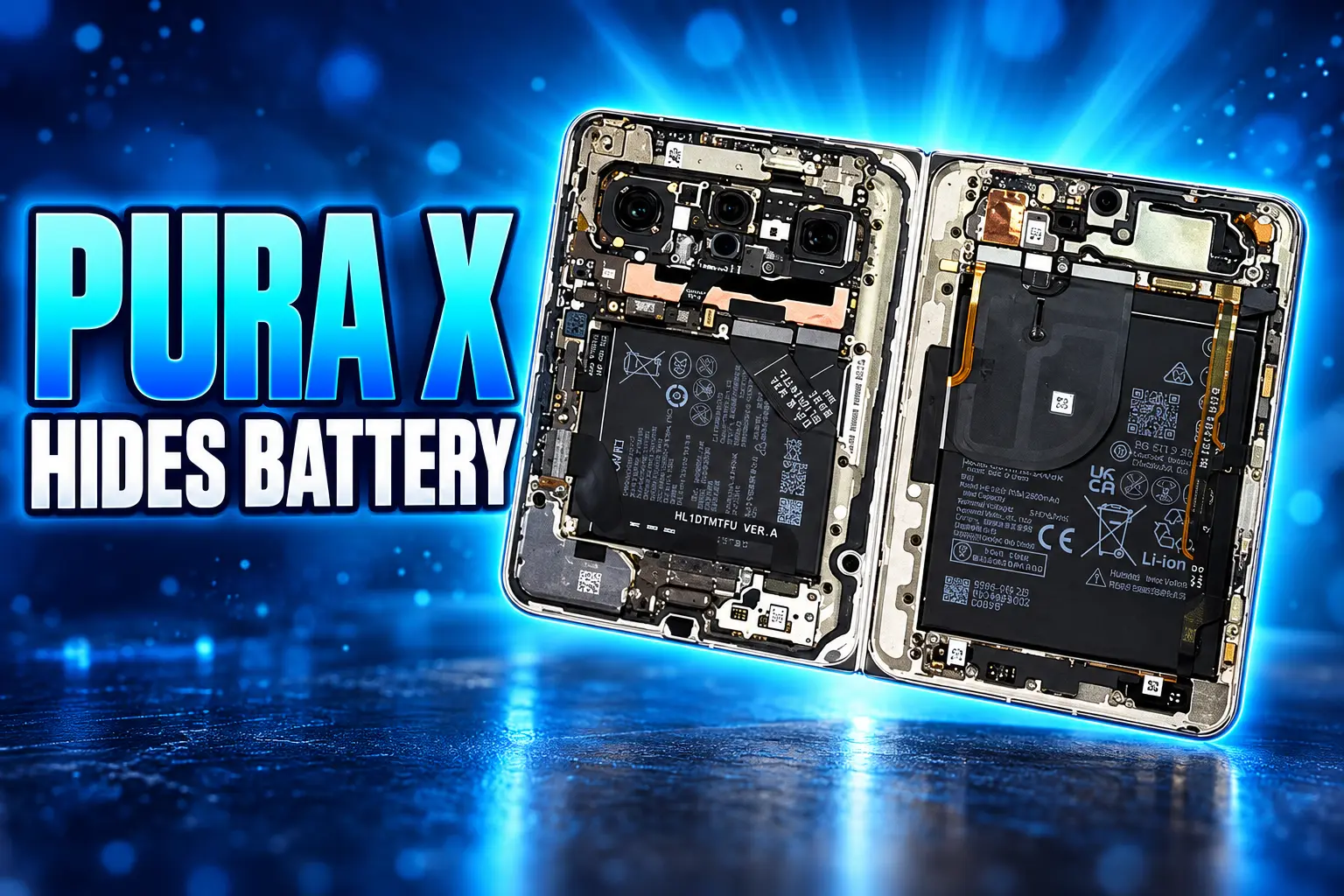
Both Cells Sit Glued With No Pull Tab
Entry starts at the back glass, heat and a suction cup, which iFixit called standard. The cover screen uses much stronger glue. Under the wireless-charging assembly sit two packs. Reaching them means pulling the lower assembly and the USB-C port, which at least is modular.
iFixit treats batteries as the only parts you should plan to swap, usually after 2 to 3 years. These cells are buried, glued, and bare of any strip or release. The tech used isopropyl alcohol and a suction cup. Together the packs hold 19.73 Wh, listed as 5,300 mAh, which iFixit said is just over 14% more energy than the Galaxy Z Fold 7.
That battery replacement process is where this phone fails most egregiously. Both cells are glued in without a pull tab or any kind of release mechanism in sight, a very odd thing to see in 2026.
iFixit, Pura X Max teardown, May 8, 2026
The presenter added that the phone looks to the future in hardware and stays stuck in the past at the pack. There is no service manual. One screw hides under a tamper sticker, another under the flash. For a phone that will need a new pack before most owners are done with it, that is the design choice that will follow the form factor west.
Six Cameras and a Hinge Sealed Against Dust
The 50 megapixel main camera uses a physical aperture from f/1.4 to f/4.0, a trick iFixit had not seen since the Galaxy S9 and one it said is common in Chinese flagships. A 50 megapixel periscope with 3.5x optical zoom and a 12.5 megapixel ultrawide sit beside a 2 megapixel Red Maple colour sensor. Two 8 megapixel selfie cameras, one on the cover and one in a corner of the inner panel, bring the count to six.
The Kirin 9030 Pro is a HiSilicon design built by SMIC. Lab work published as an SMIC N+3 process analysis places the node as a scaled 7nm-class step, not a match for current 3nm flagship chips. iFixit noted the large die and the export controls that keep SMIC off the newest lithography tools. Huawei’s own figures claim a 25% CPU gain, 40% GPU gain, and 70% NPU gain against the Kirin 9020. The 9-core layout runs 2.75 GHz, 2.27 GHz, and 1.72 GHz. Wired charging is 66W.
Huawei rates the phone IP58 and IP59, two labels iFixit’s presenter said a translator called domestic Chinese marks. The hinge is sealed against grit. Under a microscope, pores along the screen spine are filled with a flexible glue that plugs paths onto the inner panel. TechInsights later described the Basalt Water Drop Hinge as a teardrop bend meant to spare the OLED and ultra-thin glass.
Why Repair Shops Refuse Inner-Screen Jobs
The inner panel is the part you buy a foldable for, and it is the part independent shops already avoid. iFixit heated the panel, fought a stubborn plastic bezel, and sliced a flex cable that ran to the far edge instead of sitting near the visible connector. The panel itself held up better than the shop expected, which is not the same as a safe repair.
OEM replacements, the presenter said, usually arrive as a chassis with the screen already mounted. The only reason this one came off was to inspect the spine. Alignment is the trap: if a new inner panel does not sit true, the fold cracks it on the first week of use.
WHY INNER-SCREEN JOBS GET TURNED AWAY
- Alignment risk: A panel that is even slightly off the chassis will split when the hinge cycles, so the mistake costs a second expensive screen.
- Bezel and glue: The plastic edge and the adhesive under the sheet fight heat and picks, and the flex path is easy to cut.
- No public manual: Without official steps or calibration tools, most techs move every board into a new chassis that already has a good inner display.
That last habit turns a cracked foldable into a parts donor. It is also how a “durable” inner sheet still produces a write-off. USB-C is the easy module. The screen you actually use is not.
Samsung’s Fold 7 Already Scored 3 Out of 10
Wide-fold repair is not a Huawei-only mess. iFixit’s Galaxy Z Fold 7 repairability listing sits at 3 out of 10. Samsung at least fitted pull tabs. They tear, and the shop still needed solvent. The inner 8-inch panel was quoted at $589. Spare parts and free manuals were missing at the time of that score, which iFixit said it would revisit if Samsung shipped both.
The energy gap is real and small. The Fold 7’s two cells are 8.55 Wh and 8.62 Wh, or 17.17 Wh combined. Huawei’s 19.73 Wh is the larger tank. Huawei also skipped the tab that Samsung at least tried. On how iFixit weights battery access, the pack is the consumable that decides whether a phone lasts past its first fade, which is why a buried glue-in lands so hard on the card.
PURA X MAX VERSUS GALAXY Z FOLD 7
| Item | Pura X Max | Galaxy Z Fold 7 |
|---|---|---|
| Battery energy | 19.73 Wh (5,300 mAh) | 17.17 Wh |
| Battery access | Glued, no pull tab | Pull tabs that tear |
| iFixit score | No number published | 3 out of 10 |
| USB-C port | Modular and easy | Modular |
| Inner screen job | Panel survived a rough lift; shops still refuse solo swaps | Fragile; $589 panel |
Fairphone 6, on the same board, still does screen and battery work in minutes with no glue. Foldables will not become Fairphones. They can still ship a tab, a manual, and a pack that comes out without a solvent bottle.
Glued Packs Meet Europe’s 2027 Battery Test
This chassis will not sit on a European shelf next month. The rules still matter, because the next wide folds will. Article 11 of Regulation (EU) 2023/1542 applies from February 18, 2027. The Commission guidelines on battery replaceability say the smartphone ecodesign file, Regulation (EU) 2023/1670, prevails over the broader battery law for phones and tablets.
That ecodesign track, in force for spare parts since June 20, 2025, still requires makers to offer portable batteries to professional repairers and to end users for at least seven years after the last unit is placed on the market. A pack counts as readily removable only if it comes out with ordinary tools, not specialist gear, proprietary bits, heat, or solvents. iFixit’s alcohol-and-suction method is exactly the path that test is written to shut down.
Phones that keep 83% capacity after 500 cycles and 80% after 1,000, and that carry a serious IP rating, can limit the swap to trained techs. They do not get to make the swap impossible. IP58 and IP59 may help Huawei on the water column. They do not excuse a dual-cell glue-in with no release. The July 2026 delegated act on battery derogations added wearable-style carve-outs. It did not hand foldable phones a free pass.
WHAT THE 2027 BATTERY RULES ACTUALLY SAY
- The date: Article 11 of the Batteries Regulation applies from February 18, 2027.
- The phone overlay: Ecodesign rules for smartphones and tablets take priority over the general portable-battery text.
- The spare-parts clock: Batteries must be offered for at least seven years after the last unit is placed on the market, a duty that started June 20, 2025.
- The tool test: Heat and solvents are not a valid way to call a pack readily removable.
A China-only SKU can ignore that stack. A wide foldable sold in Paris or Berlin in 2027 cannot, unless the maker redesigns the tray or confines every dead pack to its own service desk and still gives independents a legal path.
A Variable Aperture Heading for iPhone 18
On September 9, 2026, iFixit said at least one iPhone 18 camera is getting a real variable aperture, and sent viewers back to this teardown as a sneak preview of what that hardware looks like in a shipping phone. Chinese makers have been iterating the iris for years. The West is now picking it up.
Looks like at least one iPhone 18 camera is getting a real variable aperture. It's been a while since we've seen this tech in a phone sold here, though Chinese manufacturers have been iterating on it for years.
We recently tore down the Huawei Pura X Max and took a deeper look… https://t.co/taaMv1Qtgf pic.twitter.com/6toOy375nG
— iFixit (@iFixit) September 9, 2026
The aperture is the friendly headline. The buried pack is the part that will show up in European work orders when the first wide iPhone and the first wide Samsung land with the same passport silhouette. Independent shops already treat inner-screen jobs as chassis swaps. A glued dual cell with no tab teaches the next wave of wide folds the wrong lesson, and it does it months before those phones are in a Brussels shop window.
Frequently Asked Questions
How Much Does the Huawei Pura X Max Cost in China?
The standard 12GB plus 256GB model is 10,999 yuan, the 12GB plus 512GB model is 11,999 yuan, the Collector’s Edition 16GB plus 512GB model is 12,999 yuan, and the 16GB plus 1TB Collector’s Edition is 13,999 yuan, all on Huawei’s VMall first-sale list from April 25, 2026.
What Software Does the Huawei Pura X Max Run?
China units ship HarmonyOS 6.1 with no Google Play services, which is why grey-market imports in Europe need sideloads or a wrapper for common apps, on top of the missing official warranty.
Does the Huawei Pura X Max Include a Stylus?
Huawei bundles support for the M-Pen 3 Mini, which adds an air-mouse button and a writing button and ships with a drawing app aimed at the wide inner canvas.
What Do the IP58 and IP59 Ratings Mean on This Phone?
The two numbers are not a contest for a higher digit: IPX8 covers immersion, and IPX9 covers high-pressure water jets, so a device can carry both if it passes each test, which is why Huawei quotes IP58 and IP59 together rather than a single familiar IP68 mark.
The first wide foldable proved the passport hinge can ship. It also proved you can hide the only part that wears out. That second lesson is the one European shops will be stuck with if the copies arrive with the same tray.

UPI MDR Delay Hands Traders the Calendar After Paytm Falls

Google Messages Builds Nine In-Chat Games After Samsung’s Exit

Anthropic’s $100 Million Academy Trains the Firms That Bill Both Sides

Toyota’s Electric C-HR Leaves the Cheap Twin to Subaru

Markets Bet the Fed Skips October After Hawkish Minutes

The Orchard Bug Forced Zcash to Open an Empty Pool

The $5.99 Game That Won Steam’s 2026 Summer Sale

Don Lee Joins Hemsworth as Extraction 3 Starts Shooting

YouTube Shorts Retires Dislikes and Swaps Likes for Hearts

NEURA Robotics Is Spending Its $1.4B on a Machine Stack
-
 NEWS4 months ago
The Orchard Bug Forced Zcash to Open an Empty Pool
-
 GAMING4 months ago
The $5.99 Game That Won Steam’s 2026 Summer Sale
-
 ENTERTAINMENT6 months ago
Don Lee Joins Hemsworth as Extraction 3 Starts Shooting
-
 NEWS4 months ago
YouTube Shorts Retires Dislikes and Swaps Likes for Hearts
-
 NEWS4 months ago
NEURA Robotics Is Spending Its $1.4B on a Machine Stack
-

 AUTO6 months ago
Kawasaki Bets the New Z1100 Against Its Own Supercharger
-

 BUSINESS5 months ago
Norway’s Export Bank Backs Nscale’s $790 Million Narvik Loan
-

 GAMING4 months ago
Game of Thrones Dragonfire Follows Boston’s Conquest Playbook